I've quietly made my LayerProcGen framework public:
https://github.com/runevision/LayerProcGen

It's a framework (C#) that can be used to implement layer-based procedural generation that's infinite, deterministic and contextual.

Nobody else have tried/tested it yet - if you're up for taking it for a spin, let me know how it looks; what's clear or confusing, if you think there's low hanging fruit improvements I could make, etc.
#ProcGen

GitHub - runevision/LayerProcGen: Layer-based infinite procedural generation

Layer-based infinite procedural generation. Contribute to runevision/LayerProcGen development by creating an account on GitHub.

GitHub

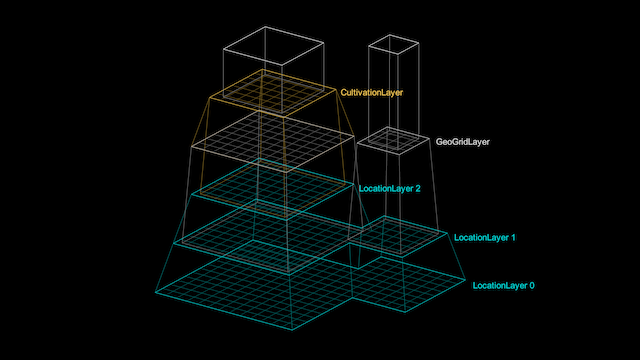
The value of layer-based generation is not just the implementation, but also a certain way to *think* about how to define spatial dependencies for large-scale generation.

I've put a lot of effort into the documentation and its illustrations (examples here), which explain the high level concepts of the framework as well as the details.
https://runevision.github.io/LayerProcGen/

LayerProcGen: LayerProcGen

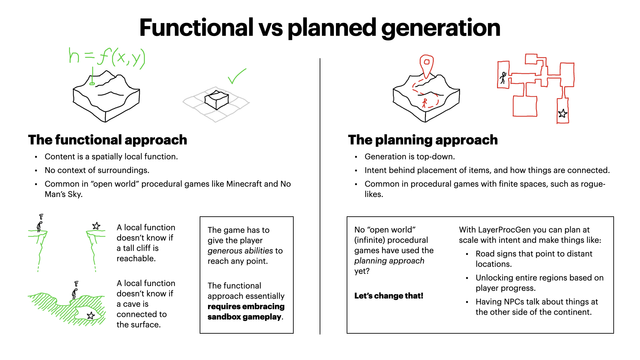
Procedurally generated open-world games tend to use "the functional approach" which essentially requires embracing sandbox gameplay.

LayerProcGen points the way towards making open-world procedural games based on "the planning approach" instead, which is normally only seen in "finite space" games such as rogue-likes.
#ProcGen

@runevision (Psst I think you meant "functional" on the first one and not "planning" on both.)

Really curious about this stuff!

@SonnyBonds Yeah indeed, just fixed that, thanks!