about printing and #typography

@Heliograph

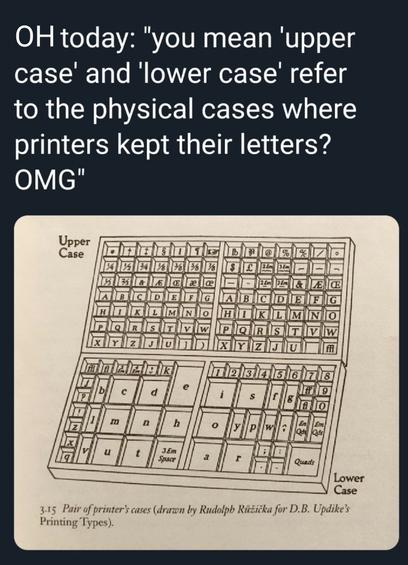
In high school I had an exam on which compartment in the California job case each type piece resided.

I also used a Linotype machine a few times in that class. It was usually broken.

@jchaven oh wow 😯 that was a while ago ey 😅 when I started working we used telex and to this day hardly anyone knows what that was
@Heliograph I was wondering why that E is so big but it's of course because @volpeon mondays exist
@Heliograph And the palaeographic names are "majuscule" and "minuscule".
@Heliograph so is dropcase for the letters that fell on the floor?
@Heliograph fun fact, "boilerplate" also comes from physical typesetting! It came from the plate metal which was formed with type on and could then be distributed to different newspapers
@Heliograph this confirms that numbers are lower case characters.
@cadellin @Heliograph you do have different sets of numbers in well designed fonts today: lower case for numbers that are part of texts, e.g. dates. Upper case numbers are used in tables for better comparison of columns.
@Heliograph

Even more fun without a type-machine.
I used to do letterpress, more fun setting type by sight with tweezers.
Helps to be left handed - reverse type.

@Heliograph
When I explain that to my students, with other litlle stories about keyboard content (such as why Shift is named Shift, why the letters on the keyboard are upercase and top left of the key, etc.), they totally discover that and are amazed!

Most of the users don't have a clue about typography vocabulary origin (font, case, etc.) and keyboard (strange) disposition.

@Heliograph Yep. Took a printing class in Junior High in the 60’s, and that’s how we did it. More info for anyone curious: https://www.google.com/search?q=hand+setting+type
Bevor Sie zur Google Suche weitergehen

@Heliograph Would be amusing to start the rumor that the arrangement of letters in that box was chosen to prevent typesetters from colliding with each other reaching for adjacent letters and getting stuck
@oldshabbyhat @Heliograph "Suppose the dining philosophers have finished eating without deadlocks, and are now printing some of their philosophical thoughts. Between the philosophers are cases of letters for the printing presses. Each philosopher needs..."
@Heliograph where is the edge case?
@Heliograph My 1960’s high school required boys to take shop (girls took home ec) including a term of print shop. The first week included memorizing the lower case layout. Later we locked a page, inked the platen, and printed.
@Heliograph
alternate explanation: when using the Shift key on a typewriter the carriage gets lifted so the upper stamp forms are imprinted onto the paper.

@Heliograph

Apparently before printing presses people used the words majuscule and miniscule.

But now using them to describe upper case and lower case characters seems like a capital offense.

@Heliograph So what do people call them before printers invented? 😿
@Heliograph and the next technological step can be learned from the origin of "shift lock" 

@Heliograph "Caja alta" and "baja" in Spanish ("case"="caja (box)" unless you are a IT translator, when you'll translate it as "caso (event)")
But I allways thought the case ("box") was about the letter bounding-box.
Spanish calligraphers use "Capitales" (capitals) instead, and grammars say "mayúsculas" and "minúsculas".

Not to forget smallcaps, which are mix of both.