Incoming! A severe G4 Geomagnetic Storm is expected to arrive around 02:00 UTC Friday night / Saturday morning.

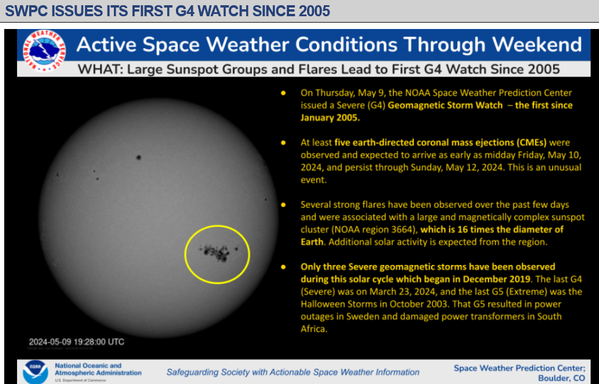
At least 5 Coronal Mass Ejections took place over the past 24 hours, directed towards Earth. These originated from a large and magnetically complex sunspot cluster (NOAA region 3664).

There is potential for disruption of communications, the electric power grid, navigation, radio and satellite operations.

And bright auroras as far south as Alabama!
https://www.swpc.noaa.gov/
1/n

Homepage | NOAA / NWS Space Weather Prediction Center

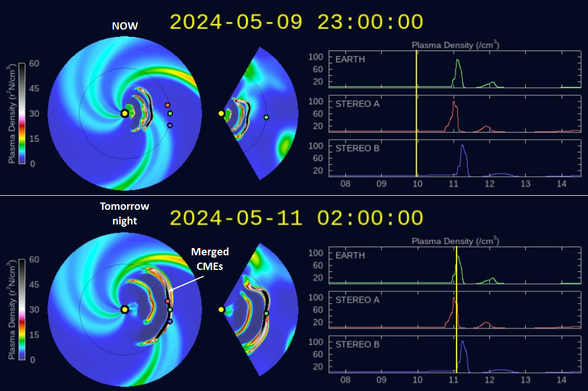
The CMEs ejected by the Sun are headed for earth, as shown in the stills from the animation at NOAA. The big merged CME should be here around 02:00 UTC Friday night / Saturday morning, which means good Aurora viewing for those in North America.

https://www.swpc.noaa.gov/communities/space-weather-enthusiasts-dashboard
2/n

Space Weather Enthusiasts Dashboard | NOAA / NWS Space Weather Prediction Center

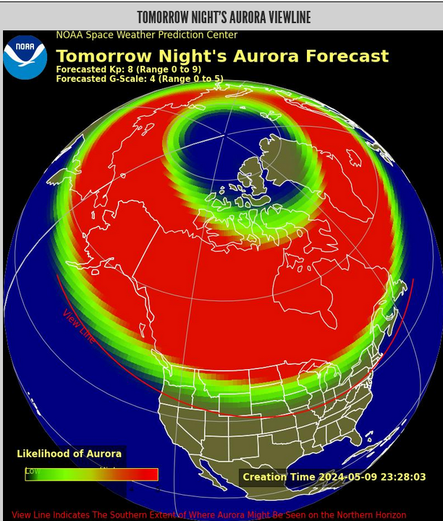
Here is the Aurora forecast for tomorrow night for N. America.

Let's hope that the Aurora viewline dips further south.

https://www.swpc.noaa.gov/products/aurora-viewline-tonight-and-tomorrow-night-experimental
3/n

Aurora Viewline for Tonight and Tomorrow Night (Experimental) | NOAA / NWS Space Weather Prediction Center

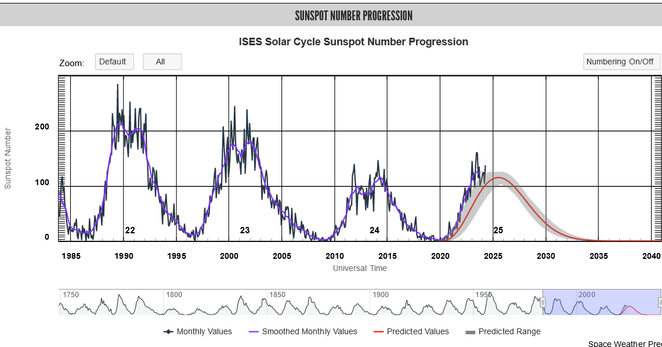
Let's keep in mind that we are approaching the peak of the current 11-year solar cycle #25. Hence, the increase in the number of sunspots, solar flares and CMEs in the past year. And there will more such events over the course of the next year.

We have experienced stronger cycles in the recent past as shown in the graph below. This cycle seems to be acting stronger than predictions and peaking earlier.

https://www.swpc.noaa.gov/communities/space-weather-enthusiasts-dashboard
https://en.wikipedia.org/wiki/Solar_cycle
4/n

Space Weather Enthusiasts Dashboard | NOAA / NWS Space Weather Prediction Center

To relax before the G4 solar storm arrives, please take a look at this fascinating time-lapse video of the surface of the Sun. The video was created using images taken by NASA’s Solar Dynamics Observatory SDO,.

Beautiful and frightening as it may appear, it is what provides the energy to sustain life on earth. The earth's magnetic field helps deflect dangerous flares and energetic particles away from earth and our atmosphere, and allows the good stuff to pass thru.

https://youtu.be/6tmbeLTHC_0
5/n

NASA | Thermonuclear Art – The Sun In Ultra-HD (4K)

YouTube

Peak Geomagnetic Activity is expected between 06 and 09 UTC with a Kp Index of 8.33 (G4 on the G-Scale).

"The K-index quantifies disturbances in the horizontal component of earth's magnetic field with an integer in the range 0-9 with 1 being calm and 5 or more indicating a geomagnetic storm.

The label 'K' comes from the German word 'Kennziffer' meaning 'characteristic digit.' The K-index was introduced by Julius Bartels in 1938."

https://www.swpc.noaa.gov/communities/aurora-dashboard-experimental
https://www.swpc.noaa.gov/products/planetary-k-index
6/n

Aurora Dashboard (Experimental) | NOAA / NWS Space Weather Prediction Center

The largest magnetic storm of the last century occurred on 13 March 1989. Its effects included -
- A 9-hour outage of the Hydro-Québec power system.
- Significant interference to the U.S. power grid
- Several satellites lost control for several hours including GOES and NASA's TDRS-1.
- Orbit changes for 2500+ satellites
- Space Shuttle Discovery suffered a malfunction in a sensor on a hydrogen tank.

https://agupubs.onlinelibrary.wiley.com/doi/10.1029/2019SW002278
https://en.wikipedia.org/wiki/March_1989_geomagnetic_storm
@mastodonmigration
7/n

The other more recent major event was the Halloween solar storms of 2003.

A series of solar flares and CMEs from mid-Oct to early Nov, peaking around Oct 28–29, caused wide ranging impacts -
- Power outages in Sweden
- ~59% of the Earth and Space science missions were impacted.
- Temp failure of the SOHO satellite
- Damage to the Advanced Composition Explorer (ACE)
- Loss of ADEOS-2 satellite
- A majority of LEO satellites were temporarily lost
- Orbit changes

https://www.weather.gov/media/publications/assessments/SWstorms_assessment.pdf
8/n

Here is an insightful graphic on Heliophysics and Space Weather from NASA that requires little explanation.

https://svs.gsfc.nasa.gov/30481/
9/n

NASA Scientific Visualization Studio | Heliophysics and Space Weather

The sun and its atmosphere consist of several zones, or layers, from the inner core to the outer corona. Beyond the corona is the solar wind, which is an outward expansion of coronal plasma that extends well beyond the orbit of Pluto. This entire region of space influenced by the sun is called the heliosphere. Controlled by the Earth’s magnetic field, the magnetosphere acts as a shield protecting the planet from solar wind. The shape of the Earth's magnetosphere is the direct result of being impacted by solar wind, compressed on its sunward side and elongated on the night-side, the magnetotail. The shock wave where the solar wind encounters Earth's magnetosphere is called the bow shock, which slows and diverts the solar wind. Solar activity lead to solar eruptions, which includes such phenomena as sunspots, flares, prominences, and coronal mass ejections that influence space weather, or near-Earth environmental conditions. Modern society depends heavily on a variety of technologies that are susceptible to space weather. CMEs for example can cause geomagnetic storms that can disrupt satellite communications and navigational equipment, and even cause blackouts. ||

NASA Scientific Visualization Studio
@AkaSci @thegibson
Why is the Earth inside a spider?
@FritzAdalis @thegibson
To be more precise, it is a magnetic spider 🧲🕷️.
@AkaSci @thegibson
That's somehow more terrifying. Thanks!