 Sjmarf
Just one more lane

 Skullgrid
highway expansion
 motor_spirit
trailblazers ad?? 🐐
One more train* will fix it
Going from where to where?
The midnight train goes anywhere I hear.
Suburban centres to city centres, in places where that’s the traffic flow
 Canopyflyer
I’ve seen that exact scene in Atlanta trying to get to Alpharetta from 75 S by 675.
Alpharetta represent! Lol
 Scrubbles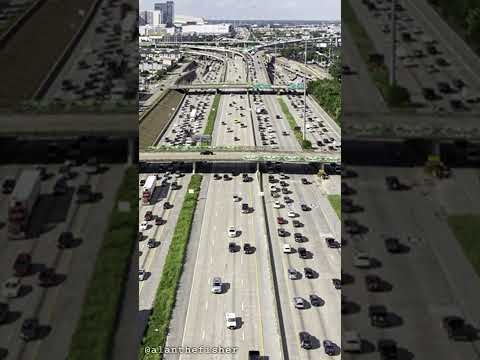
I JUST NEEEED ONE MORE LANE BRO #shorts
No! Don’t stop now! We are so close!
 NegativeLookBehind
How about 2 more lanes?
I think 3 more will be plenty.
 henfredemars
Think of it like trickle down economics. If it hasn’t worked yet, you just need to make sure that the fat cats on top are fed so forcefully and so fast that something starts trickling down eventually.
I mean we really don’t need cities, just make hundred lane roads in their place
Elon:
Guys, I think I’ve got it… What if we built another lane but, you know, under the ground, like a tunnel.
He seemed to casually ignore that at the end of the tunnel was still the concept of an offramp with a 25mph street that everyone was funneling to.
Of course he never planned on building it anyway. It was all just to distract from California High Speed Rail, because that directly gets in his way of selling more cars.
because that directly gets in his way of selling more cars.
Which is stupid in itself, because the entire goal of the CA HSR project is to link long distance corridors, not for putzing around town like most do with a Tesla.
In fact I think there’s a missed opportunity for EVs to partner with long distance public transit.
The main limitations of electric cars is distance, but if people knew they could go across the state or several states comfortably without their car, they might be more willing to take a electric car for city driving.
We have ferries. What if we could combine the efficiency of train and the convenience of ferries? People could just drive their own car on a train car of some kind and be shuttled to a destination and then drive off?
I’ve seen those trucks with a bunch of cars packed on top, something like that (minus truck) could totally fit in a train cargo container.
The loading and unloading is a pain.
Without looking deeper it’s probably cost prohibitive. Looking at long train rides cost a thousand dollars and takes 3-4 days, might as well just fly at that point.
Yeah putting cars on trains is the opposite of a solution lol. All that cargo space used on a car probably just ends up driving the cost of the train ticket up for everyone. If you really need a car, rent one at your destination, like you would when flying.
 Knuschberkeks
that’s been done in europe since I think the 1930s
I’m sure the idea is suppressed on over in Merica. Glad it’s not an original thought!
Just to be pedantic, the dumb car tunnels (or Loop), are the weird thing elon “invented” to “solve” traffic and reduce competition for his cars for urban transport. This eventually became one tunnel in LA to get between elon’s house and office, and the dumb taxi tunnel in Las Vegas.
The hyperloop, where elon “invented” the vacuum train, is a separate thing that exists to distract from CAHSR, and elon didn’t want to work on himself because “he’s too busy”, and not because it’s effectively just a scam and won’t work, and most of the companies that started up to develop it have since gone bust.
 Annoyed_🦀
 I recently watched a video about autonomous car and the dude argue the tech isn’t here yet, but it will work if we build a lane just for autonomous car and put every autonomous car on that lane.
Everyone in the comment basically calling him out for reinventing the train lol.
 driving_crooner
Trains are the crabs of transportation.
Okay, I have seen trains pinch things, but I ain’t never seen a train move sideways.
 This is fine🔥🐶☕🔥
Hehe. Well played.
Can’t improve a crab.
And put that in the basement
“What if we put lanes on top of the other lanes?”
 VicksVaporBBQrub
There is some in the California SFO bay area.
For a brief moment, you feel like you are driving\flying in the Jetsons future.
 NapKat
ngl, from the small thumbnail (on desktop) I thought this was a picture of a Venator from SW lol
Just mandate work from home, that will fix it. Whoa COVID proved it works!
 Gormadt
So many people commuting to jobs that could easily be done from home nowadays
I work in the freight industry in a position I can’t do from home but when the whole work from home thing was in full swing I didn’t get stuck in traffic except a few times when the local drawbridge went up
You know what would work just as well, but without isolating people?
Mixed zoning and mass rapid transit
Let people work walking distance to their home, give those who need to go somewhere a way of going there quicker than traffic
It’d also be good to mandate easy availability of work from home for anyone in a job where that is practical
I once heard of an experiment in economics that offers insight into this.
Say you have 100 people. You give each of them one of two choices:
A : you get $40 unconditionally B: you get $70 - n, where n is the number of people who choose B
You end up getting, on average across experiments, n = 30.
If you move the numbers around (i.e, the $40 and the $70), you keep getting, on average, a number of people choosing B so that B pays out the same as A.
I think the interpretation is that people can be categorized by the amount of risk they’re willing to take. If you make B less risky, you’ll get a new category of people. If you make it more risky, you’ll lose categories.
Applied to traffic, opening up a new lane brings in new categories of people who are willing to risk the traffic.
Or something. Sorry I don’t remember it better and am too lazy to look it up. Pretty pretty cool though.
It’s called “Induced Demand”.
As a road widening project is completed, traffic is alleviated for a short amount of time. Then as time passes word spreads, or more people move to the city, or kids get older and get their driver’s licences. More and more people know this widened road is the fastest route, so more people take it, thus undoing the improvement. Then the cycle starts again - either with the same road being widened again, or another one a block over, on and on until the world is covered in asphalt.
The solution is to make alternative transit more appealing than cars. Bikes and public transit already have significant financial benefits, but lack infrastructure to make it more viable in North America. Busses get stuck in traffic, bikes are forced to share lane space with cars or sidewalks with pedestrians.
I heard a city planner talk about why adding a new lane doesn’t help, and the term they use is “induced demand.”
Basically, people are going to take the route that they consider the most convenient, and that usually comes down to time and effort. Traffic hurts both by taking more time and being more stressful to deal with. When you add a new lane to a road, people think that the traffic will be easier there, so they take that route instead of their normal one. So you’re just adding more cars to the traffic that match or exceed the throughput of your new lane, basically putting you back at square one but a few billion dollars more poor.
You’ve essentially added a single lane one-way road to help ease traffic across the entire city.
If you make driving easier than transit, more people will drive who previously took transit. The reverse is also true. One of these situations is more desirable for myriad reasons.
As well, additional demand can be created by convenience. People will make trips they otherwise never would have if it’s easier to make them.
Communist transportation will never ever ever ever ever ever ever be easier than driving.
Because driving is “get in the car, go directly to destination”
Public transport adds walk to transport rally point, wait, follow a compromise route to accomodate other travellers with many stop, consider all the strangers gazing and judging you, arrive at not your destination, walk 5 to 20 mins to your actual destination. Plus you must carry any object on your person while navigating the terrain (good luck hauling 50lbs of groceries).
I am simply not interested in this nightmare, find a solution that isn’t horrible.
And NOoo I don’t want Musks robot taxis from the “you will own nothing” dystopia.
 Signtist
As much as I personally disagree with you, given that all you’re thinking about is your own benefit, and not any of the myriad of benefits to the city, the world, the people who can’t afford cars, etc, I understand that your outlook is shared by the vast majority of Americans, and can’t be ignored if we ever hope to have an effective public transport system.
We’re going to need to somehow devise a system so convenient that it actually sounds attractive to the huge amount of people who spend 10%+ of their paycheck on car payments not because they have to, but because they want to.
I would love public transport that is actually better than a car. I can’t imagine how that could happen. So what they will probably do is cripple car users until it is intolerable to use. Like make it cost more than your yearly salary just for the license and insurance, plus 10x the price of fuel with taxes.
By “directly to destination” did you mean the gigantic parking lot necessary to accommodate every car? You are going to walk anyway, the different is that you’re walking in the most horrible hostile car centric space instead of one made for humans.
If there isn’t parking, that mean the place is full. Go somewhere else. Or re-evaluate if you really need to go there, the answer is probably no.
I live in the forest, we have no problem with parking. There is space everywhere. I don’t mind a little mud on my tires and shoes, not everywhere has to be concrete
Given that we’re talking about cities, your experience living in the forest is completely irrelevant.
City anti-car attitude will cause us a lot of pain. They will make car ownership painful to disincentivize it and we will just have to suck it up, if we fail to kill that movement.
And car-centric city design is causing a lot of pain right now and destroying the planet.
My car is electric, if tgat’s a problem then I would instead recommend to make city cars not illegal. Personally I’ve always wanted a single seat car that weights as much as a motor cycle.
It already is, finding a parking spot and then walking through a parking lot is a lot less convenient than walking from the tram stop to the store and it’s roughly the same distance. I sold my car after moving to the city because public transit is so much more convenient.
Have you considered that within city, parking is a huge problem? Maybe in american suburb the parking space is big enough to fit housing for 100 families, but in the city they don’t have such luxury.
Now just like what you said about the public transport, for driving it’s get in the car, facing 20 min of traffic jam, waiting for traffic light, waiting for traffic light, waiting for another traffic light, reach your destination, find a parking, saw a spot, too bad because big dumb pickup truck double park because the parking spot is too small to fit that ego-sized vehicle, looking for another parking spot, finally found one but have to make 5 min walk to the shop. Now do the return trip.
The joke is on you. There are places where it already is easier than driving. What do such places have in common? There are so many people that having everyone drive is literally impossible to accommodate. You wouldn’t drive in Manhattan, Tokyo, or Seoul. It literally makes absolutely no sense to. In these cities, public transit is faster and way more convenient.
Smaller cities can replicate this effect by just… not outrageously favouring car infrastructure like they do today in North America. That doesn’t mean exclusively making driving worse, it means making public transit better at the same time with the freed up funding. And the freed up money is a lot, car infrastructure is super expensive. More routes with more stops at higher frequencies are made possible because of higher ridership, which increases convenience and makes it more likely you will get almost exactly from your origin to your destination.
But the American brain cannot conceive of this. “Communist transportation” fucking lmao. What if we made cities more liveable for humans, not for cars? Nah we can’t do that that’s communism.
The problem concentrating everyone like a pack of sardines, then you can’t move or live anyway.
There wouldn’t be a problem if the traffic wasn’t all trying to go to the same place.
So you think we should decentralize cities. Make it so you don’t need to go downtown for everything. Everything you need would be within 15 minutes of walking.
… A fifteen minute city perhaps.
I prefer transit, unfortunately for me it wouldn’t be practical, maybe even before the half of our railway lines got removed.