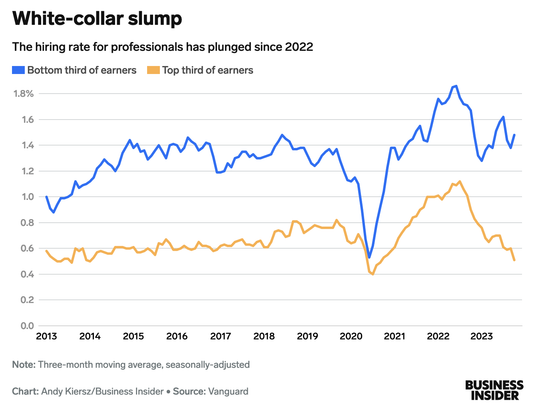
To all my friends who feel like they aren't good enough to get a job right now: it's not you. Alternative economic metrics suggest a bifurcation of the job market, with higher-earning jobs hiring less and more slowly.

https://www.businessinsider.com/hiring-slump-professional-white-collar-jobs-recession-high-salary-2024-4

"But among those who make more than $96,000? ... Hiring has slowed to a dismal 0.5%, less than half the peak it reached in mid-2022. Excluding the dip in the early months of the pandemic, that's the worst it's been since 2014."
White-collar recession: it's hard to find a high-salary job

A new report shows the real winners — and losers — in the job market.

Insider

The article hits on a phenomenon I observed at my last company:

"...says Fiona Greig, the global head of investor research and policy at Vanguard, 'pulling back on expensive workers will reduce costs to a greater extent than pulling back on your lower-income workers.' Translation: The more you earn when budgets are tight, the less an employer wants to hire you."

https://www.businessinsider.com/hiring-slump-professional-white-collar-jobs-recession-high-salary-2024-4

White-collar recession: it's hard to find a high-salary job

A new report shows the real winners — and losers — in the job market.

Insider
White-collar recession: it's hard to find a high-salary job

A new report shows the real winners — and losers — in the job market.

Insider

I'm still working though this article. While the bottom-third v. top-third graph is telling, the values are correlated over time.

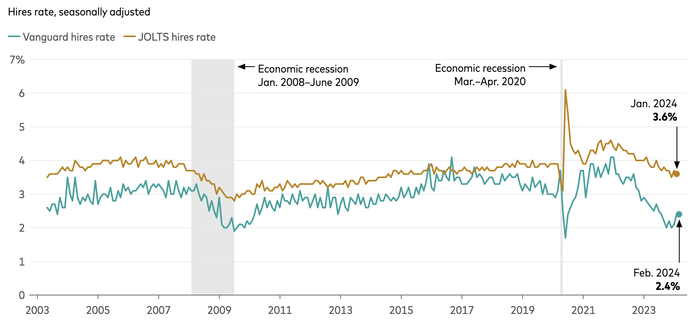
Something really telling is the Vanguard hires vs. JOLTS hires, which reverse direction during the Mar-Apr 2020 recession.

Companies were adding workers with no 401(k) while pulling back on workers who would have gotten a 401(k).