Most BLM protesters were white people advocating for Black civil rights.♥️ All their lives, they thought that they had the 1st amendment right to protest, because they had seen white supremacists march without being beaten by cops. They didn't realize that the right to free speech depends heavily on what you are speaking about, and who you are speaking for.

Now I'm seeing college professors and students learn the same lesson about what US cops will do to you if you speak up for the wrong thing.
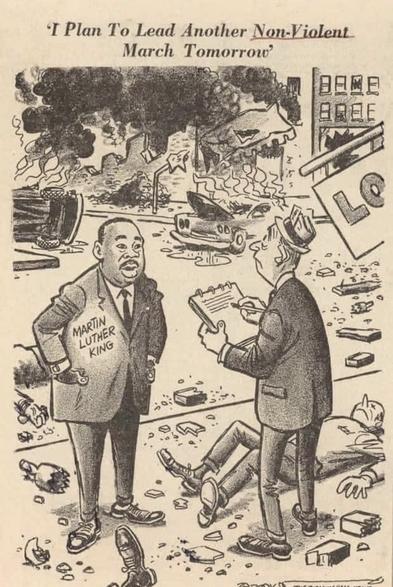

When you can understand why there weren't mass arrests of the proud boys, or mass arrests at Jan 6, but there were mass arrests at BLM protests, and there are mass arrests on college campuses... you'll be one step closer to understanding free speech in America.

@mekkaokereke

Free speech in the US is so very selective. It's far from the universal right that many seem to believe it is.

One of my go to examples:

Want to use profanity on radio/TV or show nudity on TV? No way, that's offensive and you'll be fined into oblivion.

Want to send someone a message threatening to rape or murder them? No problem, that's free speech.

On a separate and related note: it's bizarre how many people focus on the inconvenience and not the message around protests.

@psa @mekkaokereke You seem to be implying that "free speech ought to be universal" or "rights are universal." My response is, of course rights are not universal. The concept of rights was flawed from the start. The concept has its roots in deontological ethics which are circular and not action guiding. The bill of rights just confuses things and it's up to the judges of the era to decide arbitrarily what's an "unreasonable" search or an "unusual" punishment.
@psa @mekkaokereke The second amendment as written indicates that the right to bear arms ought not to be infringed (no exceptions) but amendments 4 and 5 seem to indicate your arms *can* be seized for "probable cause" or "due process" (whatever those subjective concepts mean).
@psa @mekkaokereke Deontological ethics is plagued with these sorts of judgment calls and contradictions, leaving people like me to wonder "what's the point of this?" What's the point of the categorical imperative if it can't resolve conflicts between duties?

@escarpment @psa

I'm not sure if that's what Paul meant, but my point is much simpler. You don't need to read Immanuel Kant to know that the 2nd amendment is not a real right. It is not "the right to bear arms." It's "the white to bear arms."

Because simply trying to exercise that right, can get a Black man summarily executed in the streets by the state. And there will be no consequences for the executioner. "Police shot an armed Black man, etc" Having a gun is the only justification needed.

@mekkaokereke @psa I think you're not giving the second amendment enough "credit" (philosophically), and I'm saying that as someone who personally detests guns. The 2nd amendment is a beautiful example of the problem with rights, more so than the 1st amendment. The 1st is sort of propaganda for the idea of rights: it's a right people can "get behind", despite it also having all the flaws of rights. The 2nd amendment just lays bare the problem of rights.
@mekkaokereke @psa In my view, the first and second amendments, and all other rights laid down in the bill of rights, are equally just some people's opinions at some point in time. They are vague, up to different interpretations, and internally inconsistent. I suspect that one cannot make an internally consistent and action guiding ethical framework based on rights. You don't have to read Kant, but I can tell you that problem was Kant's undoing in my opinion.

@escarpment @psa

I 100% am not giving the 2nd amendment enough credit, philosophically. Because philosophy doesn't come into my reality.

Do you know that many cops in major cities keep toy guns in their glove compartment? This is called a "drop gun." If the police officer shoots an unarmed Black child, they go back to their car, grab the toy gun, walk over to the child's body, and drop the toy gun on it.

The presence of a toy gun justifies the killing in the eyes of the average American.

@mekkaokereke @escarpment @psa Am I the only one with an urge to point out a solution might be to do the following?

a.) Have surprise inspections.

b.) Fire anyone who has a "drop gun" on their person or in their vehicle and put their name on an offender list of likely sociopaths who like to wear a badge.

@alakest @mekkaokereke @escarpment @psa the problem is that if you do anything to hold police accountable, they will run countless attack ads suggesting you are “soft on crime” and blame you for every violent crime that happens

@cohomologyisFUN @mekkaokereke @escarpment @psa Not all police. Not all the time, nor every attempt.

Do not obey.

Even if "they" win don't make it easy.

As Tim Snyder offers:

#1 Do not obey in advance

Most of the power of authoritarianism is freely given. In times like these, individuals think ahead about what a more repressive government will want, and then offer themselves without being asked. A citizen who adapts in this way is teaching power what it can do.

https://scholars.org/contribution/twenty-lessons-fighting-tyranny-twentieth-century

Twenty Lessons on Fighting Tyranny from the Twentieth Century

Americans are no wiser than the Europeans who saw democracy yield to fascism, Nazism or communism. Our one advantage is that we might learn from their experience. Now is a good time to do so. From across the fearful twentieth century, here are twenty lessons about what it takes to oppose tyranny, adapted to the circumstances of today.

Scholars Strategy Network
@alakest @cohomologyisFUN @mekkaokereke @psa It is deterministic how many people are reached by this advice from Tim Snyder, how many are receptive to it, and how many eventually act on it.

@escarpment @cohomologyisFUN @mekkaokereke @psa

...

"deterministic"?

Please explain in this context.

@alakest @cohomologyisFUN @mekkaokereke @psa

It was predetermined that, for example, Trump would become president. Nothing that any of the people opposed to fascism did worked, or ever could have worked, because that was the outcome that was "programmed in" by the laws of nature.

Information like the advice you shared from Timothy Snyder was "baked into" that outcome.

@alakest @cohomologyisFUN @mekkaokereke @psa It's sort of like when a company whose stock you own releases a new product and you expect to be able to sell your stock at a higher price, only to discover that the product release was already "baked into" the stock price.

It's fine to spread information- that's part of the predetermined outcome. But it also sometimes rings hollow because to share "tips on avoiding fascism" because nothing "we" do can stop it.

@alakest @cohomologyisFUN @mekkaokereke @psa Or it's like joining a presidential campaign and going out on the campaign trail trying to persuade people only to realize that most of the people have already made up their minds whom they will vote for, and even worse than that, only a few *states* are even in play because the whole state is pre-determined.
@alakest @cohomologyisFUN @mekkaokereke @psa My point is that whether a country turns fascist or the outcome of a presidential campaign is about as "controllable" by an individual as a hurricane or earthquake.

@escarpment @cohomologyisFUN @mekkaokereke @psa So...ok.

I won't dispute that except for the idea that people, small groups (waves hand at Mead quote) can have an effect.

Be prepared at the right moment and you *can* make a difference.

I'm sure you can can think of crucial instances where momentous events hung in the balance and then broke good, or broke bad.

In the end the sun engulfs the earth, the universe has its heat-death.

We have some latitude between here and there.

Break good.

@alakest @cohomologyisFUN @mekkaokereke @psa Yes, and they broke good or broke bad due to whichever people happened to be in a position to make a decision, and the sum of the information and experiences those people happen to have had that led to that decision and what they deemed to be good or bad outcomes.

@escarpment @cohomologyisFUN @mekkaokereke @psa Look I've had that take, so I'm not gonna try and word you out of it.

So I suppose I have no choice but to recommend reading "The Grasshopper" and maintaining a lusory attitude.

And you have no choice whether or not to heed that advice.

Ooooo! Read Name of the Wind and pay close attention to the discussion of the Ctheaha and freewill too!

@alakest @cohomologyisFUN @mekkaokereke @psa Thanks for the book recommendations. I'm always looking to learn more. Added to my list.