
Most BLM protesters were white people advocating for Black civil rights.♥️ All their lives, they thought that they had the 1st amendment right to protest, because they had seen white supremacists march without being beaten by cops. They didn't realize that the right to free speech depends heavily on what you are speaking about, and who you are speaking for.

Now I'm seeing college professors and students learn the same lesson about what US cops will do to you if you speak up for the wrong thing.
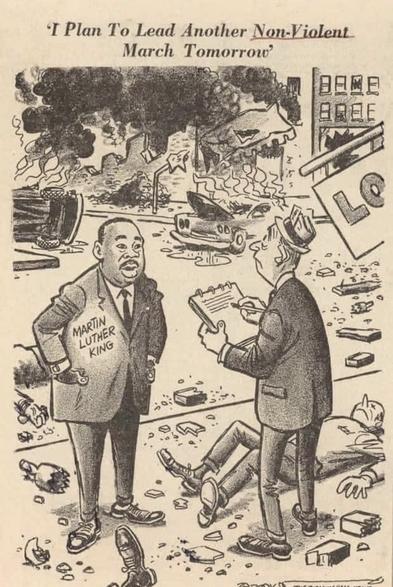

When you can understand why there weren't mass arrests of the proud boys, or mass arrests at Jan 6, but there were mass arrests at BLM protests, and there are mass arrests on college campuses... you'll be one step closer to understanding free speech in America.

@mekkaokereke

Free speech in the US is so very selective. It's far from the universal right that many seem to believe it is.

One of my go to examples:

Want to use profanity on radio/TV or show nudity on TV? No way, that's offensive and you'll be fined into oblivion.

Want to send someone a message threatening to rape or murder them? No problem, that's free speech.

On a separate and related note: it's bizarre how many people focus on the inconvenience and not the message around protests.

@psa @mekkaokereke You seem to be implying that "free speech ought to be universal" or "rights are universal." My response is, of course rights are not universal. The concept of rights was flawed from the start. The concept has its roots in deontological ethics which are circular and not action guiding. The bill of rights just confuses things and it's up to the judges of the era to decide arbitrarily what's an "unreasonable" search or an "unusual" punishment.
@psa @mekkaokereke The second amendment as written indicates that the right to bear arms ought not to be infringed (no exceptions) but amendments 4 and 5 seem to indicate your arms *can* be seized for "probable cause" or "due process" (whatever those subjective concepts mean).
@psa @mekkaokereke Deontological ethics is plagued with these sorts of judgment calls and contradictions, leaving people like me to wonder "what's the point of this?" What's the point of the categorical imperative if it can't resolve conflicts between duties?

@escarpment @psa

I'm not sure if that's what Paul meant, but my point is much simpler. You don't need to read Immanuel Kant to know that the 2nd amendment is not a real right. It is not "the right to bear arms." It's "the white to bear arms."

Because simply trying to exercise that right, can get a Black man summarily executed in the streets by the state. And there will be no consequences for the executioner. "Police shot an armed Black man, etc" Having a gun is the only justification needed.

@mekkaokereke @psa I think you're not giving the second amendment enough "credit" (philosophically), and I'm saying that as someone who personally detests guns. The 2nd amendment is a beautiful example of the problem with rights, more so than the 1st amendment. The 1st is sort of propaganda for the idea of rights: it's a right people can "get behind", despite it also having all the flaws of rights. The 2nd amendment just lays bare the problem of rights.
@mekkaokereke @psa In my view, the first and second amendments, and all other rights laid down in the bill of rights, are equally just some people's opinions at some point in time. They are vague, up to different interpretations, and internally inconsistent. I suspect that one cannot make an internally consistent and action guiding ethical framework based on rights. You don't have to read Kant, but I can tell you that problem was Kant's undoing in my opinion.

@escarpment @psa

I 100% am not giving the 2nd amendment enough credit, philosophically. Because philosophy doesn't come into my reality.

Do you know that many cops in major cities keep toy guns in their glove compartment? This is called a "drop gun." If the police officer shoots an unarmed Black child, they go back to their car, grab the toy gun, walk over to the child's body, and drop the toy gun on it.

The presence of a toy gun justifies the killing in the eyes of the average American.

@mekkaokereke @psa Philosophy does come into your reality. You are making an ethical claim that it is "morally bad" that police officers keep drop guns on them. You are proposing an ethical framework wherein drop guns are not ethically permissible.

@escarpment @mekkaokereke @psa Legality comes into reality; because the thing about drop guns is...they sound like tampering with a crime scene, where the crime is an officer of the law shooting someone who happened to be unarmed and not a viable threat.

And that while the 2nd amendment shouldn't allow that to be a valid way of tampering with a crime scene because simply having a gun is not apparently illegal, it is de facto considered as such for a specific subset of the population.

@escarpment @mekkaokereke @psa That is, the law seems to indicate that we as a society agreed that, philosophically, we don't agree with tampering with a crime scene.

And yet there's this glaring contradiction with the use of "Drop guns".

@AT1ST @mekkaokereke @psa The law indicates that some of us have identified tampering with a crime scene as something we disapprove of. The officers violating this law do not appear to agree with that, or at least think it is preferable to them to place the gun than face the consequences without the gun placed.

The outcome will be determined by whether the people who disapprove of this behavior have the power to prevent it, or if the officers have the power to continue doing this.

@AT1ST @mekkaokereke @psa In other words, the "rights" or "ethics" are irrelevant. This behavior which some people disapprove of happens at some rate. The objective facts of whether that behavior continues to occur will depend on the energy, information, and matter that the two groups of people are able to martial to make the world align with their preference.

@escarpment @mekkaokereke @psa The law is the *encoded* ethics of specific people; it's why murder is against the law, but self defense is an affirmative defense to that crime.

But the thing about the behaviour we're talking about? As @mekkaokereke pointed out, it happens *disproportionately* more to people of a specific race, to the point that it effectively doesn't to people of a different race, and thus essentially rewrites the laws that encoded the ethics of the people who wrote the rights.

@AT1ST @mekkaokereke @psa Yes, of course it happens disproportionately. Many people subjectively prefer people of their own race and disparage people of other races. They selectively modify their preferences about what the laws should be in certain circumstances. That's about as human as it gets: people make judgments in circumstances based on a variety of factors, only one small part of which is legality. No different than "eh, do I really think it's such a big deal to drive 75mph vs 60mph."
@AT1ST @mekkaokereke @psa Most people don't even go about their day thinking about what is legal or ethical. They are just driven by a variety of impulses and emotions. And many people are racist.

@escarpment @mekkaokereke @psa "Most people don't even go about their day thinking about what is legal -"

I'm going to stop you right there, because as true as that is, it's pretty much the *job* of *law enforcement* to think about what is legal. That's kind of the *point* of their job.

@AT1ST @mekkaokereke @psa It *ought* to be, but it isn't in practice. People qualified to be police officers are often not capable of that level of intellectual curiosity.

@escarpment @mekkaokereke @psa It's not an "Intellectual curiosity" - it's their *job*, that they are paid to know, and perform actions based on their understanding of the law.

That they *don't* is a problem - and...is the type of thing that the courts have glossed over with qualified immunity when they *really should not*.

@AT1ST @mekkaokereke @psa You can call it a problem, sure. But problem is a subjective term. I'd think it's a problem, too, but again my subjective opinion is worthless because it will have no material impact on the level of intellectual command of legal theory that rank and file police officers possess.

@escarpment @mekkaokereke @psa Is it "Worthless" to opine that someone who is flipping burgers in a kitchen does not know how to flip burgers?

It's the job of management to ensure that they're trained to do so as well, safely, and food-safely.

That principle applies just as equally to the police.

@AT1ST @mekkaokereke @psa It's worthless to opine about that if I don't work at the burger joint, yes. I have no way of impacting the quality of the burgers there. Perhaps I can take my business elsewhere, but then I'm just one $5 vote against the incompetent burger flipper. It's harmful to my mental health to get worked up about the bad burger flipper whom I can not fix.
@escarpment @mekkaokereke @psa It is probably still worth opining about the burger joint if the flipper is showing a history of only failing to flip burgers correctly for specific customers, and gives those specific customers a transmissible disease as a result - because that's transmissible and will be a problem elsewhere.
@AT1ST @mekkaokereke @psa I'd categorize all manner of poor burger flipping, from being a racist burger flipper to being an incompetent burger flipper, to simply being bad, and whoever has the power to align the outcome to their subjective preferences may or may not act so as to bring the world more into alignment with those preferences. That is human nature.
@AT1ST @mekkaokereke @psa The quality of the burger flipping is also subjective. The burger flipper could claim "I love salmonella so I'm doing a great job." Then it's a power struggle of who is better able to align the burgers to their subjective preferences.