Most BLM protesters were white people advocating for Black civil rights.♥️ All their lives, they thought that they had the 1st amendment right to protest, because they had seen white supremacists march without being beaten by cops. They didn't realize that the right to free speech depends heavily on what you are speaking about, and who you are speaking for.

Now I'm seeing college professors and students learn the same lesson about what US cops will do to you if you speak up for the wrong thing.
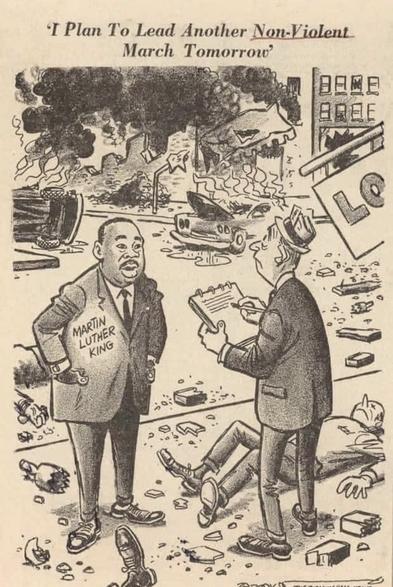

When you can understand why there weren't mass arrests of the proud boys, or mass arrests at Jan 6, but there were mass arrests at BLM protests, and there are mass arrests on college campuses... you'll be one step closer to understanding free speech in America.

@mekkaokereke

Free speech in the US is so very selective. It's far from the universal right that many seem to believe it is.

One of my go to examples:

Want to use profanity on radio/TV or show nudity on TV? No way, that's offensive and you'll be fined into oblivion.

Want to send someone a message threatening to rape or murder them? No problem, that's free speech.

On a separate and related note: it's bizarre how many people focus on the inconvenience and not the message around protests.

@psa @mekkaokereke You seem to be implying that "free speech ought to be universal" or "rights are universal." My response is, of course rights are not universal. The concept of rights was flawed from the start. The concept has its roots in deontological ethics which are circular and not action guiding. The bill of rights just confuses things and it's up to the judges of the era to decide arbitrarily what's an "unreasonable" search or an "unusual" punishment.
@psa @mekkaokereke The second amendment as written indicates that the right to bear arms ought not to be infringed (no exceptions) but amendments 4 and 5 seem to indicate your arms *can* be seized for "probable cause" or "due process" (whatever those subjective concepts mean).
@psa @mekkaokereke Deontological ethics is plagued with these sorts of judgment calls and contradictions, leaving people like me to wonder "what's the point of this?" What's the point of the categorical imperative if it can't resolve conflicts between duties?

@escarpment @psa

I'm not sure if that's what Paul meant, but my point is much simpler. You don't need to read Immanuel Kant to know that the 2nd amendment is not a real right. It is not "the right to bear arms." It's "the white to bear arms."

Because simply trying to exercise that right, can get a Black man summarily executed in the streets by the state. And there will be no consequences for the executioner. "Police shot an armed Black man, etc" Having a gun is the only justification needed.

@mekkaokereke @psa I think you're not giving the second amendment enough "credit" (philosophically), and I'm saying that as someone who personally detests guns. The 2nd amendment is a beautiful example of the problem with rights, more so than the 1st amendment. The 1st is sort of propaganda for the idea of rights: it's a right people can "get behind", despite it also having all the flaws of rights. The 2nd amendment just lays bare the problem of rights.
@mekkaokereke @psa In my view, the first and second amendments, and all other rights laid down in the bill of rights, are equally just some people's opinions at some point in time. They are vague, up to different interpretations, and internally inconsistent. I suspect that one cannot make an internally consistent and action guiding ethical framework based on rights. You don't have to read Kant, but I can tell you that problem was Kant's undoing in my opinion.

@escarpment @psa

I 100% am not giving the 2nd amendment enough credit, philosophically. Because philosophy doesn't come into my reality.

Do you know that many cops in major cities keep toy guns in their glove compartment? This is called a "drop gun." If the police officer shoots an unarmed Black child, they go back to their car, grab the toy gun, walk over to the child's body, and drop the toy gun on it.

The presence of a toy gun justifies the killing in the eyes of the average American.

@mekkaokereke @psa Philosophy does come into your reality. You are making an ethical claim that it is "morally bad" that police officers keep drop guns on them. You are proposing an ethical framework wherein drop guns are not ethically permissible.

@escarpment @mekkaokereke @psa I don't think that is what he's saying. I mean, I'm pretty sure he believes it to be bad, but it's not the point he's making here.

The point is that there clearly isn't a "right" for black people to bear arms, no matter what the constitution says, when cops know and act in the knowledge that if they murder a black person, all they have to do to get away with it is make it look like their victim was exercising that "right".

@escarpment @mekkaokereke @psa ...and therefore he's not going to pretend that there is such a right, in the face of overwhelming evidence that there isn't.
@dragonfrog @mekkaokereke @psa I say there's overwhelming evidence that no rights exist. The UN made the universal declaration of human rights. Yet these rights are violated every day. I'm not sure I'm explaining this concept very clearly, but it's at least clear in my mind and I believe true. Is a right something that people *cannot physically* violate? No. Is a right something that people *do not ever* violate? No. What's different about the world before and after declaring something a right?

@escarpment @dragonfrog @mekkaokereke @psa Rights are not given - they are recognized.

"Respecting rights" is not a token in some transaction because the treatment some call respect is only service rendered if it priced, or if it is not mutual.

Understand your rights.

Don't let fascists whisper you into considering them an optional *treat* allowed by thugs or taken by guile.

Here's the hard part:

Or even *earned*.

Does anyone *earn* the right to a lawyer?

*earn* the right to vote?

Nope

@alakest @dragonfrog @mekkaokereke @psa Whether someone has whispered that to you or not has no effect on whether your rights will be recognized.

That's exactly the problem. Thugs can come along and take your rights whenever they want. 6 people could nab me off the street, throw me in a van, and imprison me in a basement for the rest of my life and my rights have no bearing on whether they do that or not.

@escarpment @dragonfrog @mekkaokereke @psa In a way we already agree - rights exist.

They may be recognized - or not.

They may be respected - or not.

It's impossible for any human to completely not recognize or respect another human's rights.

A hesitant, or even more eager, whip hand betrays recognition.

Even 1 in a 1000 favors or outrages not committed erodes constructed status schemes - eventually.

Whispers and gestures, like water carving stone, etch the course of truth.

Eventually.

@escarpment @dragonfrog @mekkaokereke @psa But, I'll admit, not fast enough to counter all transgressions.

Not by a long shot IMHO.

@alakest @dragonfrog @mekkaokereke @psa Some miscellaneous examples: "I had a right to vote and voted" vs just "I voted." What is the difference between these two outcomes? "I had a right to eat a PB&J sandwich and ate the PB&J sandwich." (Why is the speech one more commonly stated than the sandwich one? Why are certain behaviors denoted as rights- e.g. speech, whereas others are almost never mentioned, e.g. eating a sandwich, blinking your eyes, waving your hands, walking, running).
@alakest @dragonfrog @mekkaokereke @psa "I did not have a right to vote and voted." How is this outcome different than the person who had the right to vote then voted?

@escarpment @dragonfrog @mekkaokereke @psa "What if 1 + 1 = [something other than 2]?" is kinda how that reads to me.

We could get to more esoteric areas of math where my confidence wavers, but x + x = 2x is how I'm recommending everyone operates until we can agree on particular differences.