Anyone who says "If you're not paying for the product, you're the product" has been suckered in by Big Tech, whose cargo-cult version of markets and the discipline they impose on companies.

--

If you'd like an essay-formatted version of this thread to read or share, here's a link to it on pluralistic.net, my surveillance-free, ad-free, tracker-free blog:

https://pluralistic.net/2024/04/22/kargo-kult-kaptialism/#dont-buy-it

1/
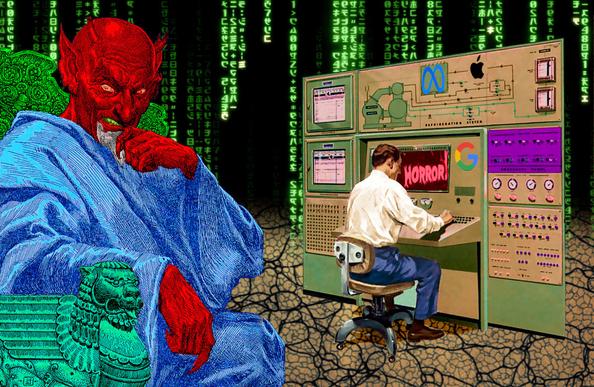
Here's the way that story goes: companies that fear losing your business will treat you better, because treating you worse will cost them money. Since ad-supported media gets paid by advertisers, they are fine with abusing you to make advertisers happy, because the advertiser is the customer, and you are the product..

2/

This represents a profound misunderstanding of how even capitalism's champions describe its workings. The purported virtue of capitalism is that it transforms the capitalist's greed into something of broad public value, by appealing to the capitalist's *fear*. A successful capitalist isn't merely someone figures out how to please their customers - they're also someone who figures out how to please their *suppliers*.

3/

That's why tech platforms were - until recently - *very* good to (some of) their workforce. Technical labor was scarce and so platforms built whimsical "campuses" for tech workers, with amenities ranging from stock options to gourmet cafeterias to egg-freezing services for those workers planning to stay at their desks through their fertile years. Those workers weren't the "customer" - but they were treated better than any advertiser or user.

4/

But when it came to easily replaced labor - testers, cleaning crew, the staff in those fancy cafeterias - the situation was much worse. Those workers were hired through cut-out shell companies, denied benefits, even made to enter via separate entrances on shifts that were scheduled to minimize the chance that they would ever interact with one of the highly paid tech workers at the firm.

5/

Likewise, advertisers may be the tech companies' "customers" but that doesn't mean the platforms treat them well. Advertisers get ripped off just like the rest of us. The platforms gouge them on price, lie to them about advertising reach, and collude with one another to fix prices and defraud advertisers:

https://pluralistic.net/2020/10/05/florida-man/#wannamakers-ghost

6/

Pluralistic: 05 Oct 2020 – Pluralistic: Daily links from Cory Doctorow

Now, it's true that the advertisers *used to* get a good deal from the platforms, and that it came at the expense of the users. Facebook lured in users by falsely promising never to spy on them. Then, once the users were locked in, Facebook flipped a switch, started spying on users from asshole to appetite, and then offered rock-bottom-priced, fine-grained, highly reliable ad-targeting to advertisers:

https://papers.ssrn.com/sol3/papers.cfm?abstract_id=3247362

7/

But once those advertisers were locked in, Facebook turned on *them*, too. Of course they did. The point of monopoly power isn't just getting too big to fail and too big to jail - it's getting too big to *care*:

https://pluralistic.net/2024/04/04/teach-me-how-to-shruggie/#kagi

8/

Pluralistic: Too big to care (04 Apr 2024) – Pluralistic: Daily links from Cory Doctorow

This is the thing that "if you're not paying for the product, you're the product" fails to comprehend. "If you're not paying for the product" is grounded in a cartoonish vision of markets in which "the customer is king" and successful businesses are those who cater to their customers - even at the expense of their workers and suppliers - will succeed.

9/

In this frame, the advertiser is the platforms' customer, the customer is king, the platform inflicts unlimited harm upon all other stakeholders in service to those advertisers, the advertisers are *so* pleased with this white-glove service that they willingly pay a handsome premium to use the platform, and so the platform grows unimaginably wealthy.

10/

But if the platforms inflict unlimited harms upon users, users will depart, and then no amount of obsequious catering to advertisers will convince them to spend money on ads that no one sees. In cargo-cult platform capitalism, the platforms are able to solve this problem by "hacking our dopamine loops" - depriving us of our free will with "addictive" technologies that keep us locked to their platforms even when they grow so terrible that we all hate using them.

11/

This means that we can divide the platform economy into "capitalists" who sell you things, and "surveillance capitalists" who use surveillance data to control your mind, then sell your compulsive use of their products to their cherished customers, the advertisers.

12/

Surveillance capitalists like Google are thus said to have only been shamming when they offered us a high-quality product. That was just a means to an end: the good service Google offered in its golden age was just bait to trick us into handing over enough surveillance data that they could tune their mind-control technology, strip us of our free will, and then sell us to their beloved advertisers, for whom nothing is too good.

13/

Meanwhile, the traditional capitalists - the companies that sell you things - are the good capitalists. Apple and Microsoft are disciplined by market dynamics. They won't spy on you because you're their customer, and so they have to keep you happy.

14/

All this leads to an inexorable conclusion: unless we pay for things with money, we are doomed. Any attempt to pay with attention will end in a free-for-all where the platforms use their Big Data mind-control rays to drain us of *all* our attention. It is only when we pay with money that we can dicker over price and arrive at a fair and freely chosen offer.

15/

This theory is great for tech companies: it elevates giving them money to a democracy-preserving virtue. It reframes handing your cash over to a multi-trillion dollar tech monopolist as good civics. It's easy to see why those tech giants would like that story, but boy, are you a sap if you buy it.

16/

Because *all* capitalists are surveillance capitalists...when they can get away with it. Sure, Apple blocked Facebook from spying on Ios users...and then started illegally, secretly spying on those users and lying about it, in order to target ads to those users:

https://pluralistic.net/2022/11/14/luxury-surveillance/#liar-liar

17/

Pluralistic: 14 Nov 2022 Even if you’re paying for the product, you’re still the product – Pluralistic: Daily links from Cory Doctorow

And Microsoft spies on every Office 365 user and rats them out to their bosses ("Marge, this analytics dashboard says you're the division's eleventh-worst speller and twelfth-worst typist. Shape up or ship out!"). But the joke's on your boss: Microsoft *also* spies on your whole company and sells the data about it to your competitors:

https://pluralistic.net/2020/11/25/the-peoples-amazon/#clippys-revengel

18/

Pluralistic: 25 Nov 2020 – Pluralistic: Daily links from Cory Doctorow

The platforms screw anyone they *can*. Sure, they lured in advertisers with good treatment, but once those advertisers were locked in, they fucked them over just as surely as they fucked over their users.

The surveillance capitalism hypothesis depends on the existence of a hypothetical - and wildly improbably - Big Data mind-control technology that keeps users locked to platforms even when the platform decays.

19/

Mind-control rays are an extraordinary claim supported by the thinnest of evidence (marketing materials from the companies as they seek to justify charging a premium to advertisers, combined with the self-serving humblebrags of millionaire Prodigal Tech Bros who claim to have awakened to the evil of using their dopamine-hacking sorcerous powers on behalf of their billionaire employers).

20/

There is a *much* simpler explanation for why users stay on platforms even as they decline in quality: they are enmeshed in a social service that encompasses their friends, loved ones, customers, and communities. Even if everyone in this sprawling set of interlocking communities agrees that the platform is terrible, they will struggle to agree on what to do about it: where to go next and when to leave.

21/

This is the economists' "collective action problem" - a phenomenon with a much better evidentiary basis than the hypothetical, far-fetched "dopamine loop" theory.

To understand whom a platform treats well and whom it abuses, look not to who pays it and who doesn't. Instead, ask yourself: who has the platform managed to lock in?

22/

@pluralistic For the record, as someone who studies mind control, what you describe here is exactly how mind control typically works. No rays or magic required. Ultimately just social connections and screwing with dopamine.

@pluralistic

> The point of monopoly power isn't just getting too big to fail and too big to jail – it's getting too big to care.

This line is just pure... 👨‍🍳😘