I had a whole thing written up about how 'having more smoke for protest tactics versus the causes that people are protesting against/for is an amoral stance' but the more I was writing on it and thinking about it, the more my realistic/myopic worldview on the state/bystanders kicked in to make me realize that...

... they're right. Just not for the reasons they [opposition/bystanders] think they are.
The tactics of disruption and civil disobedience haven't changed since the years that a collection of 20/30 somethings in the midst of fighting for their rights wile philosophising, organizing, and theorizing about the best way to be seen as full people started marching & plotting.

We're using the same playbook.

And it worked!

... in a way.

For example: The Montgomery Bus Boycotts worked because collective action put a strain on a service Black people were forced to use due to an intentional system that forced Black people into a position where they were solely reliant on the bus system. (Even though, outside bystanders were angry with a boycott that put no strain on them personally, they still took it upon themselves to bomb supporters/organizers homes).
The Sit-Ins worked because it disrupted a business' regular function and brought eyes on the movement's cause. (Even though the central tactic for a sit in is to literally exist in a place. Think about that. Just existing in a place - not even actively blocking commerce; business could've easily ignored them or served them and kept it moving but MERELY EXISTING was an offense that brought violence by the state and, most importantly, regular-degular citizens).

What REALLY pushed things over the edge, though, was the march on the Edmund Pettus Bridge (Bloody Sunday).

Every other action had the same level of apathy, devil's advocacy, or full on engagement as violent opposition as the last but this one hit hard because of one thing: shame.

The collective white public were routinely unmoved by the sight of the state striking down with violence or creating new rules and restrictions on people that they KNOW they'd never be subject to.

Previous actions brought the eyes of the media (and, slowly, the world) on the movement.

So when the bridge march happened, it became a perfect storm.

Cameras. The state's immediate reaction (which didn't require much to trigger). The core players protesting peacefully and 'blocking the road'.

Gas masks. Billy clubs. (Y'all know what they used to call billy clubs? N* sticks.) Fire hoses. Police dogs AND horses.

The scene looked similar to your Twitter timeline circa 2016-2021.

And when that happen, all of America fell in love with King, the movement, and their non-violent tactics.

... Psych!

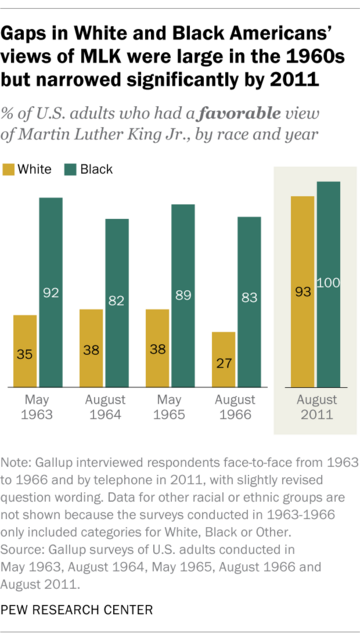
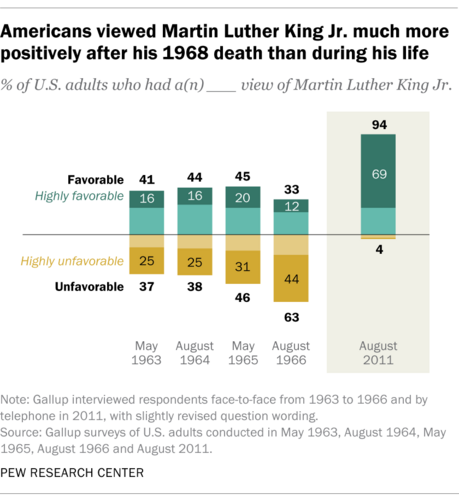
Even a year later, they fucking hated his ass - https://www.pewresearch.org/short-reads/2023/08/10/how-public-attitudes-toward-martin-luther-king-jr-have-changed-since-the-1960s/#:~:text=King's%20favorable%20ratings%20remained%20about,who%20viewed%20him%20highly%20unfavorably.

So why did it work?

There was still pressure put on legislators and that was largely driven, in no small part, by shame. People couldn't look away - they didn't have the luxury to anymore - and that helped the push for the VRA. Shame got shit done.

So why am I bringing this up?

Shame doesn't exist like it used to. These tactics still work, in some way, but the large dearth of shame gives people this feeling of moral superiority to just... not be moved by people's struggles.

Either because one side of the political spectrum pushes hard to excise shame from its supporters and legislators or because the other, more liberal side, has commodified 'having a conscience' to the point that showing concern is seen as disingenuous.

So, in a way, opponents and apathetic bystanders alike are correct.

These tactics don't hit like they used to.

And that's not an indictment to the efficacy, intention, motivations of those organizing but one of the state entity and its people they are trying to motivate.

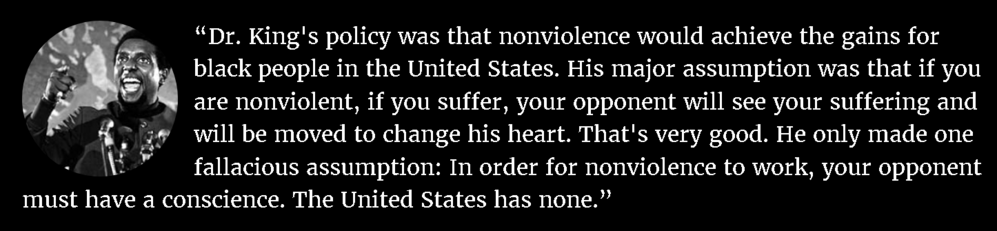
Kwame Ture said it best back then but these words, in my opinion, were seen as a harsh salvo against America and its people that was driven bias and, thus, viewed as illogical. But, in reality? He was spot on.

@Spotted_Menace Are there any books on him that you’d recommend?

@Ciraeon Honestly? I'm not sure what to recommend since most of my knowledge on him is interviews and first hand, familial accounts I gathered from an uncle some years ago.

However! i'd always suggest the words from the man himself with "Ready for Revolution: The Life and Struggles of Stokely Carmichael". I've been meaning to pick it up myself.

@Spotted_Menace I think that’s a really salient point about concern being peddled to the point of it being disingenuous. Can see that in ‘cringe’ culture, can see that in gender divides too. Trying to use shame as a tool against giving a fuck.