 Delf
DelfEvery once in a while i start to feel like i want to do FE again... Then something like this happens and i immediately loose all my motivation.
#javascript #frontend
#javascript #frontend
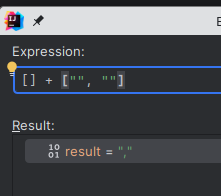
@CFDS the result of empty-array + array-with-two-empty-strings should be array-with-two-empty-strings. And not a string with one comma in it with no reason, which is beyond WAT. I got irritated when i saw that empty-array plus empty-array results in empty-string, which is already stupid as hell, but OK, its JS..¯\_(ツ)_/¯
But this? ... I dont know. Its creating commas out of thin air.. thats so stupid.
@CFDS See, even with an explanation, its still stupid as hell. Its so sad that this crap is still the same since https://www.destroyallsoftware.com/talks/wat
Why cast arrays to strings in the first place 🤷 why not type-error if `+` wants to see stringable things. Why does `+` want to see strings. Number+number is number, not number-as-string for example. Hach.
@CFDS well i hit this in a real-life project :)
There is nothing wrong with admitting that parts of a language suck btw... i did a lot of PHP, i have no problems with admitting that eg haystack-needle positioning inconsistency there is super stupid. Or GC..or speed.. Or Python, where the actual error in error reporting is often somewhere at ~3/4 of the 20-pages-long error message. Or Java where ..its Java. Golang and "exceptions"..
Dont feel attacked :) If you like JS, then thats good :)
@CFDS i think that this metaphor doesnt fit completely-legit expectations like "order of left and right operant shouldnt matter on + operator"
But its OK if we disagree :)
@leKnecht Your last example is actually demonstrating a gotcha in REPL/console, and not in JS per se.
"{} + []" can be interpreted as an expression OR as a statement. If it's an expression, the "{}" gets evaluated as an object. If it's a statement, the "{}" gets evaluated as an empty control block.
Different REPLs and consoles use different heuristics for figuring out whether the given line(s) are supposed to be a statement or an expression. This is the cause of seemingly different outcomes.
@CFDS ah! That does make sense. I was already puzzled, as explicit string casts stayed the same on browser and repl.
But i still think that some behaviors do have no benefit / use-case and create pitfalls, so raising errors would be better 🤷
@leKnecht Let's try another metaphor.
In English, we can safely assume that the verb is between the subject and the object.
Is it legit to expect that the word order should be the same in any language? Is Japanese a stupid language because it places the verb last, and thus breaks the English speaker's expectations?
 CFDS
CFDS