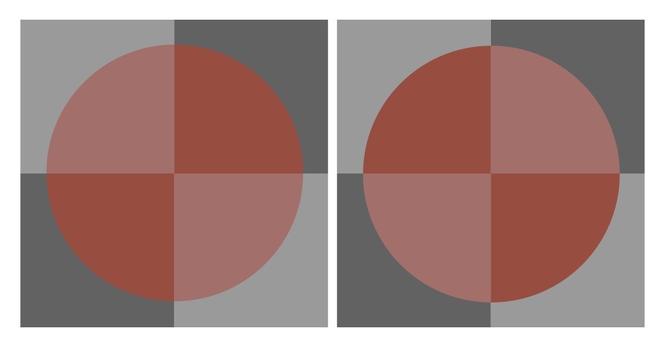

This still is 🤯 to me with respect to the “fingerprint” of spatiotemporal articulations and how we create information.

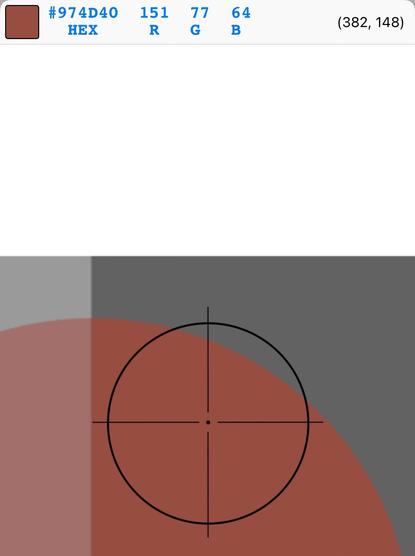
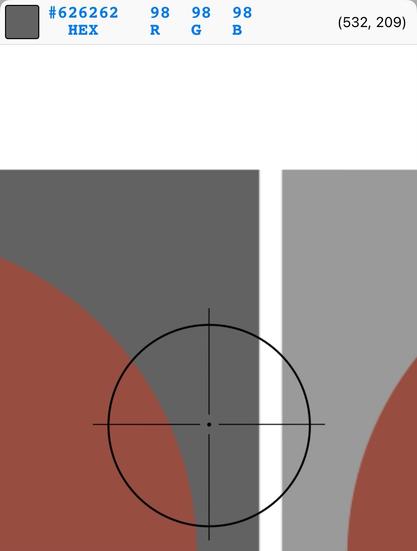
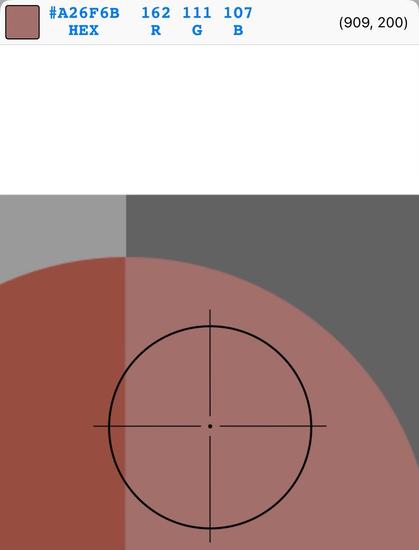
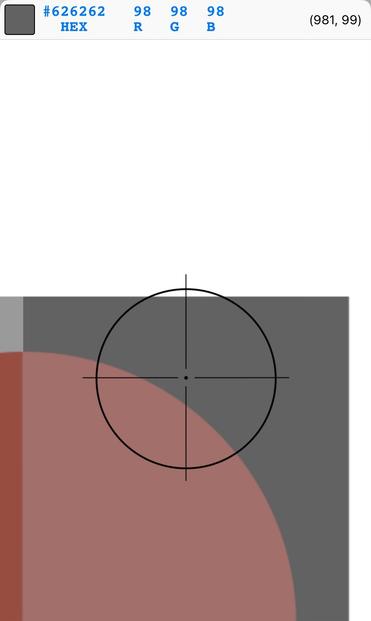
This is my riff on Ekroll and Faul’s work from 2011. Here, I chose to make the tristimuli **identical** in both depictions, with the sole difference is that the “disc”is rotated 90°.

The nature of the polarity along luminance vs chrominance triggers a strong probability of “transparency mode” in the first, while very low in the second.

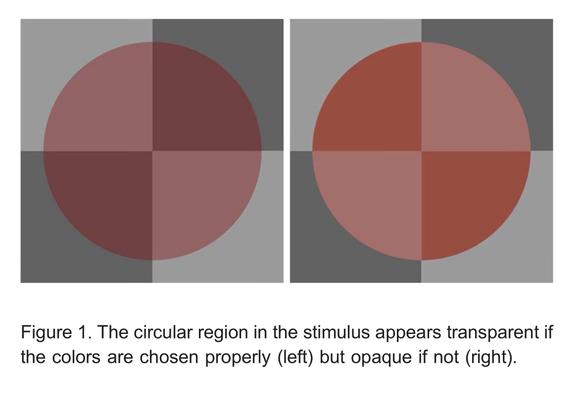
The original had varying tristimuli, which in my opinion degrades the superimportance of the spatiotemporal articulation.

This demonstration is absolutely crucial to keep at the front of our lens when we hear the rabble discussing nonsense like “gamut mapping”.

There’s a 10000 thread at GitHub on CSS gamut mapping that is going to screw generations of web developers. https://www.w3.org/TR/css-color-4/#css-gamut-mapping

Folks really need to slow down and think more.

Never mistake motion for action.

CSS Color Module Level 4

So what all of these lines of thought succumb to is the brain wormed idea that “colour is stimuli”. We all know this is false, as the Ekroll and Faul demonstration shows with incredible persuasiveness.

So what **can** we learn from Ekroll and Faul? Is there a deeper pattern here?

I believe there is.

First would be to identify a key factor in the Ekroll and Faul demonstration. In my revision, given that the tristimuli are identical, we can get a sense that the local mean energy will be the +

- sole difference between the articulations. That is, we can expect the neurophysiological inhibitory opponent signals to be of similar gradient maxima and minima.

The key point is the polarity of the signal. What do we mean by “polarity”? This is the idea that there appears to be sizable indications that the information inference computations are grounded strongly by the energy “directions”.

Here, the arrows loosely identify the neurophysiological gradients of our biological assemblies.

If we ignore the nonlinear encoding OETF of the RGB, we can see rather clearly that in terms of the upper right quadrant, there is a unique energy progression. If we consider going from the disc to the ground, note the *minima* of the RGB. Why might RGB be useful for analysis? Because it is quite literally a normalized wattage.

All of this is rather interesting if we step back and fully appreciate that in terms of the neurophysiological signals, we are quite literally “hard wired” with energy analysis assemblies. The decrement signals could be broadly considered to be “energy down” gradient signals, and the increment signals are “energy up”.

If we compare to the low probability transparency mode upper right quadrant, we can see that the minima of the RGB uniquely “points” in a different direction.

I believe it is informative to think about the polarity gradient in terms of an “energy window”. That is, we can get a sense that the “energy floor” **could** be an important qualifier of the heuristic. In the “transparency mode” of the left side, the “form” of the “disc” has a *lower* energy floor on all four of the “wedges”. In the right form, the wedges *vary* in energy polarity. The upper right wedge is an increment to ground, and vice versa for the lower right.
@TonyVladusich Interesting! I never thought to do an achromatic version! Is that proper luminance calculated values for the chromatic regions?

@troy_s

Just ran it through Colors so who knows. Remarkable how strong the impression of a disc is even though only part of the disc border is “actually there”.

@TonyVladusich Yeah I just sampled it and the “disc” is decrement by a code value. Which in terms of normalized wattage is about 11.9% to 12.2% of the total wattage.
@TonyVladusich I guess conversely, it is worth noting that the chromatic variation is unarguably *more strongly* decomposed into a disc.