 Brad Hulse
 Kristin Branson
Absolutely beautiful work from Stephen Huston and coauthors finally published yesterday:
"Motor neurons generate pose-targeted movements via proprioceptive sculpting"
https://www.nature.com/articles/s41586-024-07222-5
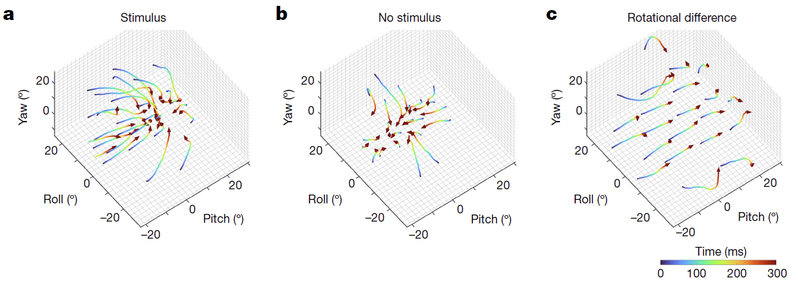
Motor control is really complicated and so so interesting. This work embraces that complexity to dissect control of a fly's neck with pretty unexpected but clear results. Rather than each motor neuron encoding a single movement direction, the direction of movement depends on the pose of the head. 1/n
"Motor neurons generate pose-targeted movements via proprioceptive sculpting"
https://www.nature.com/articles/s41586-024-07222-5
Motor control is really complicated and so so interesting. This work embraces that complexity to dissect control of a fly's neck with pretty unexpected but clear results. Rather than each motor neuron encoding a single movement direction, the direction of movement depends on the pose of the head. 1/n
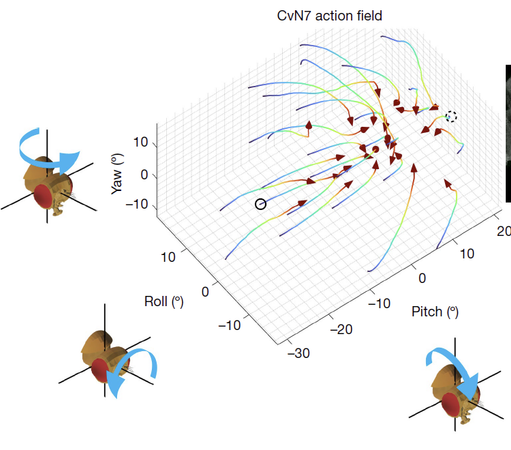

Motor neurons generate pose-targeted movements via proprioceptive sculpting - Nature
Single motor neurons in Drosophila are stimulated to show that they direct head movements towards specific postures rather than generating fixed movement vectors, suggesting that the brain controls movements through a continuing proprioceptive–motor loop.
 Ben de Bivort
 Aaron In Minnesota
 Bill, organizer of stuff