 Sarah Taber
Y'all know what day it is 🍀
In the US, St. Patrick's Day is strongly tied to the event that led so many Irish people to emigrate here: the famine of 1847.
Food systems & supply chains make history.
Y'all know what day it is 🍀
In the US, St. Patrick's Day is strongly tied to the event that led so many Irish people to emigrate here: the famine of 1847.
Food systems & supply chains make history.
I'm working to build a better food system here in the southern US. Both regions share rich land that can grow plenty of good food- and a history of deep rural poverty, thanks to what could generously be described as "poor leadership."
There's also a lot of ingenuity in both.
So today we're doing another round!
For every donation to the link below, I'll post one (1) fact about agriculture in Ireland- before, during, & after 1847.
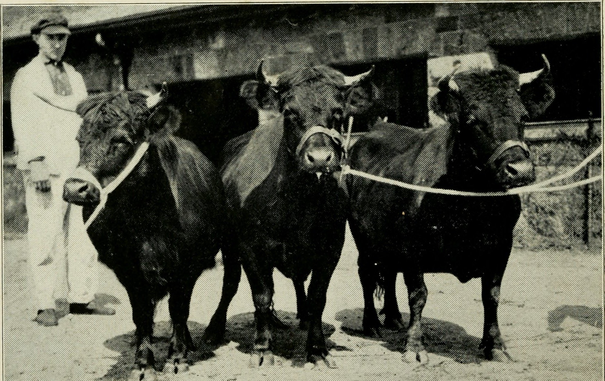
There's WAY more than potatoes. Like what's going on with these fully-grown, halfling-sized cows.
And we're off!
1/ Ireland has a long history of smallish cattle. Here's a guy posing with a bull, with some forced perspective to make this compact king look like full-sized.
Why small cows? They weigh less.
That's a big plus in Ireland. When it's rainy, big heavy cows can easily tear up sod with their weight. Next thing you know the pasture is a music festival-style mudpit. The grass can take years to grow back right.
You can avoid all of that just by having smaller cows!
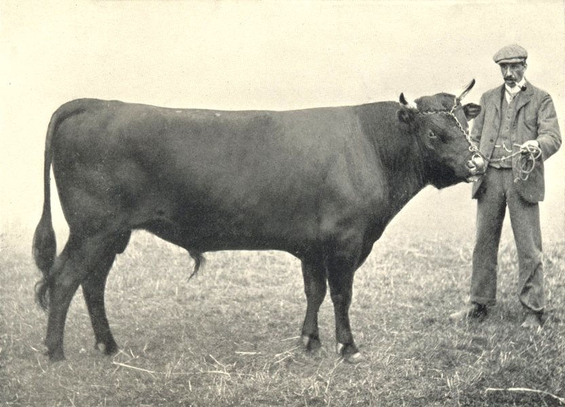
2/ This answers a question I'd had for a long time. When we learned about the 1847 famine in schools, the textbooks would say "People got almost all their calories from potatoes, and their fat and protein from a little bit of dairy." But I knew cows are big honkin' animals that need lots of space and food.
If people were living on tiny plots, how were they keeping cows?
Oh the cows were little. That helps a lot.
3/ If you're eating a lot of potatoes & dairy, you gotta find a way to make it interesting!
Enter colcannon: mashed potatoes with greens and ideally (IMO) as much milk/butter as possible.
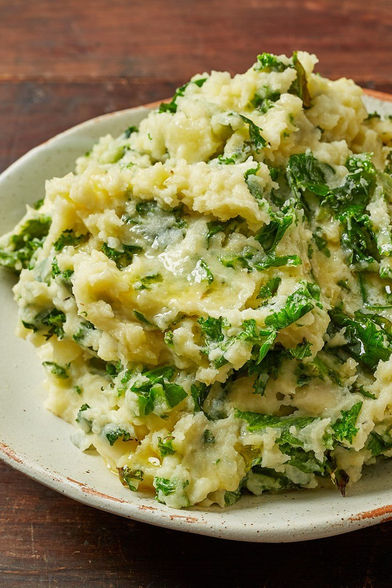
4/ There's a song about colcannon! Fittingly called "Colcannon."
It's a little sappy but I think for a thing that stood between a lot of people & starvation, this is permissible.

5/ After emigrating to the US, a lot of people kept using colcannon as a side dish along with corned beef (a working-class friendly main dish in 19th century US) or other heartier options.
But for people living on small plots in Ireland, it often served as the main dish.
6/ What did people in Ireland eat before potatoes?
By all accounts, lots & LOTS of dairy. The weather's good for growing lush grass, which keeps cows well-fed enough to milk most of the year.
Drinkable yogurt-type beverages, curds, clabbered cream, and lots & lots of butter.
7/ But there's a problem: dairy is perishable. Hard aged cheeses have a longer shelf life. But those take dry conditions (part of why they're popular in the Mediterranean).
What's a dairy farmer in cold, rainy Ireland to do?
Bog butter, apparently!
8/ Starch came from oats- the grain most tolerant to wet weather- and root crops like turnips.
Ireland's food history didn't start with the potato! Potatoes arrived into a food system that had already been fully formed since the Bronze Age.
9/ Potatoes arrived from the Americas in the late 1500s/early 1600s.
And that was right around when England began seizing large amounts of land to set up plantations. (In Ireland, plantations = land grants the monarch gave to English gentry.)
11/ But by 1815, a few things had changed.
The population of Ireland skyrocketed from 1M in 1600 to 8M in 1840.
The super-high yield/acre of potatoes had a lot to do with it: adding the potato to Ireland's crop mix just allowed the land to support more people.
12/ At the same time, grain was having an export boom because of the Napoleonic Wars.
France, which was normally a grain powerhouse, was short on both labor and functional farmland to grow grain.
Suddenly, anyone who owned large acreage could make lots of money exporting grain.
Even after the Napoleonic War ended, English families who owned estates in Ireland got used to the income from exporting grain.
England had various controls on exporting grain, to keep food affordable. But those laws didn't apply in Ireland.
(A quarter = a little over 1/4 ton.)
The population boom, combined with the grain export boom, pushed Irish tenants' personal plots to minuscule size.
By 1845 40% of Irish tenant farmers' plots were under 15 acres per family. 24% were under 2 hectares- which WOW, is NOT enough to support a family. AT ALL.
Most people wound up growing a potato variety that became known as the "Irish Lumper."
It's a knobby little guy that thrives on poor, wet soils.
Usually when you live on potatoes, you either have them in a root cellar or dig a day's worth out of the ground at a time.
One day, everybody went to their cellar or garden. And all the potatoes were slimy and rotten.
Potato late blight is what the crop scientists call an explosive disease. The time from first symptoms to "your entire crop has melted down" is very short- days or hours.
It hits so fast, there's a distinctive smell to it. The smell of "entire potato field in distress."
So a country of 8M people lost all their groceries in a week. And almost nobody had savings or backup food.
Meanwhile Ireland was also growing lots of grain!
But the people who owned most of the land kept exporting it, while subsistence farmers who rented from them starved.
It's important to note that Ireland wasn't alone in getting hit with late blight. This disease, caused by Phytophthora infestans, was going all over Europe at the time.
But Ireland was the only place that wound up with a famine so deep it changed the shape of the country.
In conclusion, man do I wish it were as simple as "late blight caused the Irish potato famine."
But it never is.
And that's why it's important to have a food system where everyday people have a say.
I'll wager long odds it's that same population that starved bc no potatoes that was doing the actual work to grow the grain that was being exported.
Also: this is fascinating. My lineage descends directly from the potato famine on my mother's side. Don't know if the immigrant was my gDa or my ggDa, but it was big in the family awareness.
I came late to the family taste for potato, but have made up for lost time.
(My personal fav is a nice sticky Yokon Gold....)
My story as well, mostly (not the late taste for potatoes though). Donegal.
The history is brutally shameful.
As is most colonial history. The whole extractive mindset is going to kill us all, ultimately, if we don't figure out how stop it.
I have a copy of Cecil Woodham-Smith's *The Great Hunger: Ireland 1845 - 1849*.
I haven't finished it, I get too emotional reading it.
🤬😭
@sarahtaber related, BBC has published a 5 part radio/podcast about the Bangladesh Famine in WW2, disturbingly similar except no potatoes involved, and little discussion. https://www.bbc.com/mediacentre/proginfo/2024/10/three-million
Someone said, "History may not exactly repeat but it sure does rhyme."
(Some say "once as tragedy, once as farce", but this is tragic outrage both times. )
Because nothing says "compassion" like forcing the starving to do pointless heavy labour. /s
Look up "Irish famine roads" or "Irish roads to nowhere".
@RhinosWorryMe @sarahtaber Different time, different culture, different concept of charity. Remember that hard work was seen as morally improving, and handouts as corrupting. So charity didn't mean distributing food, to save the body and cripple the spirit. It meant giving people the opportunity to earn their own food. Even if that meant building roads to nowhere, or other pointless tasks: The work itself was the point.
The view as not died out. We still see strong opposition to welfare.
Yeah, not so different, not much has changed in British attitudes.
@RhinosWorryMe @sarahtaber Don't give us all the credit. The US pioneered food stamps, because poor people apparently can't be trusted with real money and need to be punished for their lazyness until they find a job.
Britain didn't invent the toxic protest work ethic, equating hard (paid) work with good morals. We are just really good at it, particularly as many pioneers of industrial capitalism promoted it to encourage their workers towards longer hours in worse conditions.
@RhinosWorryMe @Qybat @sarahtaber
I think making #billionaires work even a couple hours a day manual labour for every $400 million worth of tax cuts seems like it would go over well with voters
@sarahtaber absolutely. It wasn't a quirky protestant sense of morality of the time period, it was deliberate colonial decision-making by a government who saw their colonial subjects as, at best, a nuisance to be "solved".
People who ascribe it to harmful, but typical, attitudes of the time end up both distorting what actually happened and doing a great disservice to the many Irish and Britons who spoke out at the time against the cruelty of the government's actions.
It was all about 'Trevelyan's corn'. Exporting wheat and barley while the people working the land starved.
@legumancer Haha similar struggle over here. We had farmers in Appalachia turning themselves inside out for years trying to find crops that would be happy in small mountainside fields that are soggy much of the year.
Then some Hmong folks moved in. They're happily growing traditional Laotian mountain rice there, just like God intended 🌾
We English are good at giving other people's land to ourselves.
(I'm now a settler on the traditional territories of the Mississauga branch of the Ojibwa Nation.)


 glasspshr
 Cavyherd
 Patrick McLaughlin
 DJ Paavi
 Eddie the Bulldog
 Eric Lawton
 Lindley Ashline
 Mathias ❄️🐺🐶
 Ben Rosengart
 BenAveling
 D2
D2 oisin
oisin Bill Ricker

 Rhinos Worry Me has moved
 AccordionBruce
 snott
snott George Potter
 John Timaeus
 6x6
6x6 Glenn Fleishman
 Trux
Trux Elisabeth Olson
 legumancer Davy