 Marc Hedlund
A toddler and an adult were killed, and a baby and two other adults (including the driver) were injured, when a driver hit a bus shelter in San Francisco today. This event produced some polarized reactions today and I wanted to talk about how I see it. https://sfstandard.com/2024/03/16/one-child-one-adult-killed-others-injured-when-car-strikes-bus-shelter-in-west-portal/ #StreetSafety #VisionZero #SanFrancisco.

Mayor London Breed made a remarkable comment about the crash: "I'm not sure that this particular incident fits in the scope of that problem around Vision Zero but our goal is to make sure we are doing everything we can to ensure the safety of people in this city." What did she mean by that? It's hard to say but I have a guess.
Vision Zero is the idea that cities should work to reduce traffic deaths and serious injuries to zero. Obviously, an adult and a child dying and three others being injured is very severe and many street safety activists (of which I am one) reacted very negatively to Breed's apparent desire to define these deaths as outside of the goal. https://en.wikipedia.org/wiki/Vision_Zero

San Francisco committed to reach Vision Zero by 2024—this year. Here's how it's going as of last year: not well. (Source: https://sfgov.org/scorecards/transportation/traffic-fatalities)
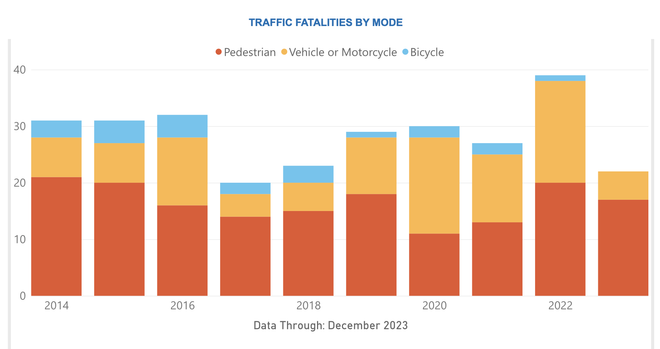
Traffic Fatalities | City Performance Scorecards
Vision Zero SF San Francisco's "Vision Zero" policy represents the City's commitment to eliminating traffic deaths on our streets by 2024. Through building better and safer streets, educating the public on traffic safety, enforcing traffic laws and adopting policy changes, we can save the lives of all road users — people who walk, bike, drive, or ride public transit. Achieving
So what did Mayor Breed mean? Some of the early reports suggest the driver may have had a medical emergency, so it's possible she meant that essentially doesn't count for the Vision Zero goal. We can't prevent medical emergencies, so putting that in the same column is unfair. Right?
If that is the Mayor's intention, I disagree with it. There are a lot of factors that seem to have played into this crash, and the medical condition of the driver before the crash is only one of them. Pointing at the medical emergency is a so-called "root cause analysis"—there is this one factor that explains the incident, and having discovered that factor, we can stop our analysis. This is not the way to reduce crashes.
What are some of the other factors (recognizing this just happened and a full analysis will take time)? The driver was driving an SUV, which is large and heavy, and car size and speed have increased in the US for years. The road is wide and fast, and allows drivers to get up to speed often. There's a mix of pedestrian, car, bus, and light rail traffic in a commercial district, creating many potential conflicts. The bus shelter apparently had no bollards (heavy poles) protecting it. And so on.
In other countries, including the Netherlands and some of the Nordic countries, a cross-disciplinary team analyzes fatal crashes and tries to recommend improvements based on their analyses. Those improvements are often applied system-wide. In the US, we usually do not do that. Instead, we use a system of "warrants" to say that *a particular intersection* must experience a high number of injuries or deaths to produce a differently-engineered street.
In other words, if you have a four-lane high-speed road in your town and it produces a lot of injuries and deaths in a short time, the four-lane high-speed road in my town will not get changed. Things could be different here! We need to wait and find out.
It's my view that we could learn from many years of cross-disciplinary analyses of deaths and injuries elsewhere, and engage in those ourselves, to improve our whole traffic system. Until we do, Vision Zero will be unattainable.
At some level, we are grossly disrespecting the work others have done to learn from deaths and serious injuries. *We know how to prevent traffic deaths.* It is not that hard and not that expensive. It requires slowing down cars and prioritizing other modes of travel on at least some roads. And we are unwilling to do that, so instead the deaths stay the same—or increase. (nyt gift link) https://www.nytimes.com/2023/12/11/briefing/us-traffic-deaths.html?unlocked_article_code=1.dU0.61or.A_5eVL5lxvTC&smid=url-share

So, I interpret Mayor Breed to mean that we should not analyze or learn from today's deaths because they were out of our control. I disagree. We can take control of our streets and the deaths and injuries they produce—magnitudes more than plane deaths and injuries, so much in the news right now—by making changes we know will slow cars. To say that the toddler and the adult who died today are just inevitable deaths is simply wrong.
 BrokenFlows
@marcprecipice I wasn’t aware of countries analysing crashes and deaths to make system-wide changes. It feels obvious that it should be done this way.
Road deaths are rising faster in Ireland than anywhere else in the EU, and solutions include campaigns asking pedestrians to wear hi-vis vests and take precautions. This blames individuals and lacks systematic change. A complete rethink of how we determine factors leading to deaths is necessary, and such analysis is a right-minded approach.
@BrokenFlows yes. Victim blaming is a sure way to avoid improvements.
@marcprecipice I really appreciate this thread. The injuries and loss of life are tragic, though I find hope in knowing something could be done more than explaining it away as anomalous.
 PedestrianError

@marcprecipice #VisionZero (especially the US version) is as full of loopholes as “net zero emissions” plans that rely heavily on buying dubious carbon offsets instead of actually eliminating emissions. People have medical emergencies. Some are predictable, some not. When a transportation system is built to encourage too much driving, a lot of people will have medical emergencies while driving. Reducing driving/ensuring there are alternatives is bigger than fixing individual dangerous roads.
@marcprecipice A lot of #VisionZero programs will keep a crash out of their statistics if a driver is found to have been committing a non-traffic crime &/or fleeing from police. Police chases are a significant cause of high speed crashes, but they get written off as an inevitable cost of doing business instead of prioritizing safety and ending police chases. It also ignores the fact that the design of a road allowed a driver to get up to 80 mph if the driver happens to have just robbed a bank.
 szakib
@PedestrianError @marcprecipice LOL, even in Hungary, where everything is fucked up beyond hope, the police will stop a car chase if they think it endangers bystanders.
 Benjamin Fry
@marcprecipice beyond just bollards, speed limiters could have potentially made this crash less destructive. Every bus stop needs bollards, at some point the cost of the infrastructure to make it safe to exist around cars will be so high that it will just be cheaper and more cost effective to just ban them all together.
 kimu
kimu@marcprecipice it was really striking language on her part, and confusing.
@kimu totally. Reinforced by SFPD today. I don’t get it.
 😀🚲
😀🚲@marcprecipice infrastructure is essential to Vision Zero. The bollards we need to stop drunk drivers, dead drivers, glitching driverless cars, distracted drivers, raptured drivers... they're all the same concrete-filled steel hardware. Yet no American city seems to have a #VisionZero plan which actually directs #trafficEngineers to literally slow down cars and prioritize safety (including equal efficiency/convenience) of other modes.
 Owen
OwenI know this makes me a bit of a negative Nancy ... But Seattle's "better bike lane" curbs genuinely make me angry. We're using all this money and time to install curbs that won't physically stop a vehicle, or even discourage a larger vehicle with clearance.
Bob Svercl (@[email protected])
Attached: 4 images 3/4 Everyone on the Beacon Hill Safe Streets community bike ride was able to enjoy freshly installed concrete protection on the Columbian Way bike lanes while construction workers were installing more pieces; we cheered on the workers as we passed by. Thank you SDOT! #SEAbikes #Seattle #Volunteer #BikeTooter #PNW
They also said they couldn't do Toronto barriers because there wasn't enough room... Look at that first picture and tell me there isn't enough room. It's gaslighting.
@owen @marcprecipice at least they have somewhat squared sides, Portland's are far easier to roll over in a car. "Shy distance" is such a ridiculous design parameter, scared drivers slow down, but we give them 14ft or whatever.