
Ist aber völlig falsch.
In den letzten 8 Jahren ist die Stromerzeugung aus Kernenergie in der EU um 21% gefallen.
Warum wird so viel Blödsinn erzählt?
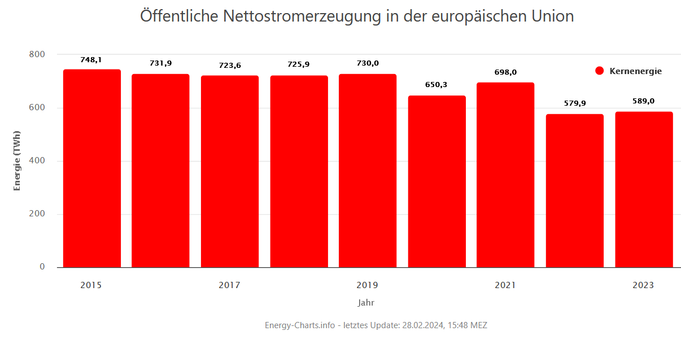
@VQuaschning Natürlich muss man da erwähnen, daß Deutschland aus der Atomkraft ausgestiegen ist und das natürlich nicht ohne Effekte bei der ganzen EU bleibt. Die installierte Leistung hat sich um 20 GW seit 2014 reduziert, Deutschland hat in der Zeit 23 GW abgeschaltet. Dito bei der gelieferten Kernenergie, wo wir 100 TWh Unterschied ausmachen, es aber 160 TWh runterging.
Gut gemeint, aber ein SEHR leicht angreifbares Argument. Ich würde lieber auf die Performance im Ausland achten.
@urwumpe Einen Überblick zu Status und Trends der Kernenergienutzung weltweit findest Du im World Nuclear Industry Status Report: https://www.worldnuclearreport.org/-World-Nuclear-Industry-Status-Report-2023-.html
Das Maximum der Energiegewinnung aus Atomkraft wurde 2006 erreicht. Seitdem nimmt die Produktion weltweit ab; nur China hat in den letzten Jahren seine Kernenergienutzung nennenswert gesteigert.
The World Nuclear Industry Status Report 2023 (WNISR2023) assesses on 549 pages the status and trends of the international nuclear industry. It provides a comprehensive overview of nuclear power plant data, including information on operation, production, fleet age, and construction. The WNISR assesses the status of newbuild programs in existing as well as in potential newcomer nuclear countries, and looks at the status of Small Modular Reactor (SMR) development. WNISR2023 contains a special focus chapter on Nuclear Power Economics and Finance that assesses how persistent competitive pressures force the nuclear sector to rely on increasing state support. Further focus chapters include an expanded analysis of U.S. nuclear policy, including its multiple new subsidy mechanisms, as well as an assessment of the struggling South African nuclear program amidst a continued electricity crisis. The report also looks at the history of Germany’s phased-out nuclear fleet until its last three reactors were closed in April 2023, and scrutinizes the difficulties that neighboring France has been facing in a historically catastrophic year of nuclear performance. The situation of the Russian nuclear industry, as well as complex implications of the international interdependencies with nuclear players in other countries, are subject to closer scrutiny. A United Kingdom Focus looks at the many challenges of operation, decommissioning, ongoing construction, and future prospects. The Fukushima Status Report provides an overview of ongoing onsite/offsite challenges of the 2011-disaster, as well as legal developments regarding citizens’ health and compensation claims. The Decommissioning Status Report looks at the current situation of the now over 210 closed nuclear power reactors, close to one third of all units in the world that have generated electricity at some point. The chapter Nuclear Power vs. Renewable Energy Deployment provides an overview of the increasing gap between the development patterns of the two electricity generating technologies. Annex 1 offers an overview by region and country of all operating nuclear programs not covered in the focus chapters.
@StephanB @VQuaschning ich weiß, ich lese auch die Seite und kenne auch die Trends. 😉 Oder die wirtschaftlichen Indikatoren und gegenwärtigen Trends.
Würde doch Russland endlich mal die seit 20 Jahren versprochenen Reaktoren bauen, statt Krieg zu spielen. 😇