14. Hot House

Max Roach had played with Charlie Parker as early as 1945, but that recording is taken from a legendary concert in Toronto, Canada, on May 15, 1953 — Live at Massey Hall, there were Charlie Parker on tenor saxophone, Dizzy Gillespie on trumpet, Bud Powell on piano, Charles Mingus on bass, and of course Max Roach on drums.

This Tadd Dameron composition is pure bop — a very simple melody, almost just a riff repeated following a chromatic descent (IV-V-1) which serves as a pretext for improvisations. Many jokes in the solos — listen how Parker quotes Carmen, and Gillespie responds with Do nothing till you hear from me?

It's interesting to listen to Roach's playing too: after a 4-bar improvisation, he mostly plays a swing rhythm on the ride cymbal during the exposition of the theme (goes to the hi-hat for the B-part), with accents on the snare and floor drums, some parts with an afro-cuban feel, but brushes on Mingus's solo, until everybody rejoins (rejoices) for the theme.
Everyone in this legendary band swings like hell, the audience is on fire. I hope you're all well!

https://www.youtube.com/watch?v=GbEM3eJ5Isk

#Jazz #MaxRoach100 #PouetRadio

Hot House

YouTube

15. When lights are low

Still in my chronological discovery of Max Roach's be bop era, mostly as a side man, and this time within a quartet led by Miles Davis on trumpet. Percy Heath is on bass and John Lewis on piano.
The theme is a melancholic ballad, composed in 1936 by Benny Carter and Spencer Williams.
After a small introduction on the piano, the trumpet takes the lead and plays the melody, with a minimalist accompaniment from which the musicians won't depart, even during the very short piano chorus where John Lewis, to say the least, doesn't try to show his virtuosity.

That recording is from Miles Davis's album Blue Haze, where the trumpet player experiments various quartets (Kenny Clarke and Art Blakey also take the drums, Horace Silver on piano, and Charles Mingus as well!) recorded in 1953 (as for that sone) and 1954.

It's late, friends,
lights are low in the club,
it's raining outside, or your flat may be empty and cold
let's indulge ourselves one more tune…

https://youtu.be/E15RCBrH8rc

#Jazz #MaxRoach100 #PouetRadio

When Lights Are Low (feat. Max Roach, John Lewis, Percy Heath)

YouTube

16. Ondine (for @titedino78 )

Here is Oscar Pettiford's sextet playing compositions by the critic and music journalist Leonard Feather, who, as one can hear, was also a fine composer. (With Mingus, he arranged poems of Langston Hughes.)

Together with Roach on drums and Pettiford on bass, there is Kai Winding is on trombone, Al Cohn on tenor saxophone, Tal Farlow on guitar, Henri Renaud on piano. This is a short piece anyway — after the melody where the sextet plays a nice arrangement, you got solos by Cohn, Winding, Farlow, Renaud, and Pettiford, and it's time to play the melody and conclude.

https://www.youtube.com/watch?v=7I3Ui1GxgWk

#Jazz #MaxRoach100 #PouetRadio

Ondine

YouTube

17. Just One of Those Things

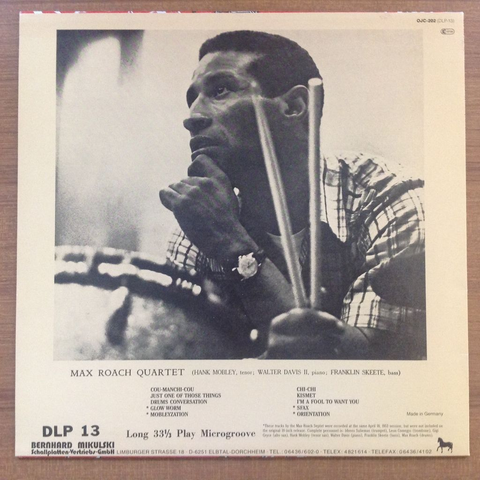
1953. Time for Max Roach to start his own band, as a leader. Hank Mobley is on tenor saxophone, Walter Davis Jr on piano, and Franklin Skeete holds the bass. Just One of Those Things is a Cole Porter composition, a true standard according to the definition of a standard, since this song was part of a musical — Jubilee. The initial composition was labeled as a foxtrot, and played at moderate tempo — 120bpm — it seems vocal versions keep that tempo.

Having a bebop band with no singer allows to play it faster, although you can't feel that upcoming speed at Roach's short intro, which plays quite freely on the cymbal and the toms. The last two short notes on the bass drum send the start signal — and they are quarter notes, so that the tempo is roughly 200bpm.
The melody is played by Mobley on saxophone — Roach essentially plays 8th notes on the ride (with almost no swing in it) and some accents on the bass drum. After the melody, the saxophone starts a riff that seems to mean he's going to chorus, but no! Roach takes the lead for a very fast drum chorus where he doubles the tempo, playing all quarter notes on hi-hat and 8th notes on the bass drums. That marks a strong and fast pulse above which he plays rudiments on the snare drum. Only then can Mobley, and then Davis, do their own solos, until Mobley redoes the melody and Roach concludes with a small drum finale.

https://www.youtube.com/watch?v=6L7tkwfzQUM

#Jazz #MaxRoach100 #PouetRadio

Just One of Those Things (feat. Hank Mobley)

YouTube

18. Parisian Thoroughfare

Max Roach and Clifford Brown with their quintet play this astonishing composition.
Listen to the long intro, where the horns imitate the busy city of Paris, reminiscing of Gershwin's American in Paris, and then, when the melody starts, how the piano fills the end of the first 8 bars with hints of the Marseillaise or, for the next one, of the classic French cancan. They're having fun, and play this fast tune with both energy and lightness.
George Morrow is on piano, Harold Land on tenor sax and Richie Powell on bass. Enjoy!

https://youtu.be/dLk9Ur2j0_8

#MaxRoach100 #Jazz #PouetRadio

Clifford Brown & Max Roach - 1955 - 02 Parisian Thoroughfare

YouTube

19. Cherokee

We continue our exploration of the Max Roach / Clifford Brown quintet.

A 1938 Ray Noble composition, from his Indian Suite (in 5 parts, all bearing the name of an Indian tribe), it didn't become part of the jazz canon until Charlie Parker proved that it was possible to improvise on it. It is also very fast, 240bpm, — and if, by listening to the melody, you think it isn't that fast, it is because the melody is written in full notes. It is from the drums that you hear the pulse that the musicians have to internalize to play that song, especially in the choruses. Also, the bridge is written as a II-V-I progression, hence its tonality changes every second… you can get how tough it is to improvise on it!

Here, all musicians expose their virtuosity, without losing on musicality… The first drum chorus is probably hard to follow, but you get a second chance when the musicians replay the melody, because Roach takes a new chorus on the bridge part.

A great version !

https://youtu.be/M283JFxesic
#MaxRoach100 #Jazz #PouetRadio

Clifford Brown - Cherokee

YouTube

20. What is this thing called love?

A 1929 song by Cole Porter, it turned into a wonderful jazz standard that allows the creativity of musicians to expand in unforeseen directions. Despite what the title of this album may suggest, it was not recorded “At Basin Street”, New Orleans, but in New York City's studios of the Capitol company, February 1956.
It features once again the Clifford Brown / Max Roach quintet, except that Harold Land left the band to live in California, to be replaced by Sonny Rollins! George Morrow is on bass, Richie Powell on piano, and these five guys embark in a fast-paced rendition of that tune.

After a long intro on a single chord, the theme starts on the trumpet, and the saxophone answers for the bridge, and we're set for a succession of choruses propelled by Roach's drumming : Brown, Rollins (who takes his time, starting with a 2-note motive he will repeat several time, recall at various places, and end with it), Powell, Morrow (with an interesting counterpoint by Roach and Powell), then a long riff passage that launches Roach's chorus, at 5:00 on. Here, we have an extremely dense playing with the sticks, with accents on the hi-hat and cymbals — Note how Roach departs from the standard way of playing the hi-hat: it is no more played regularly on beats 2 and 4, as a pulse keeper, but as an autonomous melodical instrument, to which the other cymbals respond. Time for a 2-voice chorus on trumpet/saxophone, 8 bar each, then 4 bar, to finish by playing a melody at unison. The song ends like it started, on a pedal point.

https://www.youtube.com/watch?v=JTWRZkoLGx8

#PouetRadio #Jazz #MaxRoach100

What Is This Thing Called Love

YouTube

21. Valse Hot

At the same time where the quintet of Max Roach and Clifford Brown was emerging as a new force in jazz, Max Roach served as a side man in various bands. Tonight's recording is exactly that quintet, but for the leader since it is now Sonny Rollins who leads the band.

The song, Valse Hot, is a composition of Sonny Rollins, but Max Roach will later record it again. You can hear in that version, already in 1955, with how much ease he can bring a jazz feel to the waltz rhythm. One of the key of his playing is understating the third beat: instead of playing boom-tcheek-tcheek, boom-tcheek-tcheek…, he plays boom-tcheek-(hush), boom-tcheek-(hush)… and that makes a tremendous difference.

https://www.youtube.com/watch?v=SIVtK2gXLpk

#PouetRadio #Jazz #MaxRoach100

Sonny Rollins + 4 - Valse Hot

YouTube

22. These foolish things (for @jaztrophysicist )

“These foolish things remind me of you
How strange how sweet to find you still”

A beautiful and tender ballad for tonight. Because we deserve this quietness, this calm, be it for three minutes only. George Morrow sings the melody at the bass with a little harmonic support of the Richie Powell's piano and consistent brushes by Max Roach. A vague attempt to swing during the bass chorus, but we're back to the sound of brushes. No horns, no effects, nothing but nostalgia.

“These things are dear to me
They seem to bring you near to me”

https://www.youtube.com/watch?v=xK7u3_TtsBc

#PouetRadio #Jazz #MaxRoach100

These Foolish Things

YouTube

23. Drums

Back to 1955 again when, together with his own quintet with Clifford Brown, Max Roach served as a side man for various bands.
Today, the leader of the band is Charles Mingus on bass, with Eddie Bert on trombone, George Barrow on saxophone and Mal Waldron on piano. And Max Roach is not a side man, he's a guest! (The usual drummer of Mingus's band is Willie Jones).
So Max Roach appears on two tracks of that live album (recorded at Café Bohemia, New York, December 23, 1955), and this song, Drums, of which both Mingus and Roach are credited as composers, puts him in front of the scene.

https://www.youtube.com/watch?v=ZU9Y0NG2284

#PouetRadio #Jazz #MaxRoach100

Drums (Live)

YouTube

24. Rose Room

For his second album as a leader, Julian “Cannonball” Adderley gathered an octet in August 1955, with arrangements by Quincy Jones. On three tracks, Max Roach is on drums — it's Kenny Clarke on the other ones.

Tonight was the first time I heard this song, Rose room, a 1917 composition by Hickman and Williams, which was famous in the swing era, and Jones's arrangement definitely do justice to the spirit of swing.
Apparently, Ellington revived the song in 1932, and “borrowed” its chord progression to compose “In a mellowtone”. Max Roach gives a great background here, with a light but directive style most of the time, and uses the silences at the end of the musical phrases for bebop-style interventions that relaunch the music (can you get them in the exposition of the theme)? There is also a nice trading in fours between Adderley and Roach at the end of the song (Roach doubles the tempo there, so it sounds as if they play 8 bar each).

https://www.youtube.com/watch?v=e3GHS9PP8RA

#PouetRadio #Jazz #MaxRoach100

Rose Room

YouTube

25. Blue Seven

22 June 1956. Sonny Rollins enters the van Gelder studios at Hackensack to record a somptuous album, with Doug Watkins on bass, Tommy Flanagan on piano and Max Roach on drums. Five exceptional songs.
We already listened to St Thomas. Tonight is Blue Seven, a composition of Sonny Rollins that alternates between calm are dense phrases, a structure that allow the saxophonist to build a great chorus. Max Roach himself takes the opportunity of this medium tempo to offer us a drum solo based on the melody. That's something which may be hard to grasp when you listen to the recording, but in an episode of the Black and Blue radio show devoted to Roach, the drummer and music educator Georges Paczynski made the experiment of playing the chords on the piano during the whole drum chorus — and then, suddenly, one realizes what the drummer was really doing : rather than showing off his dexterity, he was actually giving his own interpretation of the melody. The saxophonist takes back the lead, proposes a second version of the melody, offers a new chorus, and then engages in a discussion with the drummer by trading fours with him.

https://www.youtube.com/watch?v=59aXJ8GvMYE

#PouetRadio #Jazz #MaxRoach100

Sonny Rollins - Blue 7

YouTube

26. Nice And Easy

Still floating around spring 1956, this time introducing Johnny Griffin, on tenor saxophone, with Wynton Kelly on piano, and Curly Russell on bass. This blues (a 12 bar form) composed by Griffin is based on the repetition of quite a simple looking riff and serves as a pretext for all musicians to show their musicality, without too much virtuosity. No chorus for Roach, but some of his interventions are interesting, especially during the piano chorus, and at the end of the bass chorus, before Griffin retakes the melody. Nice and easy. So it seems, at least.

https://www.youtube.com/watch?v=8d4GdKjTEpY

#PouetRadio #Jazz #MaxRoach100

Nice And Easy (Remastered 2006/Rudy Van Gelder Edition)

YouTube

27. Powell's Prances

1956, Clifford Brown / Max Roach quintet, with Sonny Rollins on saxophone, George Morrow on bass and Richie Powell on piano. It comes from the album *At Basin Street*, which features three compositions by the pianist. Tonight's track is one of them, a very fast hard bop piece where all musicians show their dexterity, from the exposition of the theme which Brown and Rollins play together (it is possible that Rollins plays a fifth lower), to the choruses which run as fast as possible, the one after the other. (Listen how strong the rhythm section plays behind the soloists!) With a bit of a paradox, it becomes quieter for the piano chorus, but that's only for a moment. Roach's chorus is very dense as well, and one needs to step back a little to listen to its melodic inspiration. Back to the theme, and it's time to conclude this short and fast piece.

https://www.youtube.com/watch?v=q3o9SdL651g

#PouetRadio #Jazz #MaxRoach100

Powell's Prances

YouTube

28. Time

Same album as yesterday, Clifford Brown / Max Roach At Basin Street.
Same composer, Richie Powell.
Completely different mood, though.

A calm ballad.
The song of a trumpet that pulls away the tears out of our sadness.
Have a good night.

https://www.youtube.com/watch?v=ELC7LPC9O4E

#PouetRadio #Jazz #MaxRoach100

Time

YouTube

29. Smoke Gets Into Your Eyes

Max Roach and Clifford Brown with strings. Arrangements by Neal Hefty. Recorded January 1955.
It's so sweet we want it to go on forever. But we can't.

Some people know the story already, but some don't, and I know it, and I can't manage to tell it right.
There are things that make you sad. It's about the passing of time, about people who go, and those tears, they're not caused by the smoke in the jazz club.

https://www.youtube.com/watch?v=xlXvYpxrtTI

#PouetRadio #Jazz #MaxRoach100

Smoke Gets in Your Eyes / Clifford Brown with Strings

YouTube

30. Memories of You

25 June 1956. Clifford Brown and Richie Powell play at a jam session in Philadelphia, with local musicians. The night is supposed to have been memorable. Then they take their car towards Chicago, where they had to play with the quintet. The musicians need to rest, and Nancy Powell, Richie Powell's wife, drives. Alas, under a heavy rain, we suppose she lost control of the car which crashed of the road. All three died in the accident.

Nancy Powell was 19; Clifford Brown, 25; and Richie Powell, 24.

All we have, now, is “Memories of You”.

https://www.youtube.com/watch?v=jtIF8sid3Sw

#PouetRadio #Jazz #MaxRoach100

Clifford Brown - 1955 - With Strings - 08 Memories Of You

YouTube

31. I Remember Clifford

In 1957, the saxophone player Benny Golson composed a song to the memory of Clifford Brown — “I remember Clifford”. There is an awsome version of it by Art Blakey's Jazz messengers (with Golson on saxophone), recorded at Paris Olympia in 1958.

The present version seems to be the only one which Max Roach recorded. That was in 1981, in the album *Chattahoochee Red*. But what I hear from this version is that 25 years later, Max Roach's wound hadn't healed.

Cecil Bridgewater is on trumpet, Odean Pope on saxophone, Calvin Hill on bass.

https://www.youtube.com/watch?v=pLTsBXzjTzE

#PouetRadio
#Jazz
#MaxRoach100

Max Roach Quartet - I Remember Clifford

YouTube

32. Mr. X

Despite the tragic death of Clifford Brown and Richie Powell, Max Roach managed to run a quintet, with Kenny Dorham on trumpet and Ray Briant on piano.
Recorded in september 1956, the album *+4* features two compositions of the drummer, in particular this one, Mr. X, in the pure tradition of hard bop: short rhythmic phrases which are barely more than riffs, with a more lyrical bridge.

Around 3:20, it is very surprising to recognize Sonny Rollins playing Mr PC, a famous composition by John Coltrane which, however, would only be recorded in 1959. At that point, the musicians start trading in fours, with Max Roach playing every four other bars. After some time, he runs into a dense chorus, sustained with block chords on the piano that delineate the song's changes.

https://www.youtube.com/watch?v=LSk7yIzR1Sk

#PouetRadio #Jazz #MaxRoach100

Mr. X

YouTube
Update : According to Lewis Porter (mentioned by Wikipedia), Mr PC is based on a 1931 song, “Shadrack”, which Sonny Rollins had recorded in 1951. The first phrase is basically the same, except that Shadrack ends with the same note (F), that Rollins repeats three times (in the sung version, it just does “Shad-Rack”…), while Mr PC modulates (C, Bb, C).

33. Brilliant Corners

October 1956. Max Roach takes part in Thelonious Monk's quintet. The piece that gave the album its title is supposed to have been a nightmare to record, because of its complexity, so that the producer Orrin Keepnews built it from 25 takes. Sure, that piece is awkward, with its ABA form which is played once at a normal tempo, and the second time with a double time feel. On the other hand, it seems, by listening to Max Roach's chorus, that he so perfectly understood the composition he offers us a drum interpretation.

https://www.youtube.com/watch?v=Ncjb6GIvLmo

#PouetRadio #Jazz #MaxRoach100

Brilliant Corners by Thelonious Monk from 'Brilliant Corners'

YouTube

34. Love Letters

A 1957 recording from the Max Roach + 4 album. This Victor Young composition, “Love Letters” was very successful in 1945 — it just lost the Academy Award for the best song against “It might as well be spring”!

This version is interesting because it features a full range of atmospheres, as if it were a full movie — it starts with a melancholic introduction by Sonny Rollins, goes on to a joyful exposition of the melody by Kenny Dorham on trumpet, and turns to a wonderfully sad piano solo by Bill Wallace, after which it takes another look, swinging like life at its happiest (the saxophone and piano choruses, for example), to end in the beginning's mood. Max Roach doesn't put himself forward in this piece, but still, together with George Morrow, he's driving this piece resolutely.

https://www.youtube.com/watch?v=LBqGVGE-Ll0

#PouetRadio #Jazz #MaxRoach100

Love Letters

YouTube

35. 100 Proof

In April 1957, Max Roach participated in several sessions for J. J. Johnson's quartet, a trombone player he had already played with in the Benny Carter orchestra, already by 1944 ! Johnson was actually one of the first trombone player to engage in bebop. There is a beautiful recording with the other trombone player Kai Winding. In the 70s, Johnson would move to California and be also famous as a TV film composer, for example for Starsky & Hutch, or The Six Million Dollar Man!

This song, “100 Proof”, is a fast bop composition by Johnson himself, that features two long choruses that show his dexterity, separated by a piano chorus by Tommy Flanagan. For the second one, Roach switches sticks to brushes, which he keeps during the bass chorus which Paul Chambers plays on the bow. Then it's time for a melodic chorus by Roach, a last version of the theme, and quite an abrupt ending!

https://www.youtube.com/watch?v=5K3TCLphtCw

#PouetRadio #Jazz #MaxRoach100

100 Proof

YouTube

36. Don't Explain

1957 is also the year of Max Roach's first recording with the singer Abbey Lincoln. This album, *Abbey Lincoln with the Riverside Jazz Stars* (Kenny Dorham, Sonny Rollins, Wynton Kelly, Paul Chambers and Max Roach), will be the first of 10 years of creative music, mutual love, and, as we will see later in this series, of many battles for civil rights.

This song, “Don't Explain”, is a wonderful ballad written by Billie Holiday and Arthur Herzog Jr. This interpretation is amazing in so that the musicians (especially Dorham and Rollins) manage to bring their own creativity into the playing without hindering Lincoln's moving interpretation.

Hush now, don't explain
You're my joy and pain
My life's yours, love
Don't explain

https://www.youtube.com/watch?v=9-wq3Y5nsVc

#PouetRadio #Jazz #MaxRoach100

Don't Explain

YouTube

37. Blues on down

It's incredible how many different projects Max Roach have joined in that year 1957. Tonight, we meet a team of musicians we've already heard, except for the leader of the session, the saxophone player Benny Golson. We also have J. J. Johnson on trombone, Kenny Dorham on trumpet, Wynton Kelly on piano, Paul Chambers on bass and, of course, Max Roach on drums.

You may have noticed how the presence of a second horn allows for a subtle change in the mood, from be bop to hard bop. Here we have a third one, and there is a kind of west coast feeling in the arrangement, allowed by the three distinct pitch ranges of the trombone, the saxophone and the trumpet.

Blues on down is a Golson composition. The form is short, 12 bars, with a very common harmony. A good pretext for almost 12 minutes of improvisations. Every player does his own. Every chorus is perfect, and Roach's is unmistakable!

https://www.youtube.com/watch?v=LTCc1P1DcpE

#PouetRadio #Jazz #MaxRoach100

Blues On Down

YouTube

38. The Freedom Suite

Recorded in February/March 1958, The Freedom Suite is a Sonny Rollins album in trio — with Oscar Pettiford on bass, and Max Roach on drums. (Apparently, Rollins had been fed up of piano players coming up late and he made several recordings without piano during the years 1957-1959.)

The main track is a long composition in many parts (hence the title “suite”) where the instruments are not reduced to their traditional role in jazz — all of them contribute to both melody and rhythm — and we can hear that something in the music is trying to gain freedom.
There is freedom in music, but the claim is of course political.

Allow me to copy verbatim Rollins's liner notes:
“America is deeply rooted in Negro culture: its colloquialisms; its humor; its music. How ironic that the Negro, who more than any other people can claim America’s culture as his own, is being persecuted and repressed; that the Negro, who has exemplified the humanities in his very existence, is being rewarded with inhumanity.”

https://www.youtube.com/watch?v=oSpaqjCl358

#PouetRadio #Jazz #MaxRoach100

The Freedom Suite

YouTube

39. Love for sale

That's a 1930 song by Cole Porter (from the musical The New Yorkers) which is very nice to play, because of its AABA form, with an annoying subtlety that the AABA is played twice, and 8 bars are added, which you may forgot if you don't pay attention… The A part is in minor, the B part is in major, and nowadays, the A part is sometimes played with a latin feel, while the B part is played in swing style…

Tonight's version was recorded live at Newport in 1958, and it is very interesting to compare that version with other versions recorded the same year: In Cannonball Adderley's quintet (Something else; Art Blakey is on drums) or Miles Davis's sextet (it appears in recent editions of Kind of Blue, with Jimmy Cobb), or the next year's Dexter Gordon (GO, with Billy Higgins), not speaking of the vocal versions (Billie Holiday recorded a beautiful one in 1952).

You'll hear : Max Roach has already past the musical style he had contributed to shape since 1944 (be bop, and then hard bop). Surely the five musicians play that song (with Max Roach, there is Booker Little on trumpet, Ray Draper on tuba, George Coleman on tenor sax and Art Davis on bass), but most of the music sounds like a common improvisation, and the rhythmic support is much closer to what would become common in free jazz.

https://www.youtube.com/watch?v=L63DEQBTXpE

#PouetRadio #Jazz #MaxRoach100

Love for Sale

YouTube

40. Deeds, not Words

Same line up as yesterday, for an album recorded a few months later. The music is quieter, almost meditative, but the subtext is certainly not : Deeds, not Words, it says.
(And a few years later, Max Roach will insist!).

Except for the introduction and the ending, where the horns play a beautifully sad arrangement, most of the tune features only the bass, the drums and one of the horns. Listen how bass and drums play a kind of counterpoint to the improvisations.

Bill Lee, the composer, passed away last year. He was a bass player, recorded with Bob Dylan or Simon & Garfunkel, and composed several operas. The father of Spike Lee, he is also known for having written the music of some of his movies — in particular Do the right thing or Mo Better Blues.

https://youtu.be/bQhhwYJrcgA

#PouetRadio #Jazz #MaxRoach100

Deeds, Not Words

YouTube

41. Conversation

Same album as yesterday, but today is a solo piece.

Everything is built around a simple rhythmic figure (.♪♫) but where the offbeat note is slightly accentuated. Max Roach moves this figure everywhere on the instrument, and improvises around it, in a very structured way. (See these 3 sections of 16 bars which start with 4 bars of swing rhythm?)
Max Roach is said to have introduced the concept of melodic drumming. Maybe after having listened to this piece, that will not sound like an oxymoron to you!

https://www.youtube.com/watch?v=wmK0XC7i7mM

#PouetRadio #Jazz #MaxRoach100

Conversation

YouTube

42. Tuba de Nod

A Max Roach composition in the style of hard bop, which I believe is really beautifully arranged, and where the tuba plays a big melodic part.
The drummer alternates between playing a straight rhythm, either on sticks or brushes, or playing counterpoint; the bass line during the drum solo is also very interesting.

https://www.youtube.com/watch?v=aQ6VAWhiORA

#PouetRadio #Jazz #MaxRoach100

Tuba de Nod

YouTube

43. Let up

When will trouble let up?
This heartache is draggin' me down
Is where I'm bound

In 1959, Abbey Lincoln records Abbey is Blue with two different bands.
Among the 10 songs of this beautiful album, 4 are accompanied by Max Roach's sextet.
Tommy Turrentine is on trumpet, Stanley Turrentine on tenor saxophone, Julian Priester on trombone, Cedar Walton on piano, and Bob Boswell on bass.
One of these 4 songs is a composition of Lincoln : Let up.

When will trouble ease up?
How much can a body abide?
Who's on my side?

https://youtu.be/dxSLzAtg07M?si=nbPx_7JA4tdlnK_X

#PouetRadio #Jazz #MaxRoach100

Let Up (Remastered)

YouTube

44. Moon Faced and Starry Eyes

A Kurt Weill song, from a 1959 recording by Max Roach +4 (some tracks feature Abbey Lincoln).
But here we have a bass/drums/piano trio only : Ray Bryant and Bob Boswell.
That's a sweet song, and Bryant plays it quite bluesy.

https://www.youtube.com/watch?v=AmCFtO3aZUk

#PouetRadio #Jazz #MaxRoach100

Max Roach - Moon Faced, Starry Eyed

YouTube

45. Praise for a Martyr

This is a composition by Max Roach, from his album “Percussion Bitter Sweet”, recorded in 1961. Booker Little is on trumpet, Julian Priester on trombone, Eric Dolphy on alto saxophone, Clifford Jordan on tenor saxophone, Mal Waldron on piano, and Art Davis on bass.

Let me copy the liner notes (by Margo Guryan) from the album:
“Praise for a martyr was composed in homage to all the men and women who have sacrificed their lives fighting for their individual and collective freedoms. There is, again, a pulling quality in the voicing of the chords which is both somber and respectful. As the improvisation section progresses, you begin to notice three repeated notes dwelled upon by the bass. This repetition gives one the feeling of a solid foundation being laid ; a feeling that the martyr has not died in vain, but that his struggle will be continued by those who remember him. The soloists are Clifford Jordan, Julian Priester, Booker Little and Mal Waldron.”

Tonight, France is honoring the memory of Missak and Mélinée Manouchian by laying their ashes in the Panthéon. Manouchian was the head of a group of communist, resistants, mostly Jews and of immigrant origin, who fought for freedom against the Nazi occupation and the collaborating French Vichy régime.

Manouchian was shot by the Nazis on this day, 80 years ago, together with 21 of his comrades.

Let this song honor their memory.

https://www.youtube.com/watch?v=Ut6XQLe8D7k

#PouetRadio #Jazz #MaxRoach100

Praise For A Martyr

YouTube

46. Mendacity

Same album as yesterday, with vocals by Abbey Lincoln.

The music is by Max Roach and the lyrics are by Chips Bayen, a lyricist, soprano saxophonist, and musician manager (of Charlie Parker in particular, and Elmo Hope wrote the song Chips), he was the son of the Ethiopia emporer Haïlé Selassié.

The song starts with a heartbreaking cry on the horns, accompanied by cymbals, and continues with the voice of Abbey Lincoln, simply accompanied by piano and bass. After the first verse comes the moment of choruses, first Eric Dolphy (I guess). It goes on with a drum solo (at 3:42), where Max Roach articulates short phrases, separated by noticeable silences, as if he speaked — there is anger, but it is as if it couldn't go out in full. (In her liner notes, Margo Guryan notes that as well, she adds: that “Max describes it as ‘taking a breath’, a technique often overlooked by many musicians.”) Then the piano/bass/drums trio resumes for the second verse, with a nice background horn accompaniment.

https://www.youtube.com/watch?v=1kyhnNM1RRM

Now voting rights in this fair land
We know are not denied
But if I tried in certain states
From treetops I'd be tied

At an era of moral panics, it is good to remember that in 1960 (and already in 1900, and already in 1850, and already…) people had the sense that the power was confiscated in the benefit of a few.

#PouetRadio #Jazz #MaxRoach100

Mendacity

YouTube

47. Nica

Let's cool down a little bit after the two demanding tracks of the last days.
Recorded in March 1960, today's song is a Sonny Clark composition, recorded by his trio.
Sonny Clark is on piano, George Duvivier on bass, and Max Roach on drums.

This song, of course, is a homage to baroness Pannonica de Koenigswarter whose house was a home for jazz musicians — Charlie Parker, and Thelonious Monk in particular.

https://www.youtube.com/watch?v=IAUcfCQ0tQg

#PouetRadio #Jazz #MaxRoach100

Nica - The Sonny Clark Trio

YouTube

48. Driva' Man

Two years after Rollins's Freedom Suite, Max Roach recorded his own political claim — Freedom Now Suite. It consists on five pieces, written for the centenary of the Emancipation proclamation (1963). The album was published in 1960 under the title *We insist! Max Roach's Freedom Now Suite*, all written in huge block letters.

The first track is an evocation of the slaves working in cotton fields, under the brutal overseeing of “Driva' Man” — a personification of the white man.

Driva' man he made a life
But the Mamie ain't his wife

Choppin' cotton don't be slow
Better finish out your row

Keep a-movin' with that plow
Driva' man'll show ya how

The lyrics are sung — almost chanted — by Abbey Lincoln, simply accompanied by a tambourine. Coleman Hawkins then takes again the melody, backed up by the trumpet of Booker Little, the trombone of Julian Priester and the tenor saxophone of Walter Benton, together with James Schenck on bass. The song is a blues in 5/4, and — unusually for a jazz piece — the first beat of every bar is accentuated, already by the tambourine and then by a rim shot on the drums

https://www.youtube.com/watch?v=XZAOUkU4luE

#PouetRadio #Jazz #MaxRoach100

Driva'man (Remastered)

YouTube

49. Freedom Day

We continue the listening of *Freedom Now Suite — We insist!*. The second track, “Freedom Day”, has already been recorded a few months ago, in Paris, under the title “Liberté”, but without vocals.
It celebrates the 1865 Emancipation proclamation, and the lyrics, sung by Abbey Lincoln, depict the anxiety, the surprise, the disbelief that they could be free.

Whisper, listen, whisper, listen
Whisper, say we're free
Rumors flyin', must be lyin'
Can it really be?

And indeed, as the claim of the whole album recalls, with its cover picture from the 1960 North-Carolina sit-in movement, they still aren't fully free.

Freedom Day, it's Freedom Day
Free to vote and earn my pay
Dim my path and hide the way
But we've made it Freedom Day

This hiatus is rendered by the discrepancy between the rhythmic feelings imposed by the various players — the rhythm section plays very fast, while the melody is written around full notes.

https://www.youtube.com/watch?v=OqhmwRSmeyI

#PouetRadio #Jazz #MaxRoach100

Freedom Day (Remastered)

YouTube

50 Triptych: Prayer/Protest/Peace

I am quite a fetishist about numbers, and I'm glad that this song gets this number 50.
In fact, there are 3 musical pieces that made me cry: Mozart's piano concerto No. 23 (when the clarinet comes in), Barbara's “Dis quand reviendras-tu ?”, and this tune — the first time I discovered it by surfing on YouTube.

This is a duet between Max Roach and Abbey Lincoln, but there are no lyrics.
The title says it all; it starts like a prayer, violently erupts in protest, until it finally finds some peace.

Opinions vary about this piece which forms the central part of Max Roach's *Freedom Now Suite*. As for myself, I cannot not be moved by the “Protest” part, and without it, the album title *We insist!* wouldn't be as strong.

https://www.youtube.com/watch?v=tGCt9U7gQFk

#PouetRadio #Jazz #MaxRoach100

Triptych: Prayer / Protest / Peace (Remastered)

YouTube

51. All Africa

The beat has a rich and magnificent history
Full of adventure, excitement, and mystery
Some of it bitter, and some of it sweet
But all of it part of the beat, the beat, the beat
They say it began with a chant and a hum
And a Black hand laid on a native drum

The last two tracks of Max Roach's *Freedom Now Suite* have a different flavour. “All Africa” is a percussion/voice song in which African and/or Afro-Cuban rhythms (played by Babatunde Olatunji on congas, and, for the second part of the track, by Raymond Mantillo and Tomas du Vall) respond to Abbey Lincoln's singing.

https://www.youtube.com/watch?v=wK2OX0Jn2YQ

#PouetRadio #Jazz #MaxRoach100

All Africa (Remastered)

YouTube

At that epoch, which was the time of a vast liberation movement in Africa, several Afro-American musicians made the effort of involving themselves into African music, and try to make a music which would eventually be more faithful to the African roots of jazz. Among them, I suggest you listen to Randy Weston's *Uhuru Afrika* (“Freedom Africa”) — also with Olatunji.

For those of you who like to read, I recommend the book by Robin D. G. Kelley, *Africa Speaks, America Answers. Modern Jazz in Revolutionary Times*. The title of that book is also the title of an interesting music album by drummer Guy Warren (which is discussed in the book).

https://www.hup.harvard.edu/books/9780674046245

Africa Speaks, America Answers — Harvard University Press

In Bedford-Stuyvesant, Brooklyn, pianist Randy Weston and bassist Ahmed Abdul-Malik celebrated with song the revolutions spreading across Africa. In Ghana and South Africa, drummer Guy Warren and vocalist Sathima Bea Benjamin fused local musical forms with the dizzying innovations of modern jazz. These four were among hundreds of musicians in the 1950s and ’60s who forged connections between jazz and Africa that definitively reshaped both their music and the world.Each artist identified in particular ways with Africa’s struggle for liberation and made music dedicated to, or inspired by, demands for independence and self-determination. That music was the wild, boundary-breaking exultation of modern jazz. The result was an abundance of conversation, collaboration, and tension between African and African American musicians during the era of decolonization. This collective biography demonstrates how modern Africa reshaped jazz, how modern jazz helped form a new African identity, and how musical convergences and crossings altered politics and culture on both continents.In a crucial moment when freedom electrified the African diaspora, these black artists sought one another out to create new modes of expression. Documenting individuals and places, from Lagos to Chicago, from New York to Cape Town, Robin Kelley gives us a meditation on modernity: we see innovation not as an imposition from the West but rather as indigenous, multilingual, and messy, the result of innumerable exchanges across a breadth of cultures.

Harvard University Press