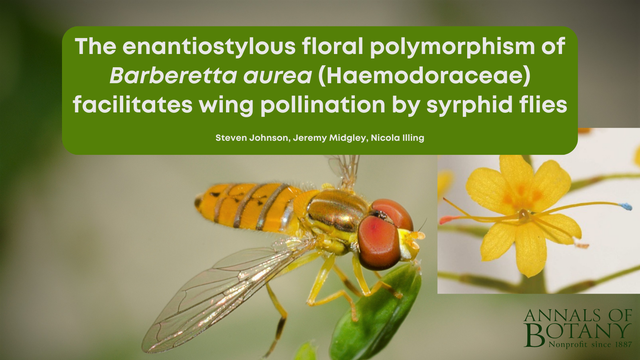
🌼🪰Check out the newly published paper ‘The enantiostylous floral polymorphism of Barberetta aurea (Haemodoraceae) facilitates wing pollination by syrphid flies’ in @AnnBot by Steven Johnson and co-authors (1/6)
👉 https://botany.fyi/hBtRdz

#AoBpapers #PlantScience

The enantiostylous floral polymorphism of Barberetta aurea (Haemodoraceae) facilitates wing pollination by syrphid flies

AbstractBackground and Aims. Sexual polymorphisms of flowers have traditionally been interpreted as devices that promote cross-pollination, but they may also re

OUP Academic
Floral polymorphisms like enantiostyly (flowers having either left- or right-deflected styles) have long been thought to promote cross-pollination, but Barberetta aurea challenges this notion. (2/6)
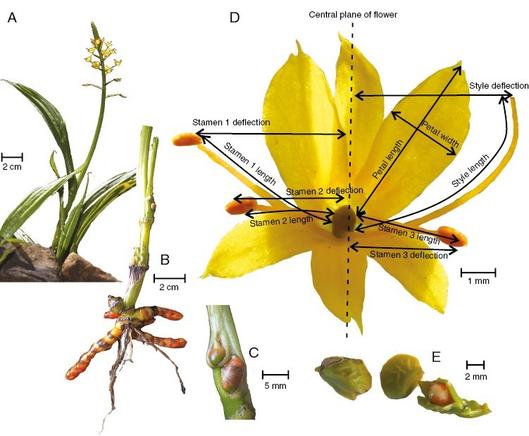
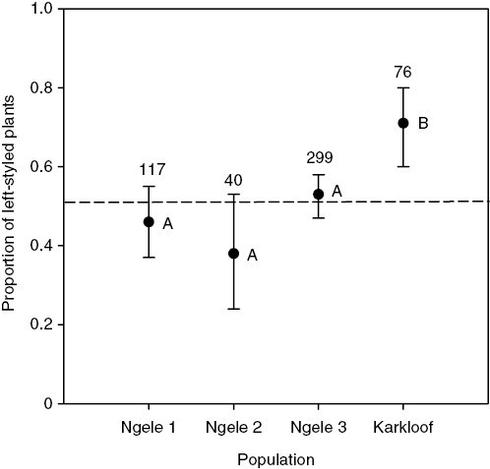
This study explores B. aurea's unique reproductive system: dimorphic enantiostyly. But what does that mean? It's all about the orientation of floral organs – left or right deflected styles. (3/6)
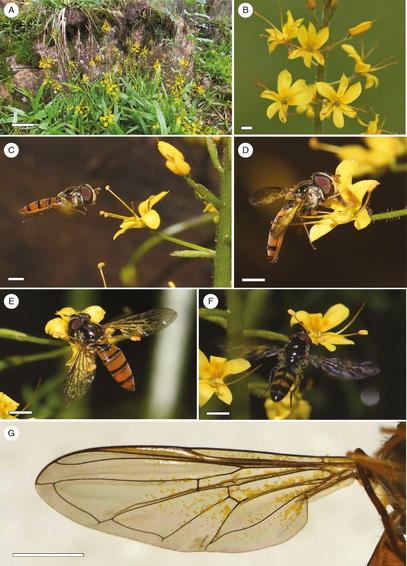
But how does B. aurea achieve pollination? While most enantiostylous species rely on bees for pollination, B. aurea has evolved to attract syrphid flies. These flies play a crucial role, transferring sticky pollen via their wings as they hover around the flower. (4/6)
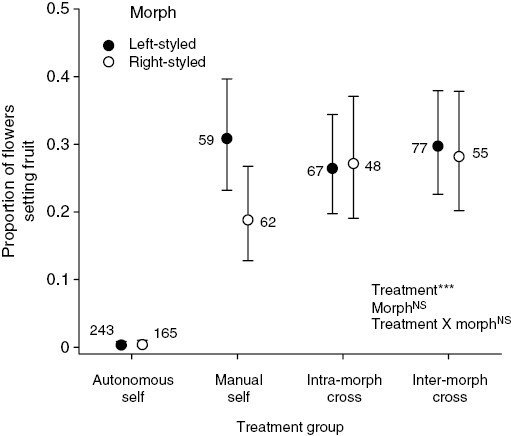
The flower's design, including the positioning of stamens and styles, facilitates both inter- and intra-morph pollen transfer. (5/6)

🌼The article suggests B. aurea showcases a remarkable adaptation, illustrating how floral polymorphisms can be finely tuned to exploit specific pollination niches. (6/6)

👉 https://botany.fyi/hBtRdz

#FloralPolymorphisms #PollinationEcology

The enantiostylous floral polymorphism of Barberetta aurea (Haemodoraceae) facilitates wing pollination by syrphid flies

AbstractBackground and Aims. Sexual polymorphisms of flowers have traditionally been interpreted as devices that promote cross-pollination, but they may also re

OUP Academic