
Last week, William Young, an 82 year old federal judge appointed by Ronald Reagan, blocked the merger of #SpiritAirlines and #Jetblue. It was a seismic event:

https://storage.courtlistener.com/recap/gov.uscourts.mad.254267/gov.uscourts.mad.254267.461.0_6.pdf

--

If you'd like an essay-formatted version of this thread to read or share, here's a link to it on pluralistic.net, my surveillance-free, ad-free, tracker-free blog:

https://pluralistic.net/2024/01/22/anything-that-cant-go-on-forever/#will-eventually-stop

1/
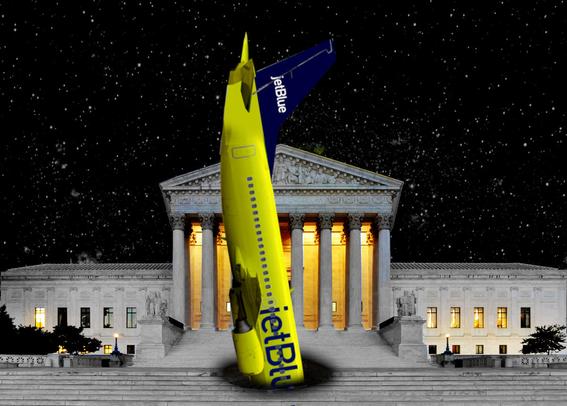
Seismic because the judge's opinion is full of rhetoric associated with the surging #antitrust revival, sneeringly dismissed by corporate apologists as "#HipsterAntitrust." Young called America's airlines and "#oligopoly," a situation he blamed on out-of-control mergers. As @matthewstoller writes, this is the first airline merger to be blocked by the DOJ and DOT since deregulation in 1978:

https://www.thebignewsletter.com/p/antitrust-enforcers-block-the-jetblue

2/

Antitrust Enforcers Block the JetBlue-Spirit Merger

For the first time, the Antitrust Division stopped an airline merger, despite wailing from executives about industry woes. That's a historic win. It's also the end of the beginning for our movement.

BIG by Matt Stoller

The judge wasn't shy about why he was reviving a pre-Jimmy Carter theory of antitrust: "[the merger] does violence to the core principle of antitrust law, 'to protect] markets –- and its market participants -- from anticompetitive harm."

The legal arguments the judge advances are fascinating and worthy of study:

https://twitter.com/johnmarknewman/status/1747343447227519122

3/

John Mark Newman (@johnmarknewman) on X

Still reading but already an interesting opinion! Will add a few thoughts below... 🔽

X (formerly Twitter)

But what really caught my eye was @ddayen's #AmericanProspect article about the judge's commentary on the state of the #aviation industry:

https://prospect.org/infrastructure/transportation/01-19-2024-how-boeing-ruined-the-jetblue-spirit-merger/

Why, after all, have Spirit and Jetblue been so ardent in pursuing mergers? Jetblue has had two failed merger attempts with Virgin, and this is the *third* time they've failed in an attempt to merge with Spirit.

4/

How Boeing Ruined the JetBlue-Spirit Merger

The judge’s ruling in the case revealed all the deficiencies in the manufacturing and distribution of commercial air travel.

The American Prospect

Spirit, meanwhile, just lost a bid to merge with Frontier. Why are these two airlines so obsessed with combining with each other or any other airline that will have them?

As Dayen explains, it's because US aviation has been consumed by monopoly, hollowed out to the point of near collapse, thanks to neoliberal policies at every part of the aviation supply-chain.

5/

For one thing, there's just not enough pilots, nor enough air-traffic controllers (recall that Reagan's first major act in office was to destroy the air traffic controller's union).

But even more importantly, there are no more planes. #Boeing's waitlist for airplane delivery stretches to *2029*. And Boeing is about to deliver a lot *fewer* planes, thanks to its disastrous corner-cutting, which grounded a vast global fleet of #737Max aircraft (again):

https://prospect.org/infrastructure/transportation/2024-01-09-boeing-737-max-financial-mindset/

6/

Boeing 737 MAX Incident a By-Product of Its Financial Mindset

The door plug that ripped off an Alaska Airlines plane only exists because of cost-cutting production techniques to facilitate cramming more passengers into the cabin.

The American Prospect

The 737 disaster(s) epitomize the problems of inbred, merger-obsessed capitalism. As #LukeGoldstein wrote, the rampant defects in Boeing's products can be traced to the decision to approve Boeing's 1997 merger with #McDonnellDouglas, a company helmed by Jack Welch proteges, notorious for cost-cutting at the expense of reliability:

https://prospect.org/infrastructure/transportation/2024-01-09-boeing-737-max-financial-mindset/

7/

Boeing 737 MAX Incident a By-Product of Its Financial Mindset

The door plug that ripped off an Alaska Airlines plane only exists because of cost-cutting production techniques to facilitate cramming more passengers into the cabin.

The American Prospect

Boeing veterans describe the merger as the victory of the bean-counters, which led to a company that chases short-term profits over safety and even the viability of its business:

https://www.airliners.net/forum/viewtopic.php?t=213075

After all, the merger turned Boeing into the single largest exporter in America, a company far too big to fail, teeing up tens of billions from Uncle Sucker, who also account for 40% of Boeing's income:

https://www.thebignewsletter.com/p/its-time-to-nationalize-and-then

8/

The US government is full of ex-Boeing execs, just as Boeing's executive row is full of ex-US federal aviation regulators. Bill Clinton's administration oversaw the creation of Boeing's monopoly in the 1990s, but it was the GOP that rescued Boeing the first time the 737 Maxes started dropping out of the sky.

9/

Boeing's biggest competitor is the state-owned #Airbus, a joint venture whose major partners are the governments of France, Spain and Germany - governments that are at least theoretically capable of thinking about the public good, not short-term profits. Boeing's largest equity stakes are held by the Vanguard Group, Vanguard Group subfiler, Newport Trust Company, and State Street Corporation:

https://prospect.org/blogs-and-newsletters/tap/2024-01-18-airbus-advantage/

10/

The Airbus Advantage

Today on TAP: Why Europe’s mixed economy produces safer planes than America’s financialized capitalism

The American Prospect

As #MattStoller says, America has an airline that the public bails out, protects, and subsidizes but has no say over. Boeing has all the costs of public ownership and none of the advantages. It's the epitome of privatized gains and socialized losses.

11/

This is Reagan's other legacy, besides the disastrous shortage of air-traffic controllers. The religious belief in deregulation - especially deregulation of antitrust enforcement - leads to a deregulated market. It leads to a market that is regulated by monopolists who secretly deliberate, behind closed board-room doors, and are accountable only to their shareholders.

12/

These private regulators are unlike government regulators, who are at least nominally bound by obligations to transparency and public accountability. But they share on thing in common with those public regulators: when they fuck up, the public has to pay for their mistakes.

13/

It's a good thing Boeing's executives are too big to fail, because they fail *constantly*. Boeing execs who are warned by subcontractors of dangerous defects in their planes order those subcontractors to lie, or lose their contracts:

https://www.levernews.com/boeing-supplier-ignored-warnings-of-excessive-amount-of-defects-former-employees-allege/

As a result of Boeing's mismanagement, America's only aircraft supplier steadily has lost ground to Airbus, which today enjoys a 2:1 advantage over Boeing.

14/

Boeing Supplier Ignored Warnings Of “Excessive Amount Of Defects,” Former Employees Allege

Weeks before Alaska Airlines’ terrifying debacle, one of the aircraft’s manufacturers was accused of systematically ignoring safety problems.

The Lever

But it's not just Boeing that's the weak link aviation. US aviation is a chain entirely composed of weak links.

Take jet engines: #PrattAndWhitney are Spirit's major engine supplier, but these engines suck as much as Boeing's fuselages. Much of Spirit's fleet is chronically grounded because the engines don't run.

15/

The reason Spirit buys its engines from those loveable goofballs at Pratt & Whitney? The Big Four airlines have bought all the engines for sale from other suppliers, leaving smaller airlines to buy their engines from fat-fingered incompetents.

This is why - as Dayen notes - smaller US airlines are so horny for intermarriage. They can't grow by adding routes, because there are no pilots.

16/

Even if they could get pilots, there'd be no slots because there are no air traffic controllers. But even if they could get pilots and slots, there are no planes, because Boeing sucks and Airbus can't make planes fast enough to supply the airlines that don't trust Boeing. And even if they could get aircraft, there are no engines because the Big Four aviation cartel cornered the market on working jet engines.

17/

Part of Jetblue and Spirit's pitch was that they hand off the routes that they'd cut after their merger to other small airlines, like Frontier and Allegiant. But Frontier and Allegiant can't service those routes: they don't have pilots, slots, planes or engines.

18/

Spirit hasn't been profitable since 2019 and is sitting on $4b in debt. Jetblue was proposing to finance its acquisition with another $3.5b in debt. The resulting airline could only be profitable by sharply cutting routes and massively raising prices, cutting 6.1m seats/year. With a debt:capital ratio of 111%, the company would have no slack and would need a bailout any time anything went wrong.

19/

Not coincidentally, the Big Four airlines *also* have debt:capital ratios of about 100-120%, and they *do* get bailouts ever time anything goes wrong.

As #WilliamMcGee reminds us, it's been 14 years since anyone's started a new US airline:

https://twitter.com/WilliamJMcGee/status/1747363491445375072

20/

William J. McGee (@WilliamJMcGee) on X

3/6 It's left us in a place that's--yes--unprecedented. As in not since the earliest days in the 1910s. We've never had so few scheduled passenger airlines or so much concentration at the top with the Big 4 oligopoly controlling 80%+. And a 14-year gap without any new-entrants.

X (formerly Twitter)

US aviation is deeply cursed. But Boeing's self-disassembling aircraft show us why we can't fix it by allowing mergers: private monopolies, shorn of the discipline of competition *and* regulation, are extraction machines that turn viable businesses into debt-wracked zombies.

This is a subject that's beautifully illustrated in Dayen's 2020 book *Monopolized*, in the chapter on #HealthCare:

https://pluralistic.net/2021/01/29/fractal-bullshit/#dayenu

21/

Pluralistic: 29 Jan 2021 – Pluralistic: Daily links from Cory Doctorow

The US health care system has been in trouble for a long time, but the current nightmare starts with the deregulation of #pharma. Pharma companies interbred with one another in a string of incestuous marriages that produced these dysfunctional behemoths that were far better at shifting research costs to governments and squeezing customers than they were at making drugs.

22/

The pharma giants gouged hospitals for their products, and in response, hospitals underwent their own cousin-fucking merger orgy, producing regional monopolies that were powerful enough to resist pharma's price-hikes. But in growing large enough to resist pharma profiteering, the hospitals also became powerful enough to screw over insurers.

23/

Insurers then drained their own gene pool by combining with one another until most of us have three or fewer insurers we can sign up with - companies that are both big enough to refuse hospital price-hikes, *and* to hike premiums on *us*.

24/

Thus monopoly begets monopoly: with health sewn up by monopolies in medical tech, drugs, pharmacy benefit managers, insurance, and hospitals, the only easy targets for goosing profits are *people*:

https://pluralistic.net/2022/01/05/hillrom/#baxter-international

This is how you get a US medical system that costs more than any other rich nation's system to operate, delivers worse outcomes than those other systems, and treats medical workers worse than any other wealthy country.

25/

Pluralistic: 05 Jan 2022 – Pluralistic: Daily links from Cory Doctorow

Now, rich people can still buy their way out of this mess, but you have to be *very* rich indeed to buy your way out of the commercial aviation system. There's a lot of 1%ers who fly commercial, and they're feeling the squeeze - and there's no way they're leasing their own jets.

#SteinsLaw holds that "anything that can't go on forever will eventually stop." America's aviation mergers - in airlines, aircraft and engines - have hollowed out the system.

26/

The powerful, brittle companies that control aviation have so much power over their workforce that they've turned air traffic controller and pilot into jobs that no one wants - and they used their bailout money to buy out the most senior staff's contracts, sending them to early retirement.

Now, I'm with the people who say that most of US aviation should be replaced with high-speed rail, but that's not why our technocrats and finance barons have gutted aviation.

27/

They did it to make a quick buck. A *lot* of quick bucks. Now the system is literally falling to pieces in midair. Now the system is literally on fire:

https://www.nytimes.com/2024/01/19/us/miami-boeing-plane-engine-fire.html

Which is how you get a Reagan appointed federal judge issuing an opinion that has me punching the air and shouting, "Yes, comrade! To the barricades!"

28/

Boeing Cargo Plane Makes Emergency Landing in Miami After ‘Engine Malfunction’

The plane, a 747 operated by Atlas Air, was forced to return to Miami International Airport shortly after takeoff on Thursday night.

The New York Times

Anything that can't go on forever will eventually stop. When the system is falling to pieces around you, ideology disintegrates like a 737 Max.

29/

I'm Kickstarting the audiobook for *The Bezzle*, sequel to *Red Team Blues*, narrated by #WilWheaton! Pre-order the audiobook and ebook, DRM free, as well as the hardcover. There's also bundles with *Red Team Blues* in ebook, audio or paperback:

http://thebezzle.org

30/