There was a guy named Maxwell,
who was born on that day, 100 years ago,
even if his birth certificate doesn't say so.
His second name was Lemuel.
Whatever — everybody calls him Max.
Let's embark for a 100 days celebration
with Max Roach, here on Mastodon.
You know what to do? — Follow the hashtag…

#Jazz #MaxRoach100

1. Today's tune is a solo tune, recorded 1965, from the album Drums Unlimited.
This tracks actually opens the album — The Drum Also Waltzes.

Yes, it's a waltz, and yes, it's music, and yes, it's drums!

The melody starts very simply, with a waltz groove sustained by Roach's hi-hat that plays regularly on the second beat of each 3/4 bar. Tension grows to a dense part, and the music goes back to the initial theme.

https://www.youtube.com/watch?v=_AS71j5nysw

#Jazz #MaxRoach100 #PouetRadio

The Drum Also Waltzes

YouTube

In case you wish to review all episodes at once, everything will be gathered there:

https://webusers.imj-prg.fr/~antoine.chambert-loir/Musique/MaxRoach100.html

#Jazz #MaxRoach100

Max Roach’s 100

2. Daahoud

Born in 1924, Max Roach was already an accomplished musician when he founded, in 1954, a remarkable quintet with Clifford Brown on trumpet, Harold Land on tenor sax, Richie Powell on piano and George Morrow on bass. The sound of this quintet, the music they would play, is characteristic of the then beginning hard-bop style — combining the velocity of the bebop with a fuller sound and more sophisticated arrangements. (Another important hard bop quintet would be that of Art Blakey — another drummer ! — and his Jazz messengers.)

Their first recording features tunes by notable composers, but we owe three of them to Brown. The one I chose for today, Daahoud, has a slightly unusual form. The melody starts in anticipation by a full bar, while the musicians only play one full note on the first bar. This unbalance is kept during the full AABA form, an 8 bar motive in Eb which is repeated twice, another 8 bar motive that modulates in Bb, which leads to the initial 8 bar motive. That classic pattern is then enriched by an element of surprise by the addition of 4 bar bridge in repeated II-V-I. Choruses follow: trumpet, piano, saxophone, and drums, and the musicians end the tune by replaying the melody, 3 bars at the drums, and a finale.

https://www.youtube.com/watch?v=lv4EarQxGMo

#Jazz #MaxRoach100 #PouetRadio

Clifford Brown & Max Roach Quintet - Daahoud

YouTube

3. St Thomas

In 1955, one year after Max Roach and Clifford Brown started their quintet, the saxophone player Harold Land left the band to settle in California; he was then replaced by Sonny Rollins. In 1956, Sonny Rollins led a quartet session with Tommy Flanagan on piano, Doug Watkins on bass and Max Roach on drums — Saxophone Colossus.

The song that opens the recording is a calypso, a caribbean rhythm, which energizes all musicians. Listen how Roach opens the tune by setting the groove up using the hi-hat cymbal (on beats 2 and 4), plus the clave and occasional rhythmic ornements, on which the Rollins can lay down his melody in a quite relaxed way. Follows a long saxophone chorus and which ends abruptly, and Roach takes a wonderful chorus sometimes reminiscing of the melody (on the cymbal, in particular) never abandoning the basic pulse. A second chorus, shorter, on saxophone, another one on the piano, a last exposition of the melody, and that's it!

https://www.youtube.com/watch?v=fdakJqKPRDE

#Jazz #MaxRoach100 #PouetRadio

Sonny Rollins - St. Thomas (Official Audio)

YouTube

4. Jordu

Let's go back to Max Roach/Clifford Brown's quintet and listen to another tune of that fantastic recording. This tune, Jordu, had been composed in 1953 by the pianist Duke Jordan, and although he recorded it in 1954, the interpretation of the Brown/Roach quintet still remains a reference.
The AABA melody is exposed with immense suavity, with more emphasis in the B part. (Jordan's versions, at least for the ones I know, are played faster, and flatter.)

There's something interesting to notice in the way Roach accompanies the melody: there's two ways to emphasize the melody when you are a drummer: you can play with it, or you can announce it, and Roach offers these two options.

After choruses by Brown, Land and Powell, the musicians start trading fours with Max Roach, until the drummer embarks in a full fledged solo, and expose the melody one more time.

https://www.youtube.com/watch?v=GslhRUBgXNI

#Jazz #MaxRoach100 #PouetRadio

Clifford Brown & Max Roach - Jordu

YouTube

5. Godchild

I started this series in 1966 and went back to 1954 and the great Clifford Brown/Max Roach quintet, and already mentioned that at that time, Max Roach was already a prominent musician. We'll eventually listen to Roach's debuts as we know them, in particular when he played with Charlie Parker, but for today I decided to settle to a recording Roach did as a sideman, in Miles Davis's Birth of the cool nonet.
That was 1949, and for Miles, now's was the time to overtake bebop and inventing the “cool” movement.

It's hard to tell what's really “cool” in this music, part of which is played really fast (go listen to “Move”, for example) but compared to classic bebop, it features a more mellow sound, with richer 2 or 3-voice arrangements, in particular in the middle or below of improvised parts.

Today's theme, Godchild, was composed by baritone saxophone player Gerry Mulligan. Max Roach plays brushes during the initial exposition and takes his sticks afterwards where he plays a simple and effective grooves with some accents on the floor tom. It's what I needed tonight — I hope you'll enjoy it!

https://www.youtube.com/watch?v=rj0W39jVJg8

#Jazz #MaxRoach100 #PouetRadio

Godchild (Remastered)

YouTube

6. You go to my head

Recorded live in 1954, this version features Dinah Washington on vocals, accompanied by Brown/Roach's quintet and a few other musicians. Dinah Washington starts by singing the song almost without any accompaniment, just the piano playing some notes, and without any rhythmic feel. At some point, the rhythm section comes in and provides an afro-cuban atmosphere to the tune. A few choruses, played with a straight jazz feel, come after that, until Dinah Washington retakes the song, back to the afro-cuban feel.
All these atmosphere sound a bit strange on a single recorded track — after all, the album is called Dinah Jams ! — but the audience seems to have enjoyed this moment.

https://www.youtube.com/watch?v=6fNm4v1vuVY

#Jazz #MaxRoach100 #PouetRadio

Dinah Washington & Clifford Brown - 1954 - Dinah Jams - 06 You Go to My Head

YouTube

7. Chi-Chi

In 1945-1949, Max Roach had been a prominent bebop drummer, a jazz style he contributed to shape.
Indeed, together with Kenny Clarke, he found a new way of keeping time by using the ride cymbal to play the classic syncopated rhythm figure [ding - ding-ah - ding - ding-ah] (which can be played in triplets, in 8th notes, or even in quadruplets, according to the tempo and mood), and reserved the bass drum (which was very loud) for accents (“bombs”). That left more place in the music to the soloists for improvising.

Charlie Parker composed this tune for Max Roach's first recording session as a leader (with Hank Mobley on saxophone, April 1953). Together with Percy Heath on bass and Al Haig on piano, they recorded the following version in July 1953.

https://www.youtube.com/watch?v=M_itwVFHQYY

#Jazz #MaxRoach100 #PouetRadio

Chi Chi-Charlie Parker.

YouTube

8. Living My Life

10 years before yesterday's recording, Max Roach was already leading the bebop scene and recorded with all the great.

Today's song is a Don Byas composition, Living My Life, taken from an album led by Don Byas — Savoy Jam Party — made from 4 recording sessions from 1944 to 1946 in which he shares the drums with 3 other drummers I had never heard of. I want to share two songs of that recording with you, because the way Roach accompanies them is strikingly different.

Living My Life (*) is a kind of slow drag, AABA form, at a moderate tempo (approx 120 bpm), in AABA form where the saxophonist takes all the light: he exposes the theme, takes one chorus, leaves some space to the piano for 8 bars and takes back the melody to conclude. Roach's accompaniment is very minimal : he plays quarter notes on the snare drum all along, probably playing sort of flas with brushes — that allows him to create a longer sound — but nothing more.

I had explained a few days ago how Max Roach and Kenny Clarke had helped create bebop by switching the beat from the snare drum to the ride cymbal. Here, you have a great example, recorded in August 1946, of what hadn't happened yet!

https://www.youtube.com/watch?v=fiJ5wEFHRLE

(*) Of course, it's also the title of Emma Goldman's autobiography, but that's an entirely different story…

#Jazz #MaxRoach100 #PouetRadio

Living My Life

YouTube

9. St Louis Blues

Yesterday, we had listened to a 1946 recording by Don Byas in which Max Roach played in a pre-bebop way, marking all beats on the snare drum. Today's tune comes from the same recording, but we can hear that something has changed.

First of all, St Louis Blues is an extremly famous W.C. Handy composition from 1914, it is the first ragtime tune to have been published in score, and some even say it's the most recorded song in the first half of 20th century. Moreover, although this song is called St Louis *Blues* and W.C. Handy himself codified the blues form as a 12 bar form, that song does not obey this for. In fact, part of it is explicitly an afro-cuban rhythm — that of an habañera.

In this version, with Max Roach on drums, you can get the afro-cuban in the first part of the theme: Max Roach plays 16th notes on the rim of the snare drums, and the accents he gives suggest the habañera, as if it were a clave on woodblock. But on the second part and in the choruses, you can hear the jazz feel on the ride cymbal.

One day, we'll listen to yet another version of that song that Max Roach recorded in 1965, this time played as a jazz waltz!

https://www.youtube.com/watch?v=VBsQkhnwyIY

#Jazz #MaxRoach100 #PouetRadio

St. Louis Blues

YouTube

10. I Don't Stand A Ghost Of A Chance With You

A sweet and kind melody for tonight. The times they are changin', and not for the best.
Clifford Brown plays this ballad softly, with a lot of kindness — and it's wonderful…
And at 2:25, you find some energy to swing a little bit, for not for too long. It's already late, my friends. The day has been long, probably exhausting, or maybe that was the day before, and is there hope in everything that we have to endure. The piano will let you fall asleep, maybe, but no, that's not the time yet, and you need that energy from the trumpet at 6:00 to sing that song again, that there is so little hope, but that you are still there, alive, for the best.
Good night, friends.

https://www.youtube.com/watch?v=Nx4-Vm13uJ4

#Jazz #MaxRoach100 #PouetRadio

I Don't Stand A Ghost Of A Chance With You

YouTube

11. Blues Changes

Back to the bebop period, where Max Roach serves as a sideman.
Ellis Larkin is playing a stride blues on the piano, and Max Roaches draws a brushes tapestry beneath him. Then comes the guitar of Jimmy Shirley, followed by a bass chorus by Oscar Petitford.
At 2:25, after some short questions and answer between piano and drums, we can finally hear the boss, Coleman Hawkins on tenor saxophone.
This happened in New York City, 18 December 1943 — Max Roach's first recording!

https://www.youtube.com/watch?v=MzBdxfr0XOc

#Jazz #MaxRoach100 #PouetRadio

Coleman Hawkins Quintet - Blues Changes

YouTube

12. Dexter Digs In

Another bebop tune with Max Roach as a drummer — I need to spend some time listening to those tunes before returning to 1955. So this song comes from Dexter Gordon's first album, *Dexter Rides Again*, which is assembled from three recording sessions in 1945 and 1946.
That one dates from January 1946, besides Gordon on tenor saxophone and Roach on drums, you can hear Leonard Hawkins on trumpet, Bud Powell on piano and Curly Russell on bass.
Due to the recording medium — 78 rpm vinyl disks — the song needed to be short: barely 3 minutes, but 3 minutes full of energy pushed forward by this unmistakable riff.

https://www.youtube.com/watch?v=Jaef3QYlSg4

#Jazz #MaxRoach100 #PouetRadio

Dexter Digs In

YouTube

13. Opus de Bop

1946 again, Max Roach holds the drums for saxophonist Stan Getz ; Curley Russell is on bass (as for yesterday) and Hank Jones on piano and at the composition for this fierce tune.
On the 10" 78 RPM, the musicians are presented as “The Be Bop Boys featuring Stan Getz Tenor Sax”.
On that 31 July 1946, New York City was really hot!

https://www.youtube.com/watch?v=WyrRE_Ry9KE

#Jazz #MaxRoach100 #PouetRadio

Opus De Bop

YouTube

14. Hot House

Max Roach had played with Charlie Parker as early as 1945, but that recording is taken from a legendary concert in Toronto, Canada, on May 15, 1953 — Live at Massey Hall, there were Charlie Parker on tenor saxophone, Dizzy Gillespie on trumpet, Bud Powell on piano, Charles Mingus on bass, and of course Max Roach on drums.

This Tadd Dameron composition is pure bop — a very simple melody, almost just a riff repeated following a chromatic descent (IV-V-1) which serves as a pretext for improvisations. Many jokes in the solos — listen how Parker quotes Carmen, and Gillespie responds with Do nothing till you hear from me?

It's interesting to listen to Roach's playing too: after a 4-bar improvisation, he mostly plays a swing rhythm on the ride cymbal during the exposition of the theme (goes to the hi-hat for the B-part), with accents on the snare and floor drums, some parts with an afro-cuban feel, but brushes on Mingus's solo, until everybody rejoins (rejoices) for the theme.
Everyone in this legendary band swings like hell, the audience is on fire. I hope you're all well!

https://www.youtube.com/watch?v=GbEM3eJ5Isk

#Jazz #MaxRoach100 #PouetRadio

Hot House

YouTube

15. When lights are low

Still in my chronological discovery of Max Roach's be bop era, mostly as a side man, and this time within a quartet led by Miles Davis on trumpet. Percy Heath is on bass and John Lewis on piano.
The theme is a melancholic ballad, composed in 1936 by Benny Carter and Spencer Williams.
After a small introduction on the piano, the trumpet takes the lead and plays the melody, with a minimalist accompaniment from which the musicians won't depart, even during the very short piano chorus where John Lewis, to say the least, doesn't try to show his virtuosity.

That recording is from Miles Davis's album Blue Haze, where the trumpet player experiments various quartets (Kenny Clarke and Art Blakey also take the drums, Horace Silver on piano, and Charles Mingus as well!) recorded in 1953 (as for that sone) and 1954.

It's late, friends,
lights are low in the club,
it's raining outside, or your flat may be empty and cold
let's indulge ourselves one more tune…

https://youtu.be/E15RCBrH8rc

#Jazz #MaxRoach100 #PouetRadio

When Lights Are Low (feat. Max Roach, John Lewis, Percy Heath)

YouTube

16. Ondine (for @titedino78 )

Here is Oscar Pettiford's sextet playing compositions by the critic and music journalist Leonard Feather, who, as one can hear, was also a fine composer. (With Mingus, he arranged poems of Langston Hughes.)

Together with Roach on drums and Pettiford on bass, there is Kai Winding is on trombone, Al Cohn on tenor saxophone, Tal Farlow on guitar, Henri Renaud on piano. This is a short piece anyway — after the melody where the sextet plays a nice arrangement, you got solos by Cohn, Winding, Farlow, Renaud, and Pettiford, and it's time to play the melody and conclude.

https://www.youtube.com/watch?v=7I3Ui1GxgWk

#Jazz #MaxRoach100 #PouetRadio

Ondine

YouTube

17. Just One of Those Things

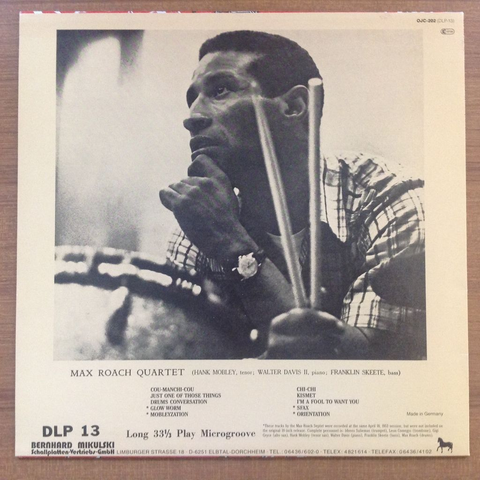
1953. Time for Max Roach to start his own band, as a leader. Hank Mobley is on tenor saxophone, Walter Davis Jr on piano, and Franklin Skeete holds the bass. Just One of Those Things is a Cole Porter composition, a true standard according to the definition of a standard, since this song was part of a musical — Jubilee. The initial composition was labeled as a foxtrot, and played at moderate tempo — 120bpm — it seems vocal versions keep that tempo.

Having a bebop band with no singer allows to play it faster, although you can't feel that upcoming speed at Roach's short intro, which plays quite freely on the cymbal and the toms. The last two short notes on the bass drum send the start signal — and they are quarter notes, so that the tempo is roughly 200bpm.
The melody is played by Mobley on saxophone — Roach essentially plays 8th notes on the ride (with almost no swing in it) and some accents on the bass drum. After the melody, the saxophone starts a riff that seems to mean he's going to chorus, but no! Roach takes the lead for a very fast drum chorus where he doubles the tempo, playing all quarter notes on hi-hat and 8th notes on the bass drums. That marks a strong and fast pulse above which he plays rudiments on the snare drum. Only then can Mobley, and then Davis, do their own solos, until Mobley redoes the melody and Roach concludes with a small drum finale.

https://www.youtube.com/watch?v=6L7tkwfzQUM

#Jazz #MaxRoach100 #PouetRadio

Just One of Those Things (feat. Hank Mobley)

YouTube

18. Parisian Thoroughfare

Max Roach and Clifford Brown with their quintet play this astonishing composition.
Listen to the long intro, where the horns imitate the busy city of Paris, reminiscing of Gershwin's American in Paris, and then, when the melody starts, how the piano fills the end of the first 8 bars with hints of the Marseillaise or, for the next one, of the classic French cancan. They're having fun, and play this fast tune with both energy and lightness.
George Morrow is on piano, Harold Land on tenor sax and Richie Powell on bass. Enjoy!

https://youtu.be/dLk9Ur2j0_8

#MaxRoach100 #Jazz #PouetRadio

Clifford Brown & Max Roach - 1955 - 02 Parisian Thoroughfare

YouTube

19. Cherokee

We continue our exploration of the Max Roach / Clifford Brown quintet.

A 1938 Ray Noble composition, from his Indian Suite (in 5 parts, all bearing the name of an Indian tribe), it didn't become part of the jazz canon until Charlie Parker proved that it was possible to improvise on it. It is also very fast, 240bpm, — and if, by listening to the melody, you think it isn't that fast, it is because the melody is written in full notes. It is from the drums that you hear the pulse that the musicians have to internalize to play that song, especially in the choruses. Also, the bridge is written as a II-V-I progression, hence its tonality changes every second… you can get how tough it is to improvise on it!

Here, all musicians expose their virtuosity, without losing on musicality… The first drum chorus is probably hard to follow, but you get a second chance when the musicians replay the melody, because Roach takes a new chorus on the bridge part.

A great version !

https://youtu.be/M283JFxesic
#MaxRoach100 #Jazz #PouetRadio

Clifford Brown - Cherokee

YouTube

20. What is this thing called love?

A 1929 song by Cole Porter, it turned into a wonderful jazz standard that allows the creativity of musicians to expand in unforeseen directions. Despite what the title of this album may suggest, it was not recorded “At Basin Street”, New Orleans, but in New York City's studios of the Capitol company, February 1956.
It features once again the Clifford Brown / Max Roach quintet, except that Harold Land left the band to live in California, to be replaced by Sonny Rollins! George Morrow is on bass, Richie Powell on piano, and these five guys embark in a fast-paced rendition of that tune.

After a long intro on a single chord, the theme starts on the trumpet, and the saxophone answers for the bridge, and we're set for a succession of choruses propelled by Roach's drumming : Brown, Rollins (who takes his time, starting with a 2-note motive he will repeat several time, recall at various places, and end with it), Powell, Morrow (with an interesting counterpoint by Roach and Powell), then a long riff passage that launches Roach's chorus, at 5:00 on. Here, we have an extremely dense playing with the sticks, with accents on the hi-hat and cymbals — Note how Roach departs from the standard way of playing the hi-hat: it is no more played regularly on beats 2 and 4, as a pulse keeper, but as an autonomous melodical instrument, to which the other cymbals respond. Time for a 2-voice chorus on trumpet/saxophone, 8 bar each, then 4 bar, to finish by playing a melody at unison. The song ends like it started, on a pedal point.

https://www.youtube.com/watch?v=JTWRZkoLGx8

#PouetRadio #Jazz #MaxRoach100
What Is This Thing Called Love

YouTube

21. Valse Hot

At the same time where the quintet of Max Roach and Clifford Brown was emerging as a new force in jazz, Max Roach served as a side man in various bands. Tonight's recording is exactly that quintet, but for the leader since it is now Sonny Rollins who leads the band.

The song, Valse Hot, is a composition of Sonny Rollins, but Max Roach will later record it again. You can hear in that version, already in 1955, with how much ease he can bring a jazz feel to the waltz rhythm. One of the key of his playing is understating the third beat: instead of playing boom-tcheek-tcheek, boom-tcheek-tcheek…, he plays boom-tcheek-(hush), boom-tcheek-(hush)… and that makes a tremendous difference.

https://www.youtube.com/watch?v=SIVtK2gXLpk

#PouetRadio #Jazz #MaxRoach100

Sonny Rollins + 4 - Valse Hot

YouTube

22. These foolish things (for @jaztrophysicist )

“These foolish things remind me of you
How strange how sweet to find you still”

A beautiful and tender ballad for tonight. Because we deserve this quietness, this calm, be it for three minutes only. George Morrow sings the melody at the bass with a little harmonic support of the Richie Powell's piano and consistent brushes by Max Roach. A vague attempt to swing during the bass chorus, but we're back to the sound of brushes. No horns, no effects, nothing but nostalgia.

“These things are dear to me
They seem to bring you near to me”

https://www.youtube.com/watch?v=xK7u3_TtsBc

#PouetRadio #Jazz #MaxRoach100

These Foolish Things

YouTube

23. Drums

Back to 1955 again when, together with his own quintet with Clifford Brown, Max Roach served as a side man for various bands.
Today, the leader of the band is Charles Mingus on bass, with Eddie Bert on trombone, George Barrow on saxophone and Mal Waldron on piano. And Max Roach is not a side man, he's a guest! (The usual drummer of Mingus's band is Willie Jones).
So Max Roach appears on two tracks of that live album (recorded at Café Bohemia, New York, December 23, 1955), and this song, Drums, of which both Mingus and Roach are credited as composers, puts him in front of the scene.

https://www.youtube.com/watch?v=ZU9Y0NG2284

#PouetRadio #Jazz #MaxRoach100

Drums (Live)

YouTube

24. Rose Room

For his second album as a leader, Julian “Cannonball” Adderley gathered an octet in August 1955, with arrangements by Quincy Jones. On three tracks, Max Roach is on drums — it's Kenny Clarke on the other ones.

Tonight was the first time I heard this song, Rose room, a 1917 composition by Hickman and Williams, which was famous in the swing era, and Jones's arrangement definitely do justice to the spirit of swing.
Apparently, Ellington revived the song in 1932, and “borrowed” its chord progression to compose “In a mellowtone”. Max Roach gives a great background here, with a light but directive style most of the time, and uses the silences at the end of the musical phrases for bebop-style interventions that relaunch the music (can you get them in the exposition of the theme)? There is also a nice trading in fours between Adderley and Roach at the end of the song (Roach doubles the tempo there, so it sounds as if they play 8 bar each).

https://www.youtube.com/watch?v=e3GHS9PP8RA

#PouetRadio #Jazz #MaxRoach100

Rose Room

YouTube

25. Blue Seven

22 June 1956. Sonny Rollins enters the van Gelder studios at Hackensack to record a somptuous album, with Doug Watkins on bass, Tommy Flanagan on piano and Max Roach on drums. Five exceptional songs.
We already listened to St Thomas. Tonight is Blue Seven, a composition of Sonny Rollins that alternates between calm are dense phrases, a structure that allow the saxophonist to build a great chorus. Max Roach himself takes the opportunity of this medium tempo to offer us a drum solo based on the melody. That's something which may be hard to grasp when you listen to the recording, but in an episode of the Black and Blue radio show devoted to Roach, the drummer and music educator Georges Paczynski made the experiment of playing the chords on the piano during the whole drum chorus — and then, suddenly, one realizes what the drummer was really doing : rather than showing off his dexterity, he was actually giving his own interpretation of the melody. The saxophonist takes back the lead, proposes a second version of the melody, offers a new chorus, and then engages in a discussion with the drummer by trading fours with him.

https://www.youtube.com/watch?v=59aXJ8GvMYE

#PouetRadio #Jazz #MaxRoach100

Sonny Rollins - Blue 7

YouTube

Here is a link to the Black and Blue radio show by Alain Gerber and Georges Paczynski, “À la manière de Max Roach”, where Paczynski demonstrates Roach's melodic technique.

I should also add that Paczynski is the author of a great 3-volume history of jazz drumming (Une histoire de la batterie jazz, Outre Mesure, 1998-2005). He devotes a chapter of his volume 2 to the innovations by Kenny Clarke and Max Roach. It is also there that he gives details about Roach's chorus on Blue Seven — Roach starts at bar 5, after something that looks like Rollins wanted to trade fours. But Rollins doesn't play again on bar 9, so Roach goes on, completes the 12 bar theme, and goes on for 5 or 6 more choruses. Paczynski also explains how he understood, by playing the chords on the piano while he was listening to that chorus, that Roach was basing his chorus on the harmonic changes of the song.

https://youtu.be/H-ZVCmrwLHQ

À la manière de Max Roach

YouTube

26. Nice And Easy

Still floating around spring 1956, this time introducing Johnny Griffin, on tenor saxophone, with Wynton Kelly on piano, and Curly Russell on bass. This blues (a 12 bar form) composed by Griffin is based on the repetition of quite a simple looking riff and serves as a pretext for all musicians to show their musicality, without too much virtuosity. No chorus for Roach, but some of his interventions are interesting, especially during the piano chorus, and at the end of the bass chorus, before Griffin retakes the melody. Nice and easy. So it seems, at least.

https://www.youtube.com/watch?v=8d4GdKjTEpY

#PouetRadio #Jazz #MaxRoach100

Nice And Easy (Remastered 2006/Rudy Van Gelder Edition)

YouTube

27. Powell's Prances

1956, Clifford Brown / Max Roach quintet, with Sonny Rollins on saxophone, George Morrow on bass and Richie Powell on piano. It comes from the album *At Basin Street*, which features three compositions by the pianist. Tonight's track is one of them, a very fast hard bop piece where all musicians show their dexterity, from the exposition of the theme which Brown and Rollins play together (it is possible that Rollins plays a fifth lower), to the choruses which run as fast as possible, the one after the other. (Listen how strong the rhythm section plays behind the soloists!) With a bit of a paradox, it becomes quieter for the piano chorus, but that's only for a moment. Roach's chorus is very dense as well, and one needs to step back a little to listen to its melodic inspiration. Back to the theme, and it's time to conclude this short and fast piece.

https://www.youtube.com/watch?v=q3o9SdL651g

#PouetRadio #Jazz #MaxRoach100

Powell's Prances

YouTube

28. Time

Same album as yesterday, Clifford Brown / Max Roach At Basin Street.
Same composer, Richie Powell.
Completely different mood, though.

A calm ballad.
The song of a trumpet that pulls away the tears out of our sadness.
Have a good night.

https://www.youtube.com/watch?v=ELC7LPC9O4E

#PouetRadio #Jazz #MaxRoach100

Time

YouTube

29. Smoke Gets Into Your Eyes

Max Roach and Clifford Brown with strings. Arrangements by Neal Hefty. Recorded January 1955.
It's so sweet we want it to go on forever. But we can't.

Some people know the story already, but some don't, and I know it, and I can't manage to tell it right.
There are things that make you sad. It's about the passing of time, about people who go, and those tears, they're not caused by the smoke in the jazz club.

https://www.youtube.com/watch?v=xlXvYpxrtTI

#PouetRadio #Jazz #MaxRoach100

Smoke Gets in Your Eyes / Clifford Brown with Strings

YouTube

30. Memories of You

25 June 1956. Clifford Brown and Richie Powell play at a jam session in Philadelphia, with local musicians. The night is supposed to have been memorable. Then they take their car towards Chicago, where they had to play with the quintet. The musicians need to rest, and Nancy Powell, Richie Powell's wife, drives. Alas, under a heavy rain, we suppose she lost control of the car which crashed of the road. All three died in the accident.

Nancy Powell was 19; Clifford Brown, 25; and Richie Powell, 24.

All we have, now, is “Memories of You”.

https://www.youtube.com/watch?v=jtIF8sid3Sw

#PouetRadio #Jazz #MaxRoach100

Clifford Brown - 1955 - With Strings - 08 Memories Of You

YouTube

31. I Remember Clifford

In 1957, the saxophone player Benny Golson composed a song to the memory of Clifford Brown — “I remember Clifford”. There is an awsome version of it by Art Blakey's Jazz messengers (with Golson on saxophone), recorded at Paris Olympia in 1958.

The present version seems to be the only one which Max Roach recorded. That was in 1981, in the album *Chattahoochee Red*. But what I hear from this version is that 25 years later, Max Roach's wound hadn't healed.

Cecil Bridgewater is on trumpet, Odean Pope on saxophone, Calvin Hill on bass.

https://www.youtube.com/watch?v=pLTsBXzjTzE

#PouetRadio
#Jazz
#MaxRoach100

Max Roach Quartet - I Remember Clifford

YouTube
@antoinechambertloir I play-along this tune a lot, trying to be as brilliant as Miles. long way to go of course 🎺