I think this, a discussion of the parallels between "AI" and "crypto", is a good take. I want to dig into the bit on "AI" being different because it has practical use.

"AI" is a marketing term. There's the stuff that was mainly called "ML" up until 2021 or so, which definitely has practical uses. E.g., if you're running a social network and need to help humans find the toxic stuff, ML can help.

But in the last few years there's a wave of hype mainly around the large language models, LLMs, and the large text-to-image models. So things like ChatGPT and DALL-E. It's really not clear to me those have much more practical use than crypto. Certainly not over their costs. 1/

https://sfba.social/@[email protected]ial/111754701923644674

Jesse Baer 🔥 (@[email protected])

People like to say that "AI" is different from crypto in that there are actual useful applications, and that's true. But the vast majority of people you're expecting to come up with those applications are the same people who were just trying to build products on the blockchain.

Mastodon

Just to be sure I'm not being unfair, I searched for writeups of LLM uses. Here's a representative example of the genre: https://www.techopedia.com/12-practical-large-language-model-llm-applications

They mention 12 use cases. Some are done better with simpler, cheaper models or non-ML techniques (1, 4, 6, 8, 12). Some are wildly speculative (2, 9, 10).

But that leaves 4 items that I want look at carefully: content creation, customer support, sales automation, and writing code. Those are at least superficially plausible places where LLMs and large image models could have practical uses.

2/

First, though an important philosophical point: LLMs are fancy autocomplete. You give them a set of words, they'll predict the next word based on the enormous corpuses they've been trained on. This can give them the appearance of sentience. People will talk as if they "understand" things. They don't. It's the million-monkeys-with-typewriters thing, but the monkeys have seen enough English text that the next word is statistically consistent with the previous words.

Humans are subject to to pareidolia, and we really like to anthropomorphize things. It's not just thunder, it's a guy with a name and a look and a personality and a whole family. It's not just a bit of winter where we celebrate with our dearest; it's a fat guy in a red suit with specific facial hair. So although the text can feel human, we'll have to work hard to think of ChatGPT as a bit of unfeeling machinery, not our plastic pal who's fun to be with.

3/

Ok, so first, content creation. That seems positive, right? Wrong! The best way I've seen of explaining this: "Why should I take the time to read something nobody took the time to write?"

I think this one is a huge net societal negative. The people out there who want instant "content" are almost entirely not readers. They're people who want something to run ads against. They're people who want the credit for writing without doing the work. They're people who want to sell you something without understanding the something or whether or not it might be good for you. In short, they're people with various levels of contempt for their readers.

4/

As a writer, I think the real value of writing is the thinking and care that goes into it. Even for purely factual material, writing involves a careful search for truth.

LLMs, though, don't have any concept of "true". They can't. What they have is the digested correspondence between words in Wikipedia and Reddit and a zillion other sources of text. Truth can be represented in text, but it lies outside of it.

In philosopher Harry Frankfurt's "On Bullshit", he defines it as "speech intended to persuade without regard for truth": https://en.wikipedia.org/wiki/On_Bullshit

Marketing content generated by LLMs is clearly bullshit. But I'd argue that by imitating human forms of writing, *everything* produced by an LLM is bullshit. (Which would make the enormous "AI" hype cycle bullshit about bullshit, a truly American accomplishment.)

5/

On Bullshit - Wikipedia

Let's turn to the second plausible use case: customer support. People often like to talk to other people to resolve problems. What if we can automate the *feeling* of talking to a person, but with no actual people involved?

There are a bunch of things going on here. At least here, there's a real user need. But to what extent is it a real user solution?

It's plausible to me here that this will be a plausible first-query solution once you've built up a good base of Q&A examples for it, doing a bit of textual generalization. At least as long as what you're doing is pretty standard. But remember that we're using a bullshit engine here, so what happens when the statistically plausible text isn't correct or useful?

6/

A good example here is the car dealership that tried using a ChatGPT bot for customer service. It quickly agreed to a "legally binding" offer to sell cars for $1: https://venturebeat.com/ai/a-chevy-for-1-car-dealer-chatbots-show-perils-of-ai-for-customer-service/

Would any human agent do this? No. Because humans understand things. This is a toy example, but if GPT-ish things don't work for very basic cases, how much can we rely on them for important cases?

7/

A Chevy for $1? Car dealer chatbots show perils of AI for customer service

Incidents at car dealers highlight the responsibility of ensuring target chatbot deployment and safety compliance. 

VentureBeat

Moreover, I think there's a deeper problem here. Anybody who's ever tried to use large-company customer service (and I'm thinking of Amazon here) might say, "well a chatbot couldn't do much worse; it's not like talking to a person right now."

There's a really handy concept called "failure demand". Some load on a system is "value demand". E.g., I walk up to the counter in the local store and say, "I'd like a quart of milk." But if have to come back later because they're out of milk or the milk was spoiled, that's "failure demand".

For digital products, I'd argue most customer service demand is failure demand. So generally we shouldn't be putting ChatGPT in to tell people how to solve their problem, we should giving them good experiences in the first place. Chat's a bandaid.

And bad customer service generates even more failure demand. So ChatGPT might lower costs, but it won't solve the root problems or on net improve things for customers.

8/

Ok, what's next? Right, "sales automation". This is a bit of a mix of the first two cases. "Sales" is a little bit customer support, and a lot of manipulation to get people to buy things. Setting aside the possible minor customer-support improvements, I think we're mostly back at content generation with contempt for the reader.

One thing people have a hard time grasping is how much our economy spends on manipulating people to get money out of them. Advertising alone is hundreds of billions. Sales is surely at least that much. And then there's all the time lost to fending off the manipulation, plus the money lost when people fall for it. On the order of magnitude of the defense budget or all K-12 spending for sure.

So a bullshit machine might be a good fit, but is this a hole we really need to dig deeper?

9/

And lastly, we have writing code.

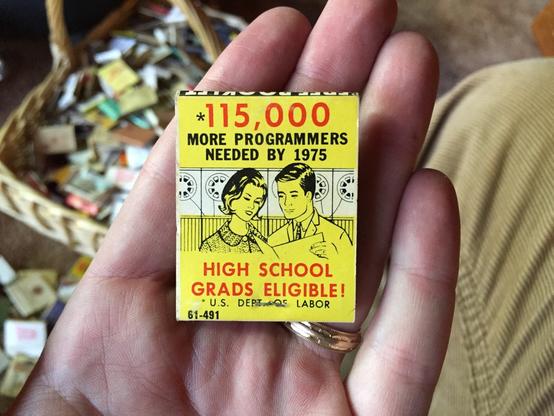
I've been writing code since I was 12. I started writing code for money at 18. And my dad started making his living as a programmer in the 1960s. And this all has a familiar ring to me.

As a young teen, so maybe 1982, I went to my first tech conference. Walking the exhibit floor, I found somebody selling a system that promised to eliminate expensive programmers by letting the business people just write in plain English.

It's an old dream, and one I've seen come up many times. Visual programming systems. Code wizards. Model-Driven Architecture. Probably many waves I've missed.

10/

Of course, we also have the dream appearing regularly in science fiction. HAL 9000 is from 1968, and was set in 2001. You can just tell the computer what to do, and off it goes, understanding your needs.

I should say that this is a lovely dream. And it can be a great inspiration as we get machines and computers to do the drudgery. But as with all powerful dreams, we have to be careful to be realistic.

11/

When people expect "AI" to do the coding, I think they're not paying much attention to what the hard parts of software development really are.

The computer I'm typing on is at least a million times better than where I started. A million times faster, a million times bigger. So much of the work I did then has been automated. But the job hasn't gotten easier, it's just a different kind of hard. Instead of me hacking away solo in my dad's basement, I now am trying to collaboratively build lasting, coherent intellectual works directly with my team and in concert with thousands of other people via libraries, services, and the like.

12/

If I need to knock out a little boilerplate in a language I don't understand? Sure, I will happily use a bullshit generator for a chickenshit job.

But if I need to build anything that lasts, then I'm going to have to do the work myself, because the major part of the work is in *understanding* the situation (the users, their needs, the team, the history, the code), and carefully improving it, not in just typing shit out.

Is it possible that tools can accelerate this? Sure. I've been using an IDE as brain augmentation for 20+ years. I think it would be amazing if I could automate myself out of a job. But at best here I think we'll see some improved autocomplete, and at worst I think we'll see, as we have before, people generating absolute reams of garbage code that other people then have to maintain and clean up.

13/

@williampietri My most optimistic/hopeful take is an LLM as a pair programmer & rubber ducker. At some point I want to try the free trial of CoPilot in VSCode to see how it works for that. Or maybe the JetBrains one in WebStorm.