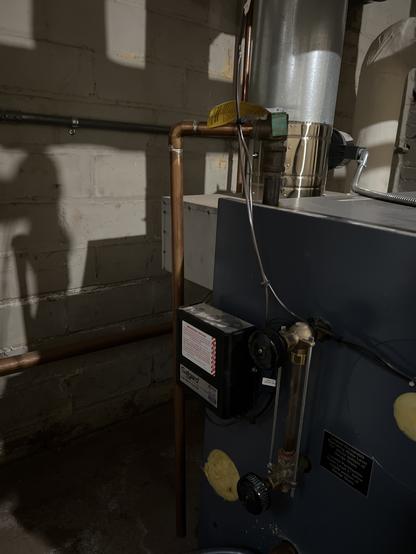
I learned a fun lesson about hysteresis, programmable water fill units, ball valves, and boilers.

That lesson? Unlike the dumb automated fill unit that used to be on my boiler, the programmable one has programmable hysteresis in the form of dip switches (neat!). I didn’t know that at 4 a.m.

Let’s start at the beginning. My house is heated by steam radiators. In my basement sits this boiler.
As you’d expect, the boiler boils water by burning gas. (It’s hard to get a photo of the fire.) It’s a (normally) closed system. The water boils, steam is generated and goes through those large pipes covered in white material (the white stuff is asbestos encapsulation). The steam condenses back to water and then runs back down the same pipe into the boiler. No water is lost in ordinary operation.
However, if steam is released from the radiators, over time, the water level will drop. If it gets too low, the boiler can explode (or so I’ve been told). So this is monitored by the low-water cut off. You can see the gauge glass to the right which gives a visual indication of the water level in the boiler.

I was told the low water cut off is really just a float sensor which is kinda neat.

In addition to stopping the boiler (possibly by turning off the gas; I didn’t look at the circuit diagram too closely and now the boiler is running and it’s very hot so I don’t want to open it up right now), it commands the fill unit to add water when it is low.

But this isn’t the only way to add water to the boiler. There’s a manual bypass controlled by a ball valve.
Our old fill unit stoped working (it would never close once the low water cut off called for water). This was a nightmare. The boiler filled completely while running. This caused disgusting (and acidic!) water to come out of the steam release valves. That was _no fun_ but not the point of the story.

While waiting for the new fill unit to arrive, I was in charge of checking the gauge glass every day and adding water if needed using the bypass valve. It was never actually needed, but I did open and shut the valve a few times when it was hard to read the gauge due to all rust and other stuff that accumulated in the system.

The point is, I had a moderate amount of experience opening and closing the bypass valve.

And that brings us to last night. Specifically, 4 a.m. last night.
The fill unit is really loud. You can hear it throughout the whole house. I happened to be in the basement at the time (playing factorio and dealing with the limitations of generating electricity using coal-fired steam boilers, as it would happen) so I heard it start.

The previous fill unit didn’t fail all at once. It was running intermittently but only for 15 seconds or so at a time before it completely stopped closing.

So after a minute or so, I got worried. The low water cut off’s “low water” lamp was off. There were several inches of water in the gauge glass. And yet it was still filling.

So I did the natural thing: I turned the ball valve. As I did so, I could hear the water going through the fill unit lessen. Success!

Except no. At 4:19, the water sensor goes off. Back to the boiler room and the relief valve on the boiler is gushing water at top speed.
Thankfully, there’s a floor drain here. That drain has gotten an awful lot use from both hot water heater and the steam system failing over time. Yay floor drains!

As I hinted at above, nearly every time I’ve used the valve that control the water fill, I’ve used the valve for the manual control. Last night was no different.

I didn’t close the fill unit valve, I opened the bypass valve all the way.

“But Steve,” I hear you say, “Ball valves have an obvious indication of whether they’re open or closed. Parallel to the pipe is open. Perpendicular to the pipe is closed. How could you possibly get that wrong?”

To which I say, “good point, imaginary critic in my head.”

Eventually I noticed that both valves were open and closed them both.

After explaining the sequence of events to the HVAC guy this afternoon, he informed me that once the low water cut off calls for water, it waits for a little bit. (My stomach sunk as the implications of hysteresis hit me.) And then, after it stops calling for water, the fill unit’s (internal) valve remains open for a few minutes and for 3 gallons of water.

I think everything was working correctly until I opened the bypass valve and completely overfilled the system.

Final point: Any time water is filling the boiler, it makes noise and you can feel the movement of the water through the line so you’d think I’d have noticed that opening the bypass didn’t actually shut off the flow of water.

But no. Opening the bypass meant that most of the water took the direct path to the boiler and didn’t go through the fill unit. (It’s kind of like connecting a weak resistor in parallel with a stronger resistor; take that every electrician who refuses to talk to me in electrical terms and insists on using plumbing analogies I don’t really understand.)

And the really noisy part was the fill unit. So as I opened the bypass, the rushing water sound basically stopped, even though water was now filling the boiler at an even greater rate.