
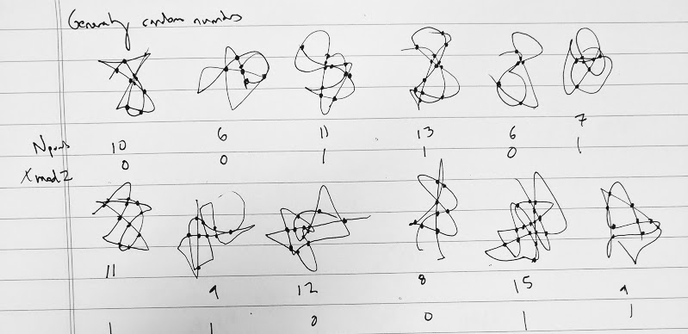
no-dice: Generate random numbers with strictly a pencil and paper by drawing simple curves and counting the number of intersections in the curve.

Obviously, it's not secure, but it's a creative way to get a quick unbiased random number without too much trouble.

Of course you could manipulate it, so it requires you to be honest about not paying attention to your curve or intersections, and just drawing freely.

Just don't get too crowded or it can be difficult to count.
https://github.com/schollz/no-dice

GitHub - schollz/no-dice: Using a pen and paper to generate random numbers, in cases you don't have dice

Using a pen and paper to generate random numbers, in cases you don't have dice - GitHub - schollz/no-dice: Using a pen and paper to generate random numbers, in cases you don't have dice

GitHub
@atoponce I wouldn’t recommend this as people are known to be very bad at generating „random” things. This is why „guess a number” & co magic tricks work. It’s not unbiased. But there are many sound way of doing this described here https://stats.stackexchange.com/questions/247094/generating-random-numbers-manually
Generating random numbers manually

How can I manually generate a random number from a given distribution, as for instance, 10 realisations from the standard normal distribution?

Cross Validated

@tymwol Again, this shouldn't be used for security or anything that involves risk. It's an insecure RNG.

But if you're honest about your curves, I'd wager it's better than "pick a random number". You won't know how many intersections you created, and if you take the result mod 2, then draw say 4 curves, and you've got an unbiased 4-bit RNG.

It fully depends on your willingness to be honest about your curves though.

@atoponce Unbiased? I don't believe that. I'm expecting the raw distribution to be closer to Gaussian centered at 6 than uniform, and that can't be corrected by a simple modulo.