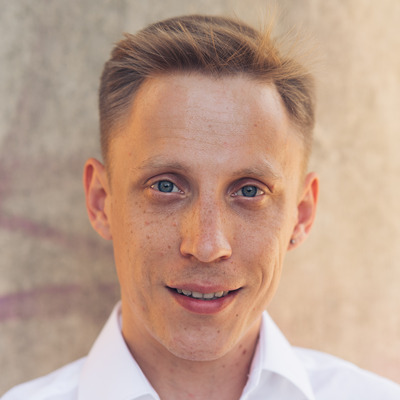
 Gleb Aliaksandrau
Nebula course is the culmination of more than 10 years of experimentation with volume shading and procedural noises in Blender. It was released yesterday.
Here's a (a bit longer) thread about why it's so important to us. 🧵👇 #b3d
1/?
Nebula course is the culmination of more than 10 years of experimentation with volume shading and procedural noises in Blender. It was released yesterday.
Here's a (a bit longer) thread about why it's so important to us. 🧵👇 #b3d
1/?
Our path to volumetric space rendering wasn't a cakewalk. Even though our first #b3d nebulae experiments date back to 2013 (and Blender 2.66 or v2.67 perhaps?), in our Space VFX course we were still mostly using the fake 2d techniques for gas clouds.
2/?
We were looking with envy at the REAL volumetric space art by Teun van der Zalm and other amazing creators. Houdini simulations were just on the whole different level.
Something we thought we wouldn't be able to reach, using Blender. Like, never.
3/?
OUR #b3d fluid sim tests looked like garbage back then. The procedural shading attempts weren't too impressive as well.
Like, what is this blob supposed to be, even?!
4/?
But actually, there was one real volumetric demo in Space VFX. This one.
The two spheres in the swirling 3d mist. Nothing too impressive, but it set our intuition bells ringing.
5/?
The final result still had to be post-processed like hell, just smeared with effects.
Still, the fact that a simple procedural noise can help to create the organic-looking interstellar shapes...
It got us thinking.
6/?
We embarked on this journey and the next couple of years went under the sign of the (procedural) noise. Much of it boils down to the default #b3d noise aka Fractal Brownian Motion (aka Perlin noise).
This algorithm was invented by Ken Perlin who got tired of 'the cg look'.
7/?
As it turned out, when plugged into any kind of a volume shader, this FBM noise produces the beautiful volumetric structures with tendrils and filaments.
...Just like the interstellar structures!
8/?


With the fourth dimension added to the algorithm, these procedural structures were able to evolve over time, too! Btw, the 4d noise was added to Blender by
@OmarEmaraDev
9/?
There's a caveat. It only looks beautiful, these structures, if you give it *the right settings*. If you know the nebula secret code.
And cracking that code proved to be... not easy. I'll fast track the part where we spent another few years researching that stuff.
10/?
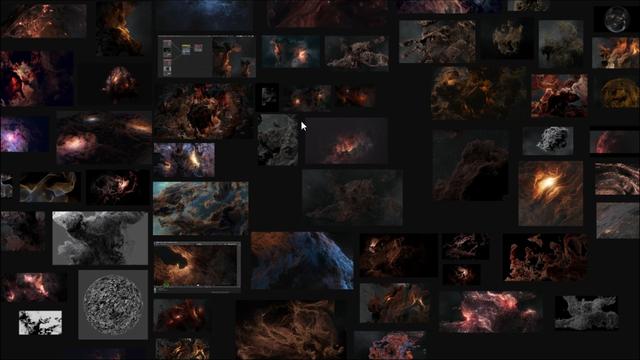
In this journey, we got help and inspiration from Samuel Krug, Simon Thommes, Brent Patterson, Gottfried Hoffmann, Clement Foucault,
Mark Kingsnorth, Jonas Dichelle, Curtis Holt, Tim Barton, Hans Chiu, Stefan Werner, Teun van der Zalm and many others.
11/?
Still, it took us many years to crack that code. At the Blender Conference 2019 we were finally able to present the fully volumetric procedural nebulae all rendered in Blender, in Cycles. It was something that wasn't TOO FAR from the reference images we had in mind! #b3d 🤯
12/?
After #bcon19 we were like, hey, we can record a course about it in no time.
Fat chance. It took us ANOTHER 4 YEARS to get to the point where we feel confident about this stuff. I grew mustache and started wearing glasses. :)
13/?
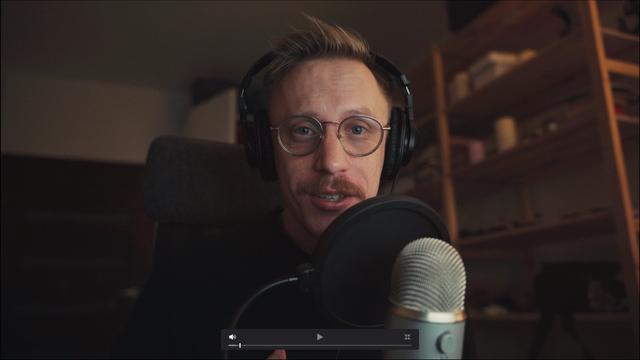
We spent these years to smooth out the rough edges and make sure the techniques are actually shareable. And doesn't require to have a Nasa supercomputer at home.
And so, ladies and gentlemen. Dear Shrimps! Today is the day when the Nebula course is finally out. ☄️🌌🌙🧑🚀
14/?
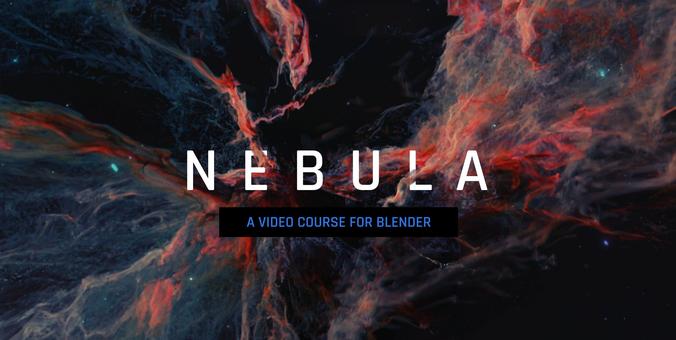
It is available on Blender Market: https://blendermarket.com/products/nebula-course
And Gumroad: https://creativeshrimp.gumroad.com/l/nebula-course
Here's the Introduction/Promo video: https://www.youtube.com/watch?v=n9vh8s9mbAU
Fun fact: @aidyburrows3d wrote the soundtrack himself, for all these videos.
15/?
