
N1-methylpseudouridylation of mRNA causes +1 ribosomal frameshifting

mRNA such as used in vaccines has been modified to decrease immunogenicity and enhance stability. Does it affect translation? #mRNAvaccines #COVID19 #VaccineSafety

https://doi.org/10.1038/s41586-023-06800-3
1/17

This question was addressed previously and the codon translation was found to be faithful:
N1-methyl pseudouridine (1-methylΨ) found within COVID-19 mRNA vaccines produces faithful protein products

https://academic.oup.com/nar/article-lookup/doi/10.1093/nar/gkx135

https://linkinghub.elsevier.com/retrieve/pii/S2211124722011202
2/17

N1-methyl-pseudouridine in mRNA enhances translation through eIF2α-dependent and independent mechanisms by increasing ribosome density

Abstract. Certain chemical modifications confer increased stability and low immunogenicity to in vitro transcribed mRNAs, thereby facilitating expression of the

OUP Academic

Crucially, a structural analysis of the protein produced by the BNT162b2 vaccine reveals that, in this instance, the overwhelmingly dominant form is the correct protein derived from the 1-methylΨ mRNA.

https://www.rcsb.org/structure/7l7k

https://www.nature.com/articles/s41586-021-03275-y
3/17

RCSB PDB - 7L7K: Cryo-EM structure of protein encoded by vaccine candidate BNT162b2

Cryo-EM structure of protein encoded by vaccine candidate BNT162b2

Health-wise, Spike protein production post-translation is robust, indicated by Spike-specific T cells and antibodies. Authors stress no reported adverse outcomes from mRNA vaccine mistranslation in humans. Important for vaccine safety. #mRNAvaccines #COVID19 #VaccineSafety
4/17

It is known from prokaryotes that some modifications can recode mRNA.
1-methylΨ, steering clear of codon misreading, introduces a subtle nuance—a frameshift potential. This provides a nuanced understanding of code intricacies. #mRNAresearch

5/17
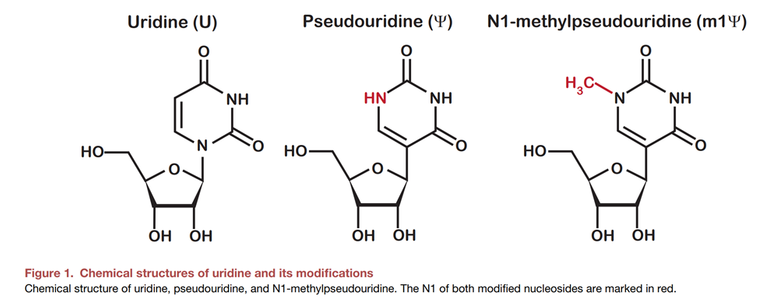
RNA is made up of 4 chemicals, annotated by the letters A, U, G and T. A row of 3 makes a codon, a 3-letter code corresponding to an amino acid. A string of amino acids makes a protein. Moving the codon code by 1, gives a different amino acid string and thus, a different protein.
Using a mRNA fluorescence-reporter construct (WT Fluc), the authors show in vitro, 1-methylΨ does not affect translation (b). Incorporating 1-methylΨ in an out-of-frame detection construct (Fluc+1FS) reports 8% fluorescence (c)., suggesting out-of-frame translation is possible.
Using HeLa cells (d), a similar observation was made. This suggests that 1-methylΨ can induce a frameshift, but that ~92% is the correct protein is translated (e), in agreement with high antibody titres, T cell specificity, and most importantly, immune protection.
Although 8%, the authors show impact using the BNT162b2 vaccine in vivo and determining T cells are selected that recognize frameshift product (b). The frameshift is real and adds additional epitopes that cause an immune response. This is absent in DNA vaccines (ChAdOx nCOV-19).

T cell responses against frameshift epitopes could also be observed in humans after BNT162b2 vaccination (d), as well as very good responses against Spike protein itself (e).

10/17

The observations were not the result of transcriptional errors or faster translation rate. 1-methylΨ resulted slower translation and in frameshifts towards the “end” of the protein. The shift seems to result from translation (ribosome) stalling and can be rescued by paromomycin
Although frameshifting is a natural phenomenon and there is no evidence of adverse effects of frameshift generated from mRNA vaccination, for future and alternative use of this technique, such as own protein supplementation, it is undesired and may cause unwanted immune activity.
The authors contribute a potential solution by codon optimizing those codons at risk for causing a frameshift (slippery codons). These substitutions reduced frameshifts (c) while overall protein translation was not affected (d), including both substitutions stopped the frameshift (e).
1-methylΨ can result in a +1 frameshift. This has no adverse effects in case of the COVID-19 vaccines, but is clearly unwanted. By altering identified slippery sequences/mRNA product design, this can be prevented in future products.
Note 1, previous work did not detect frameshifts/altered protein length https://www.nature.com/articles/s41586-021-03275-y/figures/5, staining with S1-specific antibody. The proteins from a frameshift may be too limited to detect.
Extended Data Fig. 1: Antigen expression and receptor affinity of vaccines. | Nature