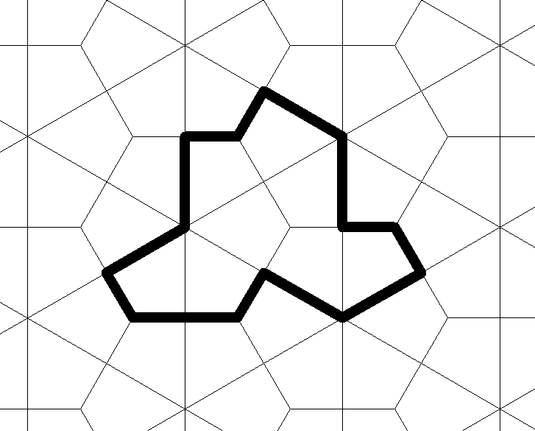
It was one year ago today that David Smith emailed me out of the blue, asking about my work on computing Heesch numbers. A few days later he tipped his hand and showed me a drawing of the hat polykite for the first time. Happy Aperiodic Monotile day to all who celebrate.
@csk Is the area of the tile the same as the skinny and fat lozenge previously used?
@majeriisli @csk You can scale it to have whatever area you want.
@OscarCunningham @csk I was probably not clear. Of course you can make the tile any size. But if you make a quasi periodic tiling using a fat and a skinny lozenge, what size are those such that the Fourier transform of both of them is the same?
@csk Am I the only one who sees this rather as a t-shirt, not a hat? It's inverted in this picture. The t-shirt has a very nice v-neck and an interesting uneven bottom.
@sverik Lots of people see a t-shirt, including us when we were first playing around with the shape. In the end I concluded that "hat" was a little nicer to write in an academic paper.
@csk Hey, is anybody manufacturing it yet? I have looked but can't find it. This old patio ain't going anywhere....
@mmm There are lots of puzzle-size tiles available in wood, plastic, foam, metal, etc. I've seen a few projects to manufacture ceramic tiles or pavers, but nothing commercial yet. I'm still waiting to see the first installed floor / patio / etc.

@csk I just watched the “Up and Atom”YouTube vlog on this. With excerpts from interviews with you and Dave.

Dave is a f****** legend. :)

Have you ever met him? If so? What’s he like in person?

@nikolaihampton Yep, Dave's a legend! I met him in person for the first time (and reconnected with @Chaimgoodmanstrauss) earlier this year at an event in Oxford (where the Up and Atom interviews were shot). It was lovely to spend time with both of them.
@csk @Chaimgoodmanstrauss has there been any more work on finding other mono tiles of a different recipe? Is there anything about Dave’s (and your) tiles that suggest there will be other families?
@csk @Chaimgoodmanstrauss I’m also extremely curious about what was it that fueled Dave’s intuition to look at this particular shape. Surely it couldn’t be brute force? It’s such a fascinating story.

@csk I've seen plenty of videos on this!

Here in Germany, the naming was … a little different but I learned why another one was picked in the paper.

@csk I searched for a tool to turn it into an aperiodic puzzle piece. So replacing each edge with appropriate connectors. So when it's tiled, it will not come apart because the pieces are interlocked. Is that possible?
Bonus if there is no need for mirrored tiles.
@gunstick That can't be conveniently done with the hat, but it *can* be done with spectres, the subject of our second paper. Spectres don't require mirrored tiles, either. See for example the puzzle created by Nervous System: https://n-e-r-v-o-u-s.com/blog/?p=9333.
Spectre Tile Set

The Spectre Puzzle is a wooden puzzle and mathematical toy consisting of identically shaped pieces which tile in a unique way that never repeats. It is based on a recent mathematical discovery, the…

Nervous System blog
@csk I remember, I immediately coded one tile with #turtlestitch and made some of these tiles with lasercutter and 3D printer, to explain teacher colleagues and students what it is about.
@csk I am creating monotile jigsaw puzzles out of plywood for my family. The perfect Xmas gift 🎅
@csk I love the mini-bio at the bottom of the article. This is exactly me too, and what my grandfather taught me 55 years ago.
Thanks !
"His research focuses on interactions between mathematics and art"
@csk FWIW, I find it fascinating to consider the intersection of Tiling Theory and Turing's exploration of morphogenesis.
https://pubmed.ncbi.nlm.nih.gov/34743596/
Studies of Turing pattern formation in zebrafish skin - PubMed

Skin patterns are the first example of the existence of Turing patterns in living organisms. Extensive research on zebrafish, a model organism with stripes on its skin, has revealed the principles of pattern formation at the molecular and cellular levels. Surprisingly, although the networks of cell- …

PubMed

@jab01701mid In an email conversation, I told someone that tiling theory might be of limited use in a context like this, where you're trying to simulate morphogenesis or other natural processes. As a mathematical subject, tiling theory really pays dividends when there are significant regularity properties or other kinds of repetition, and that's often to constraining for real-world situations.

In the intersection with Turing patterns, raw symmetry may suffice for visual interest, and tilings might be overkill. See especially Jonathan McCabe's symmetric, multi-scale Turing patterns: http://www.jonathanmccabe.com/Cyclic_Symmetric_Multi-Scale_Turing_Patterns.pdf (also: https://rreusser.github.io/multiscale-turing-pattern-gallery/). Gorgeous stuff.

@jab01701mid (Of course, there may be interesting opportunities to render non-periodic Turing patterns...)