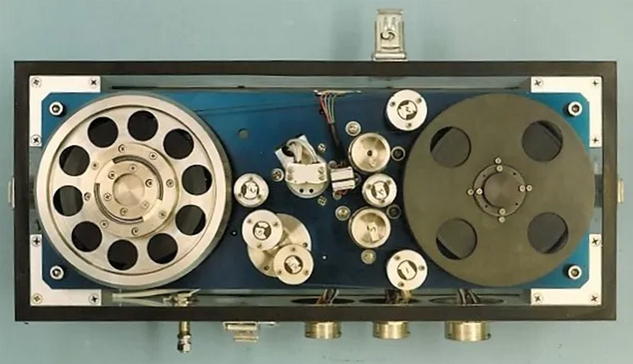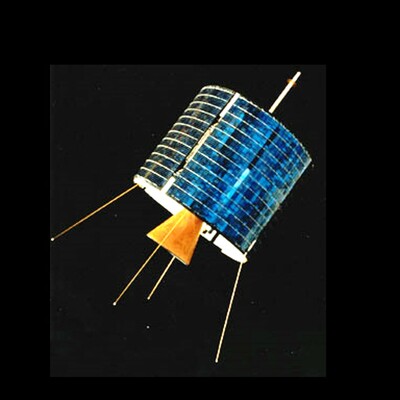
The Voyager 1 spacecraft earlier today transmitted a 6.5 hour playback of data from its 8-track digital tape recorder (DTR)!

This data will arrive 22.5 hours later between 10:37 and 17:13 UTC on Thu, Nov 9 and be captured using 5 arrayed antennas at the NASA DSN Madrid site in Robledo de Chavela, Spain.

Tx rate = 1.4 kbps instead of the normal 160 bps, which requires simultaneous reception by the 5 antennas.
1.4 kbps * 6.5 hours = 4 Mbytes

https://voyager.jpl.nasa.gov/pdf/sfos2023pdf/23_11_09-23_11_27.sfos.pdf
@destevez
#Voyager
1/n

The venerable Voyager spacecraft, launched in 1977, each carry an 8-track reel-to-reel digital tape recorder (DTR) for storing data collected by the Plasma Wave System (PWS) built and operated by the University of Iowa.

Capacity: ~67 Mbytes
Tape width: 1/2 inch
Tape length: 328 m

The DTR on Voyager 2 is no longer used because a PWS part failed in 2007.

And after 46 years in space, the DTR and many other instruments on Voyager are still ticking!

DTR info: https://hackaday.com/2018/11/29/interstellar-8-track-the-low-tech-data-recorders-of-voyager/
#Voyager
2/n

Interstellar 8-Track: The Not-So-Low-Tech Data Recorders Of Voyager

On the outside chance that we ever encounter a space probe from an alien civilization, the degree to which the world will change cannot be overestimated. Not only will it prove that we’re not…

Hackaday

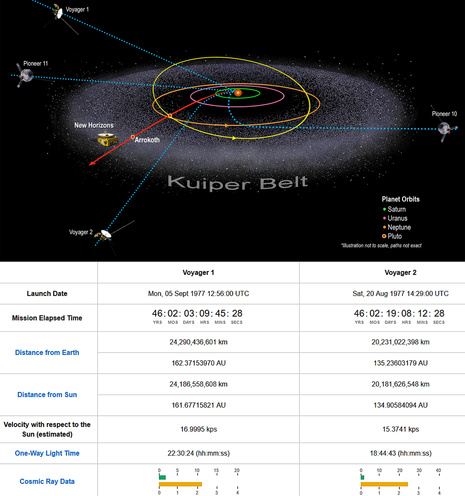
The two Voyager spacecraft, launched on Sept 5, 1977 and Aug 20, 1977, have been traveling in space for over 46 years.

Voyager 1 is farther away from earth at 24.3 mil km (22.5 light hours), while V2 is 20.2 mil km away, located below the ecliptic. Both spacecraft are in interstellar space.

Here are the locations and some vital stats on the two Voyager spacecraft.

You can follow the real-time status of Voyager at https://voyager.jpl.nasa.gov/mission/status/
Graphic source: https://www.nasa.gov/solar-system/nasas-new-horizons-reaches-a-rare-space-milestone/

#Voyager
3/n

Voyager - Mission Status

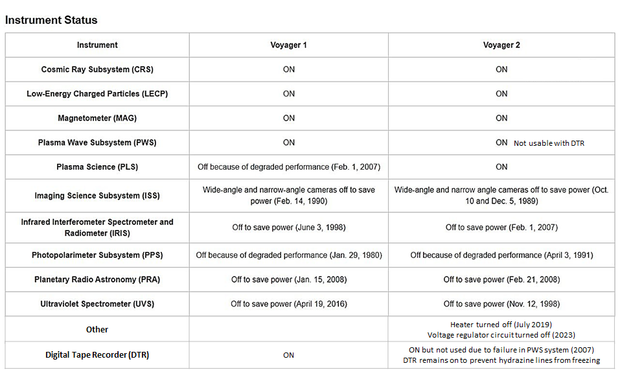
The power levels generated by the Radioisotope thermoelectric generators (RTG) have steadily declined by about 50% over the past 46 years. Therefore, various instruments have been shut off over the years. E.g., V1 cameras were shut off after the iconic images of the solar system and the pale blue dot were taken in 1990.

The Voyager probes will be unable to keep instruments powered on much beyond the early 2030s.

Here is the current instrument status from https://voyager.jpl.nasa.gov/mission/status/
#Voyager
4/n

Voyager - Mission Status

Happy Birthday to Carl Sagan, who would be 89 today.

Sagan famously wrote about the 'Pale Blue Dot' - "Look again at that dot. That's here. That's home. That's us. On it everyone you love, everyone you know, everyone you ever heard of, every human being who ever was, lived out their lives."

Voyager 1 took the image of the "Pale Blue Dot" on Feb 14, 1990, from 6 bil km away, minutes before its cameras were shut off forever.

https://www.jpl.nasa.gov/images/pia23645-pale-blue-dot-revisited
#palebluedot #Voyager #Sagan
5/n

Pale Blue Dot Revisited

This image shows an updated version of the iconic Pale Blue Dot image taken by the Voyager 1 spacecraft.

NASA Jet Propulsion Laboratory (JPL)

The 5 antennas at NASA DSN Madrid are indeed all concurrently receiving data from Voyager 1 at 1.4 kbps at this moment (12:04 UTC)!

These antennas will continue in this arrayed mode until 17:13 UTC to receive the 6.5 hour playback of data from Voyager's 8-track digital tape recorder (DTR), as detailed in post #1.

https://eyes.nasa.gov/dsn/dsn.html
#Voyager
6/n

Deep Space Network Now

The real time status of communications with our deep space explorers

Deep Space Network Now

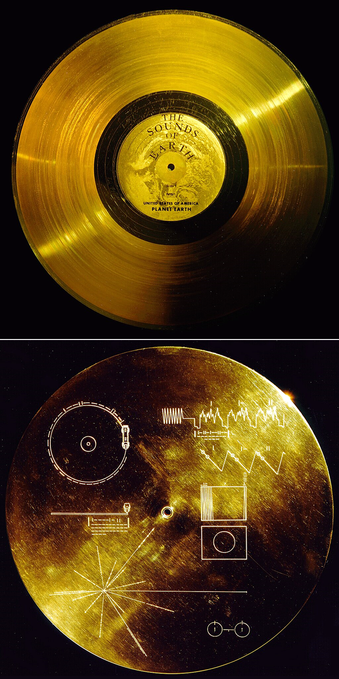
Carl Sagan (Happy Birthday) chaired the committee that selected the contents of the Golden Record carried by Voyager.

The record contains images, natural sounds, music and greetings in 55 languages.

Sagan wrote - The spacecraft will be encountered and the record played only if there are advanced space-faring civilizations in interstellar space, but the launching of this 'bottle' into the cosmic 'ocean' says something very hopeful about life on this planet.

https://voyager.jpl.nasa.gov/golden-record/
#Sagan
7/n

Voyager - The Golden Record

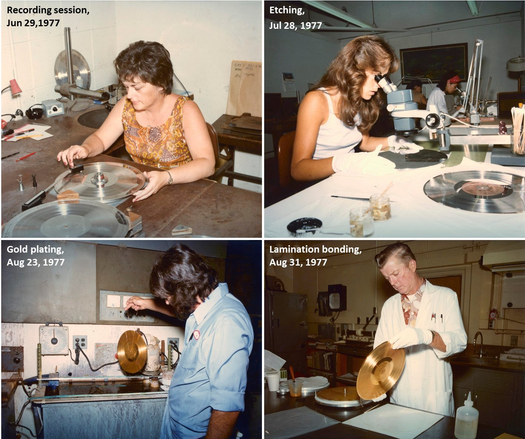
A few pics of the making of the Golden Record, carried by the Voyager spacecraft.

Jimmy Carter's message on the record - "This is a present from a small, distant world, a token of our sounds, our science, our images, our music, our thoughts and our feelings. We are attempting to survive our time so we may live into yours."

https://voyager.jpl.nasa.gov/golden-record/making-of-the-golden-record/
#Voyager
8/n

Voyager - Making of the Golden Record

True story on why the Beatles song "Here Comes the Sun" was not included.

Ann Druyan: "That was one of those cases of having to see the tragedy of our planet. Here's a chance to send a piece of music into the distant future and distant time, and to give it this kind of immortality, and they're worried about money. We got this telegram [from EMI records] saying that it will be $50K per record for 2 records, and the entire Voyager record cost $18K to produce."

https://www.vice.com/en/article/rgpj5j/the-golden-record-ann-druyan-interview
#Voyager
9/

A Space Jam, Literally: Meet the Creative Director Behind NASA's 'Golden Record,' an Interstellar Mixtape

We talked with Ann Druyen, wife of the late Carl Sagan, about curating a record for extraterrestrials.

@AkaSci
Whoa, seriously? That's kinda stupid of them.
@amin
Our descendants who find the Golden Record should get to know about this episode to get a full picture of humanity during our times.

@AkaSci @amin
Good of NASA to save whomever finds the Golden Record from committing a copyright violation should they ever try to play it.

Reminds me of the classic The Borg vs Microsoft joke that went viral in the early Internet before viral became a thing
https://www.diag.uniroma1.it/marte/homepage/humor/stmicro.html

The Borg vs. Microsoft