 András Tóth-Czifra
Over the past week since the Polish opposition’s victory I have seen a lot of optimistic commentary suggesting or hoping that Orban’s government is likely to fall next. While I welcome the optimism, there are caveats. I will share a couple of thoughts in this thread. 🧵
First of all, the Polish election is undoubtedly a momentous negative development for Orban. He lost an illiberal ally that now reportedly blames the defeat on his advice, he now has a powerful adversary, and Fico won’t be able to fill the gap.
The dismay over the election was palpable in the comments of Hungarian government representatives, e.g. deputy foreign minister Levente Magyar who feared that PiS losing would make his government “defenseless” in the EU.
Government critics have started speaking about the “Warsaw Express”, an expression used in Hungarian political parlance to imply that political developments in Poland predict developments in Hungary.
On the other hand, as several other analysts also noted, Tusk’s first months in power will be perilous as he will preside over a fractious coalition, economic problems and PiS-appointed officials from the Constitutional Court and the Central Bank to the public administration.
This of course does not mean that Tusk - a veteran of both Polish and EU politics - cannot succeed. Much will depend on how successfully PiS can keep up the narrative of eventual victory and how much it can preserve from the money flow to its active promoters and allies.
(You likely won’t be surprised to see that many of these allies are opportunistic, not ideological, just like in Hungary - even as, for a while, Poland’s illiberals were leaning more heavily into ideology than their Hungarian counterparts.)
So Tusk may very well succeed - but he doesn’t have the strongest hand. And that is the caveat about Hungary: Orban’s rule is significantly more entrenched than Kaczynski’s ever was. Here are a couple of important differences:
/a PiS did not build itself an electoral system, but Fidesz did in Hungary. Hungary’s mixed system with gerrymandered single-mandate districts (SMD) is key for the party to score large majorities against a divided opposition - just like in Russia that has a similar one.
1/b While PiS did try to increase the turnout at the countryside where its base lives by various institutional means, it could not go beyond this. Poland’s electoral system remained proportional (at least for the Sejm).
1/c In Hungary, on the other hand, Fidesz kept adopting changes to the system originally set up in 2012, e.g. even before the 2022 election in order to make it more difficult for the opposition to coordinate. Which takes us to the second point.
2/a The leaders of the Polish opposition, while battered in a major scandal in 2014, were not discredited to the same extent as the Hungarian socialists and liberals were in 2006-08.
2/b Also, PO lost the 2015 election after a period of remarkable and uninterrupted economic growth. The fruits of this growth may not have been evenly distributed, but his government wasn’t remembered for an economic crisis and a fiscal mess.
2/c This meant that the Polish opposition had a relatively easier job reinventing itself. Figures from pre-2010 politics (notably former PM Gyurcsany) still haunt the Hungarian opposition and (especially with Fidesz’s propaganda machine) limit its reach.
2/d In Hungary the disintegration of the opposition after 2010, together with pre-existing background links helped Fidesz integrate a considerable part of the opposition into its regime, the “System of National Cooperation” (NER).
2/e If you read Hungarian, it’s worth reading this dive by RFE into party financing in Hungary & its impact on political competition. I'm ready to stand corrected but afaik the Polish opposition was never so integrated into structures controlled by PiS

Az illegális pártfinanszírozás rendszere – ahogy a résztvevők látják, 3 rész.: Hogyan tartja kézben a...
Milyen politizálás várható egy párttól, amelynek elitje nem független a versenytársától? A pártfinanszírozás szürkezónájáról szóló cikksorozatunk befejező részében számba vesszük azokat a technikákat is, amelyek „fogottá” tesznek politikusokat.
2/f The fact that the Polish opposition was able to reinvent itself and coordinate relatively easily & quickly mattered. The opposition was able to retake the Senate (39/100 in 2015, 52 in 2019) after a single term, which provided it with a tribune for policies opposing PiS.
2/g The Hungarian opposition, on the other hand, is below 1/3 of parliamentary seats (in a single chamber) for the 4th term in a row and Fidesz’s draconian control of the legislative agenda & procedures means there’s little room for parliamentary politics.
2/h Also crucially - as we now know, see below - the opposition was able to offer an alternative to PiS at the countryside.

Stanley Bill on X
PiS's decline and the Polish village [THREAD]: A key narrative has been young/city voters coming out in record numbers to sink PiS. Important, but also something going on in the Polish village (where PiS dominates and where 39% of voters live) with a big impact on the result. 1/
2/i In Hungary Fidesz has spent 20 years cultivating a domination over countryside agenda and over the past 13 years it has been able to build formal and information institutions to tighten its grip on finances and publicity.
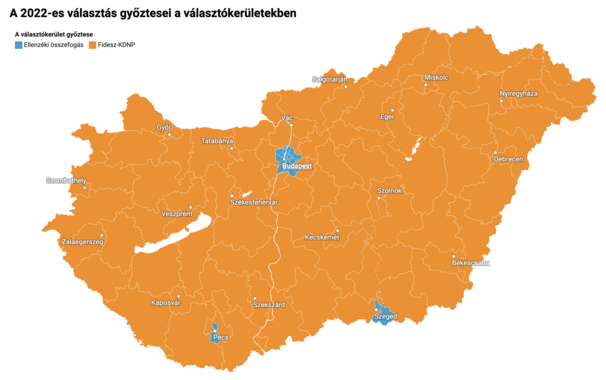
2/j There are of course many opposition voters in the countryside, but outside of towns they tend to be inactive or a minority. With the current electoral system, this results in domination and at times intimidation (see below map of SMDs in the 2022 elections by 444.hu)
3/a The Polish media was not completely subjugated by the government. Yes, they made an attempt: the public broadcaster’s bias & excesses are infamous (as they are in Hungary) & Orlen’s 2020 purchase of regional papers was similar to the purchase of county papers by an Orban ally
3/b However, several major newspapers - e.g. Gazette Wyborcza, which shortly before the election broke the story about the cash-for-visa scandal that embarrassed the government campaigning on tighter border security - remained independent & reached voters.
https://www.politico.eu/article/poland-government-under-fire-cash-for-visa-scheme-scandal-election/

3/c In Hungary, on the other hand, while there is of course media critical of the government (as Orban often points out), a Fidesz-controlled conglomerate owns the vast majority of offline news-focused outlets, the government controls a large chunk of the advertisement market…
3/d …and over the past years the government and Fidesz have spent a considerable amount of money on online propaganda as well (although of course they cannot control the entirety of the online media space).
3/e This dominance has also contributed to the inability of various groups negatively affected by Orban’s regime to coordinate or at least build solidarity with each other, although this is of course a larger and more complex issue. This atomization is key for Fidesz.
4/a Fidesz has also kept the kind of internal conflicts that often riddled PiS’s more fractious government, under lids. Apart from a minor spat between the governor of the central bank and the government, I cannot name any other major dispute from the past 4-5 years.
4/b This is partly the consequence of Fidesz being a highly hierarchical party but also of how Orban has managed to preserve the aura of being completely w/o even peers, let alone alternatives, for most of the Fidesz crowd. There’s no Duda, Morawiecki, Ziobro or Gowin in Hungary
In conclusion: we shouldn’t expect the Hungarian domino to fall by itself. Even if Tusk succeeds in pushing back illiberalism in Poland, Orban still has room to dig in his heels and radicalize further. He understands very well that he is getting more isolated.
In my view, until a split in Fidesz, the collapse of one of a central tenets of Orban’s relationship with Hungarian voters, or the emergence of a major issue to galvanize the disgruntled, Orban, while bruised, is well placed to fight off this challenge.
 Kalle Kniivilä
@MinCzifra Good thread! Thank you!