We do understand the #globalwarming caused by fossil fuels - for four decades it’s been going as predicted.
But we don’t understand the surprise upward leap that is happening now.
And that worries me.
@rahmstorf could it be that models tend to incorporate linearity assumptions by default?

@alberto_cottica @rahmstorf

yes! why is it surprising that climate change is not linear?
i get that we dont know the exact cause of this dramatic & sudden rise, but i'd guess many assumptions have been made about proportional effects

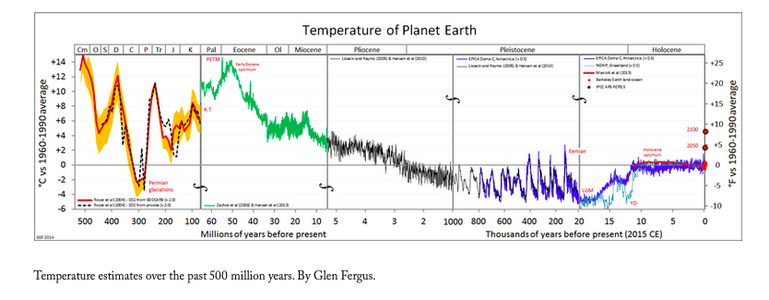
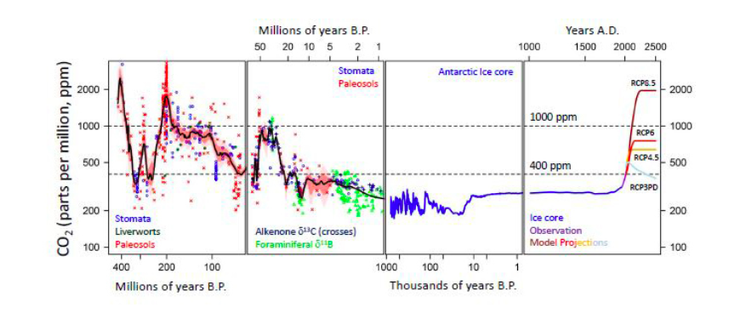
and ofc, we're carrying more CO2 in the atmosphere than earth ever has... a look at the record shows that historically, it was a much hotter planet when CO2 levels were anywhere near this high. maybe things 'catch up' in fits and starts
https://earth.org/data_visualization/a-brief-history-of-co2/

A Graphical History of Atmospheric CO2 Levels Over Time | Earth.Org

As the most abundant greenhouse gas in our atmosphere, CO2 levels have varied widely over the course of the Earth’s 4.54 billion year history.

Earth.Org

@rustoleumlove @alberto_cottica @rahmstorf

Because @rahmstorf has been part of the climate modelling community for decades and of course the models aren't in any way simplistic. If a central climate scientist says he is worried, because Earth got much hotter than expected and modeled ... then maybe it's worrisome. Extra worrisome.

@knud far from me to criticize other people's expertise. As a modeller myself, however, I have oftentimes seen linearity assumptions being plugged into situations of theoretical ambiguity, where there is no reason to choose one functional form over another for a certain relationship. @rustoleumlove @rahmstorf

@alberto_cottica @rustoleumlove @rahmstorf

Sure, but one needs a decent argument to choose a quickly diverging function over a linear one, no? So yes, one might get surprises, but in the end this means a physical mechanism or coupling that wasn't on people's radar so far. To find and include that will be important.