Introduction:
The 1971 Memorandum by Lewis F. Powell became the blueprint for the rise of the American conservative movement and the formation of a network of influential right-wing think tanks and lobbying organizations, such as The Heritage Foundation and the American Legislative Exchange Council.
(1/n):
#powellmemo #trilaterlalcommission #heritagefoundation #alec #darkmoney #peopleascommodity
https://scholarlycommons.law.wlu.edu/powellmemo/1/
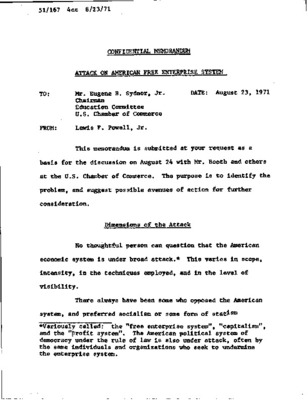
The Memo

Two copies of the Powell Memorandum, typescript and printed.

Washington and Lee University School of Law Scholarly Commons

In the 1960s masses of anti-Vietnam war, civil rights, women's liberation and gay rights activists took to the streets across the Global North.

On August 23, 1971, in the midst of this so-called "crisis of democracy", jurist Lewis F Powell Jr wrote to the U.S. Chamber of Commerce urging a full-scale counterattack on the enemy - namely, radical elements in higher education.

Who or what was driving the "massive assault" on American free enterprise?

Higher education was to blame, said Powell, and he urged the Chamber of Commerce to establish a special staff 'to address the campus origin of this hostility'

David Rockefeller, CEO and Chairman of Chase Manhattan Bank and billionaire grandson of John D Rockefeller, agreed with Powell.

A thorough study was needed.
But who were the right people to carry it out?

(2/n)
Next: The Trilateral Commission of 'private citizens'

#chamberofcommerce #rockefeller
#powellmemo #trilateralcommission

https://independentaustralia.net/politics/politics-display/an-excess-of-democracy-how-corporations-killed-the-campus,15165

An 'excess of democracy': How corporations killed the campus

In 1971, a small band of "forgotten" businessmen fought off the enemy – radical academics et al – and won the day… and the future.

Independent Australia

The Trilateral report: The crisis of democracy

In 1973, David Rockefeller founded the Trilateral Commission, a self-described group of "private citizens" of Western Europe, Japan and North America.
It commissioned Harvard centre director, Samuel P Huntington, to co-author a joint U.S.-Europe-Japan commissioned report, entitled, 'The crisis of democracy: Report on the governability of democracies to the Trilateral Commission'

The 1960s' 'democratic surge', said the report, had incited demands from the undeserving:
An 'excess of democracy'

Huntington went to great pains to explain that a large degree of non-involvement among marginal groups is required if democracy is to function:

To save democracy, said the report, democracy must be limited. The 'excess of democracy' must give way to 'desirable limits to [its] extension'.

A better balance must be struck between government and the "oppositional" force of the media.

First-Amendment protection of the media should be re-evaluated in the 'broader interests of society and government'.

The government's 'right and ability to withhold information at the source' should be exercised and, in the absence of voluntary journalistic restraint, 'the alternative could well be regulation by the government'

America must limit the education of marginal groups, said Huntington. Prior to World War II, only 40 per cent of the population was educated beyond elementary level; by 1972, that figure was 75 per cent.

The report summed up the threat thus: education raises political consciousness, which raises demands, which make democratic government unworkable.

To solve this problem: 'A decline in the saliency of school integration, welfare programs, law enforcement [would bring about] a decline in their group consciousness and hence their political participation'.

Expansion of higher education must be curtailed, the report advised.

Education must relate to 'economic development and future job opportunities' or 'lower job expectations'. And rather than allow workers' participation, employers should 'opt for job redesign'.

#trilateralreport #crisisofdemocracy
(3/n)
Next: Education as a Commodity
https://independentaustralia.net/politics/politics-display/an-excess-of-democracy-how-corporations-killed-the-campus,15165

An 'excess of democracy': How corporations killed the campus

In 1971, a small band of "forgotten" businessmen fought off the enemy – radical academics et al – and won the day… and the future.

Independent Australia

The Trilateral Commission saw American democracy as increasingly ungovernable and unaffordable. They wanted a new order to make the world more predictable and they saw radical intellectuals as contributing to the dangerous disorder.

The 1960s had seen a Keynesian commitment to education for the betterment of society. Neoliberalism, in contrast, treated education as a commodity.

Everyone in education knows what "now" looks, smells, feels and sounds like.

"Now" exceeds Lewis Powell’s and the Trilateral Commission’s wildest dreams, their entire set of prescriptions realised.

"Now" is the corporatisation of the university and the commodification of education.

"Now" is the false idea of "balance".

"Now" is unprecedented wealth disparity.

Whereas wealth disparity decreased during the 1970s, it shot up again during the 1980s as neoliberalism took hold.

The wealth of the richest 20 per cent has climbed steadily from the late 1970s onward, while real wages for most Americans have steadily declined.

"Now" is people as the commodity.
(4/4)

@cdarwin interesting that an Australian media outlet is publishing this. I hadn’t even heard about it. It certainly explains a lot of the bribery in politics today and why they are so anti-education. Thanks for sharing.