Remember the Twitter account that added "in mice" to dramatic paper titles? Maybe we need one that says, "...in Alaska" (no offense to Alaskans) https://www.nber.org/papers/w31733
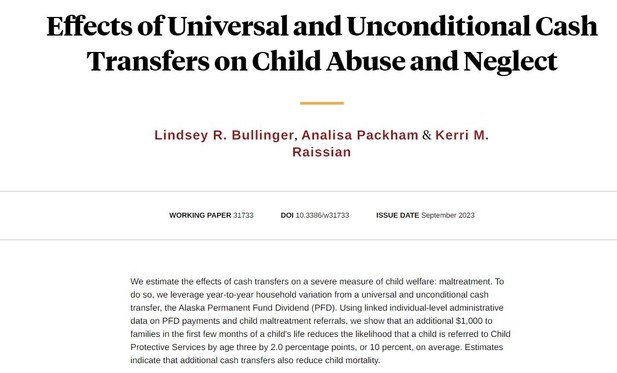
Effects of Universal and Unconditional Cash Transfers on Child Abuse and Neglect

Founded in 1920, the NBER is a private, non-profit, non-partisan organization dedicated to conducting economic research and to disseminating research findings among academics, public policy makers, and business professionals.

NBER

@philipncohen Trials on humans in Alaska > trials on mice

But yes, definitely not a random or (probably) representative sample.

@guyjantic linked records studies cannot be representative or random. They are studies of cohorts. For example, all children born in California in 1999 are included in the study, correlating the funding source for their birth (public vs private insurance) to child welfare allegations. This is not random or representative. It proves definitively that 1999 born infants whose moms used Medical had a 50% chance of being the subject of a child welfare investigation by 18. That's better than a sample.

@WhatSaraSaid No, they're not random. The Alaska and California cohorts are nonrandom multilevel samples.

"better than a sample" - In some ways. This is a quasi-experiment. Sampling was nonrandom and therefore nonrepresentative (except for the Alaskan and Californian cohorts).

@WhatSaraSaid Another note: It doesn't definitively prove anything more than "this is what happened to precisely these people." Generalization (which you seem to be implying) is sketchy.
@guyjantic Words mean things. A sample is a study of data about part of a population. These are not sampled studies, they are cohort studies. Generalizing from cohort studies, esp when the results align with the majority of sampled studies, is stronger than generalizing from sampled studies. The reason is that sampling can incorporate various forms of error that make results non-generalizable even when they are statistically significant. You can dispute the cohort definitions, though. Go ahead!

@WhatSaraSaid Words mean things here, and so do things. They mean things. These are most certainly sampled studies; the cohorts represent (very nonrandom) samples from larger samples of other cohorts, or of the larger population.

You can tell by the words. How they imply generalization beyond the data that were collected.