I can do that...
I often recommend folks start with the SCORE Business Startup Roadmap, which you can access here: https://www.score.org/startup-roadmap

The Startup Roadmap: Your Guide to Successfully Starting a Business
The Startup Roadmap outlines each step in starting a business with detailed information and resources. And with SCORE, you don’t have to do it alone.
The first thing they usually ask you to do is write a "1 Page Business Plan." When I work with my own clients through SCORE, I usually ask them to define Mission, Vision, Goals, Objectives, Activities on that 1 page.
Your Mission is what you think your business is about. Your Vision is how you think other people will see your personal business five years from now.
So your Mission might be "to provide world class service as a pro astrologer" but your Vision might be "Andrew provides real-world, actionable guidance on relationships, career, family dynamics, and spirituality using astrology."
Your Goals are 3-10 things that you think will take between 2 and 5 years to achieve or complete. It's ideal if these are SMART goals: Specific, Measurable, Achievable/Actionable, Relevant, and Time-Limited. Seeing 100 repeat clients in a single year, for example, is a goal (have to see them once before you can see them a second time).
Your Objectives are things that you think will take less than 12 months to complete; or that are necessary components of your business: opening bank account sfor your business is one; but so is seeing your first 50 clients.
Activities are what you think you need to do on a daily, weekly, or monthly basis to achieve objectives. Seeing clients, bookkeeping, record-keeping, creating marketing, encouraging sales, running your mailing list doing research, studying charts... all these are activities. The more likely you are to forget to do it (or avoid it), the more it needs to go in the Activities section.
The idea is that you do the various Activities, while keeping your mind on the Objectives and Goals. When you complete an objective, pull a new goal down from the Goals section and add it to the Objectives. As you think of new goals, write them in.
If you feel like you need a challenge or to kick your own ass, some people set both annual and quarterly Objectives. (Mine is to see at least twenty-five paid clients in October to December this year, and break a personal record.)
So, that's the Business Plan sorted. Most sole proprietors probably don't need more than that.
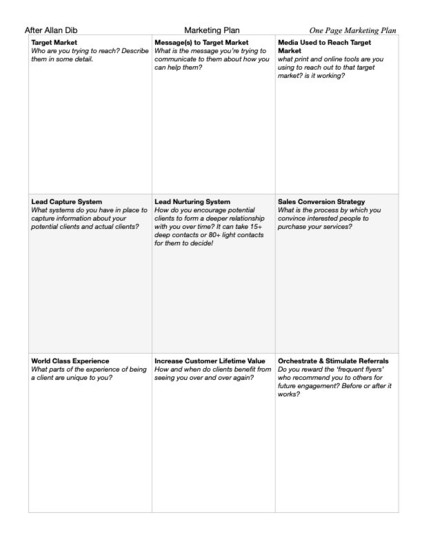
A marketing plan is something else entirely. I use a 3x3 grid created by Allan Dib for his book "the 1-page Marketing Plan" — I can't upload a PDF or a word doc but I can make it into a JPEG... It's 9 questions to help you build a better marketing strategy, and build them for different ranges of clients.
So now you have two plans: a marketing plan and a business plan. The next valuable thing is a financial projection. SCORE has a template for this:
https://www.score.org/resource/template/financial-projections-template — it's used for predicting future income.

Financial Projections Template
Download this financial projections template to calculate your small business expenses, sales forecast, cash flow, income statement, break-even analysis & more.
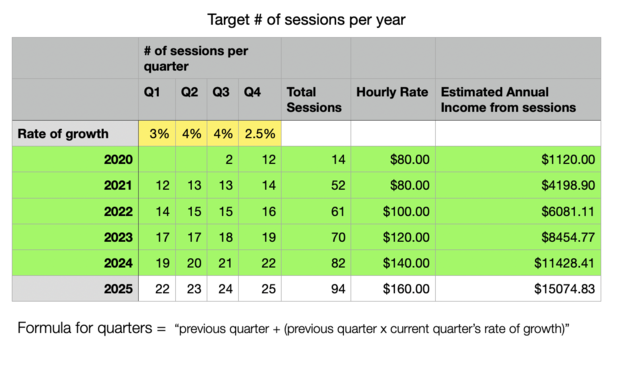
An astrologer might do better, though, with creating a simple spreadsheet based on number of consults per quarter, estimated Patreon income, and so on. Most of our expenses are not for things like offices, utilities, etc... but living. I use a chart *like* this to estimate growth by quarter; and a second chart to track actual numbers.
Vendor List — to help me track business expenses, I have a "Vendor List", which lists the monthly costs for my quickbooks account, my internet service, my scheduling service, and other fixed costs that are definitively business expenses. My goal is to exceed those numbers each month, of course.
But I learned a different trick from a book by Mike Michalowicz called "PROFIT FIRST" to have 5 bank accounts to track and manage cash flow. Each time a client pays me, 50% goes into OWNER COMPENSATION (that's my labor); 30% to OPERATING EXPENSES; 18% to TAXES; 2% to PROFIT. It's been nice to be able to pay my car and house taxes and income tax out of my business, rather than other savings, and to do it without stress or rush. DISCLAIMER: read the book, understand its methods, & what it ISN'T.
Professionalize your Operations. Donald Miller's book "How to Grow Your Small Business" is mostly for businesses that have employees, but the marketing and sales sections, and the advice on professionalizing your operations, and the section on cash flow, are going to make a lot of sense to anyone who's ever flown in an airplane.
Professionalizing your Operations means organizing your business flow in such a way that you appear to the client to have your shit together. You might not, of course. But the degree to which you can document your processes and follow them, has a lot to do with whether the client sees a real pro at work, or a hot mess. The clients want to work with pros.
 Andrew Watt