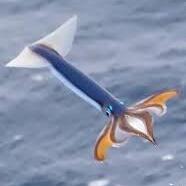
 Flying Squid
One million years from now...

 eezeebee
 JohnDClay
Do you think they’ll be extinct, transferred to computers, moved onto other corners of the universe, or become the horses?
Between climate change and nuclear proliferation, I think extinction is what I’d put my money on.
We have way too much hubris about how we’re going about life. Acting like we own nature, and we aren’t actually a part of the ecosystem. And we have an existential crisis with climate change on our hands, and we’re basically doing fuck all about it.
In fact, we are increasing oil production in many places right now. Probably the dumbest thing people will look back on when there’s no more oil and climate change is in full swing. Why didn’t we try harder to change course when we had a chance?
Because people could make money by not changing course.
(But you knew that…)
Yeah I don’t disagree. But people are also pretty adaptable, I think we can survive some pretty apocalyptic stuff. (That doesn’t mean we shouldn’t do everything we can to stop climate change, I just think it’s pretty likely at least two people will survive)
I’m reading a lot of variation about the minimum viable breeding population of humans from around 100 to over 1000, but no one says two.
Yeah inbreeding would be terrible. But anyway, I think it’s likely some people could survive an apocalypse.
Humans have almost gone extinct several times in our history. What makes you think we are special? Species go extinct all the time, just not usually by their own hands.
 be_excellent_to_each_other
I hope so badly that it's transferred into computers. We need to get there in the next few decades though or I'm gonna miss the boat. :-D
Yeah man immortality in the meta verse sounds rad lmao.
If you don't think it does, you should read a little scifi sometime.
Sci fi is great. Reality is not.
Reality doesn't include the ability to upload ourselves yet though, so I base my enthusiasm on what it could be, rather than a cynical assessment of what is. You do you though.
Cheers
Have you seen the show Upload?
I have not, but I will check it out.
Growing up, I wanted to believe humanity could become like the Federation.
The reality is, we are significantly morally inferior to the Ferengi.
The Ferengi became warp capable before they allowed women to wear clothes. I think you’re underselling us.
Are the horses a million years old or did humans go extinct recently and are they being snarky about it?
They are paleontologist supersmart-horses, many generations after their ancestors killed the last human.
They are also in a dome, decorated with a picture of mountains and a blue sky, that they set up to protect themselves from the remaining of the recent nuclear war.
 EveryMuffinIsNowEncrypted
I totally wanna read a short story about this now!
You just did!
Technically correct, which as we all know is the best kind of correct…
Best case scenario to be sure.
For sure.
But tbf it’s still a bold assumption that afte only a million years biodiversity would rebound to the point to support (mega)fauna like that again.
Hoping for the best.
Actually the fauna comes back really quick. After only a hundred years when nothing is maintenaned the plants will cover most of our infrastructure.
After probably 500 years most constructions are probably only hills.
No, not extinct species.
I don’t believe we will leave isolated, big, and diverse oasis of specimens to just repopulate vacant areas.
We are well into a huge (and particularly very fast) mass extinction event, sure only a few headline megafauna species get press coverage, but the amount of invertebrates alone that go extinct and in contrast a single or a few species temporary takes its place in turn expediting the imbalance levels & collapsing entire ecosystems is staggering.
Insect die offs really scare me, so many fruits and plants are pollinated by them, or things just up the food chain from them. Then I just can’t help imagining a chain of collapse from there.
I think humans will be the last living things to go unless we engineer our own extinction early.
Exactly. Plus the whole underwater portion of ecology we have basically no data on (yet it’s of huge global importance). Scary, sad, infuriating stuff.
Unfortunately I too think that we will outlive our consequences for long enough to take a proper mass extinction event levels of biodiversity collapse with us.
But let’s focus on the positive - biodiversity boom between mere 10 million years from now to like 50 or 100 million years from now (which in the scheme of things isn’t that long, just very unnecessary that it will come to that for something like capital/amassing of power of one species over others of the same species).
 Marxism-Fennekinism
I think humans will be the last living things to go unless we engineer our own extinction early.
Evolution happens as long as there is life. Unless we turn the planet surface into a giant ball of lava, it is impossible to kill all life and it will continue without us. Even if there is only bacteria left after we go, they will simply evolve into complex life all over again, in fact it’s not the first time that has happened. In the grand scheme of what life has withstood on this planet, humans are a speed bump at best.
Yes, debates don’t really center on the issue of sterilizing the whole planet (fyi there are deep-rock bacteria everywhere so “just” molten surface isn’t enough), but rather on the loss we are causing.
Ie ending species that without us would have no issue evolving & continuing to be part of the ecosystems.
Also from bacterial life to complex fauna its easily a billion years (+/- a lot).
Ie ending species that without us would have no issue evolving & continuing to be part of the ecosystems.
That’s not true though. Even the animals we’ve created, like cats and dogs, can live on just fine without us. As can most small and micro herbivores like mice, rabbits, certain songbirds, and most of the “pest” insects; as well as mesopredators (middle of the food chain predators) like foxes and the aforementioned cats and dogs. Plenty of plants are asexual and do not require external pollination, including many of the invasive plants that we can’t kill despite our best efforts.
Actually, invasive species in general are a major counterexample. We’ve been trying to drive many of them to extinction, they are not going extinct. Australia is trying to kill feral cats, that’s not working. The US spends billions on herbicides against invasive plants, that’s not working and many argue that it’s doing more harm to native plants in some cases than the invasive plants themselves. They also tried to kill European sparrows and starlings which are also not working. Same with fire ants. Same with invasive fish. Same with invasive seaweed and algae.
In fact, in environmental sciences which I majored in, there is increasing discussion on whether calling species “invasive” even makes sense. Humans are also part of the ecosystem and of “nature” despite us claiming to be the masters of it. We are subject to its laws just like all other life, so if a mite can hitch a ride on a bird across the ocean and that’s considered natural migration, why shouldn’t a mouse that hitches a ride on a human boat across the ocean be considered natural migration? There is no morality in nature, it just is and everything is fair game, so we really need not worry “for nature,” we should be worrying for ourselves about losing our place in it by going extinct. Adapt or die, that’s nature’s one and only rule, so if we don’t want to die we need to adapt and clean up our act basically.
No. If cats dont have anything to eat bcs their food is also extinct then they absolutely cannot just continue fine without us.
Same with plants, all of them require eg water of certain qualities etc.
We are changing habitats (and killing species trough that), not killing specific species directly (eg hunting, pesticides, etc) and via the lack of them changing the habitats.
And by changing the habitats I mean at speeds far beyond what evolution can keep up with, so it comes to more of a reset. en.wikipedia.org/wiki/Biodiversity_loss

Biodiversity loss and the loss of all life are two completely different things. Biodiversity loss and mass extinction has happened numerous times in the history of life. The one caused by us isn’t even the most significant one. We’re not even the most significant group of organisms that has caused mass extinctions, that probably goes to the myriad prehistoric species that caused the initial rapid rise in water and atmospheric oxygen levels which ended up killing most organisms including most of themselves (whom we owe our own existence to by the way, when species die out other species fill their place). Obviously not saying that we shouldn’t do something about our ecological impact, but the idea that unless WE fix ourselves all life is doomed is just not true and is a pretty “white knight” attitude. The reason we should clean up our act is for our own survival, we shouldn’t delude ourselves that all life on Earth is counting on us. “Nature” or “the ecosystem” as an entity really doesn’t care what happens to it, nor does it have any ability to care.
How do you know the extent of mass extinction event caused by humans?
We have maintained huge megafauna populations though, who are ready and able to take over the moment we go. Cows, sheep, and yes, horses like shown in the comic, are prime examples. We’re also doing a damn good job of killing all their natural predators, namely wolves and big cats.
Horses have actually become an invasive species in some parts of the Americas and driving out native large herbivores. Ever heard of American wild horses? They’re technically “feral horses” because they did not exist in this hemisphere before Europeans came.
oh no, more pro-extinction on lemmy, fun…
You need only look at how our species treats one another, despite claiming to know better, to understand why.
If you’re proud of our species, good for you.
I do think there’s something positive about being the only species we know of with the intelligence and knowledge developed over generations to even realize these things and much such judgements. The plants that filled the atmosphere with oxygen killing almost everything couldn’t know any better or do anything about it. Past species and humans before modern times changed their environments and caused extinctions without even knowing. And while we might not end up doing so, we do have the capabilities to do better.
I’ve thought about that and to me it makes it worse. We have glimmers of knowing better, of doing the right thing, just enough to demonstrate that we *can, * but 99 times out of 100 we don’t.
You can’t get angry at a lion for following it’s genetic programming, it doesn’t have the capacity for introspection about its nature. Its sentient, but not sapient. We can know better, with our cognitive abilities combined with tools of historical recording most of us do know better, but when presented the chance to take either our share of the pie with our brothers and sisters, or to take the whole pie and leave them hungry, you know what we choose 99 times out of a hundred.
The tragedy is knowing that we have the capacity to be a great people that accomplishes wonders together, but we still choose to fight one another for the biggest banana pile like impulsive beasts almost every time throughout recorded history. We refuse to learn. We refuse to heed the lessons of history for longer than a single generation. It’s maddening.
In the one million and a half/
Humankind is enslaved by giraffes/
They will pay for all their misdeeds/
When the treetops are stripped of their leaves!
 samus12345
Of course, the year one million and a half is a mere 997,997 years from now.
That’s part of the idea of the book “City” by Simak
 pomodoro_longbreak
“City” by Simak en.wikipedia.org/wiki/City_(novel) Whoa this sounds so cool!

It is! Source: I’m reading it right now
Well that’s a cool bit of synchronicity! I’m reading Titus Groan, which is totally different, but nonetheless spellbinding.
I would have also accepted:
“What’s a human?”
Also, what all the humans are saying about the extinct species since we took over
 Sordid
That’s cute and all, but it ain’t gonna be birds and deer who gets life off this rock once the Sun starts threatening to swallow it in a few billion years. We’re screwing up badly in the short term, but we’re the only hope Earth life has in the long term.
eh, birds are already very intelligent. one of the species wil probably end up creating technology at some point (assuming all humans die without ending all life on earth)
OK but then they’ll fuck it up worse.
There is enough time for another intelligent species to evolve after us, the problem is that we’ve already used up all the easily accessible fossil fuels. That means they won’t have the energy sources necessary to have an industrial revolution and will be stuck at a pre-industrial tech level forever (or rather until the oceans boil off).
Is that true? My understanding was that there’s still plenty of coal, oil, etc, we just can’t keep burning it cause of the greenhouse effect
There are still plenty of fossil fuels, but we’ve used up the deposits that are easily accessible with 1700s technology.
Ah, thanks. I guess our technology probably wouldn’t be around by the time another species replaces us, but it’d be cool if they could just pick up where we left off technologically (of course, they’d have to make good choices to not end up like we did except way faster, and I don’t have that much optimism lmao).
Then again, I wonder if there’d be new fossil fuel deposits by then. I mean, if the conditions were right and given enough time. I don’t know a whole lot about how this all works, it’s fun to think about though.
Then again again, maybe if they had no fossil fuels, they could sidestep the whole anthropogenic (pls don’t bully my spelling, I have no idea) climate change problem. I’m sure it would take longer, but maybe they’d eventually figure out how to produce lots of energy without ruining the planet for themselves (or at least ruin it differently than we did). ¯\(°_o)/¯
I wonder if there’d be new fossil fuel deposits by then.
Probably not. Coal is basically trees that didn’t rot, and the reason they didn’t rot is that there were no microorganisms that could digest wood at the time. Between the evolution of wood and the evolution of organisms that could digest it, dead trees would just pile up on top of each other and sink into the ground under the weight of new layers of dead trees above them. Now that there are microorganisms that digest wood and dead trees rot away, new coal is not forming.
Oil does continue to form in some ocean areas where there is a layer of water without any oxygen on the ocean floor. Since these areas support no life, any organic remains that descend to the bottom (mostly plankton) remain unconsumed and eventually get buried and turn into oil. But it is a slow process. Estimating oil reserves is notoriously difficult, but it seems there’s about as much left in the ground as we’ve burned in the last fifty years. So in other words, four billion years of oil formation gets you about a century or two of industry. Since the Sun is about halfway through its lifespan, that means the Earth has potentially enough juice left for one more industrial civilization. That’s assuming that those oil reserves are allowed to build up and don’t just get used piecemeal by smaller civilizations arising in between. And also assuming that that final civilization is even able to make use of that oil, which is much harder to handle than coal (extraction, refining, transportation, etc.), without using coal as a stepping stone. And also assuming that no anaerobic microorganisms evolve that can survive on the ocean floor without oxygen and consume those organic remains, which could put a stop to oil formation just like wood-eating microorganisms put a stop to coal formation. Yeah, that seems like a lot of ifs to me…
damn that’s interesting. Thanks for the science! :)