It's SUNDAY! Go see the Hokulea in #sanfrancisco if can!
From Peter T. Young, on the spiritual and cultural life of Hawaiians:
"4,000 … 40,000 … 400,000 …
When Hawaiians prayed, in order to include all aspects of God (not to omit or offend any of the akua,) they added to the prayer the words, “E Hoʻoulu ana I kini o ke akua, ka lehu o ke akaua, na mano o ke akua” (Invoke we now the 40,000 gods, the 400,000 gods, the 4,000 gods.) (Beckwith)
In Hawaiian culture, natural and cultural resources are one and the same. Native traditions describe the formation (literally the birth) of the Hawaiian Islands and the presence of life on, and around them, in the context of genealogical accounts.
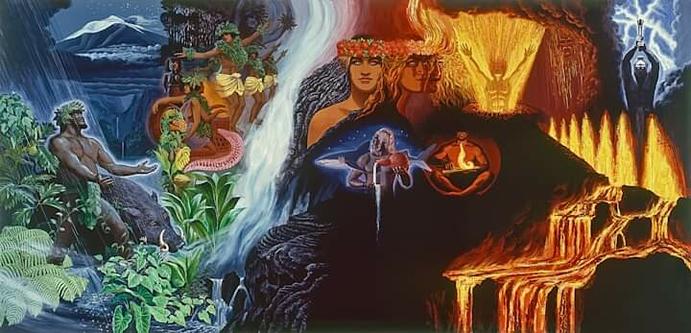
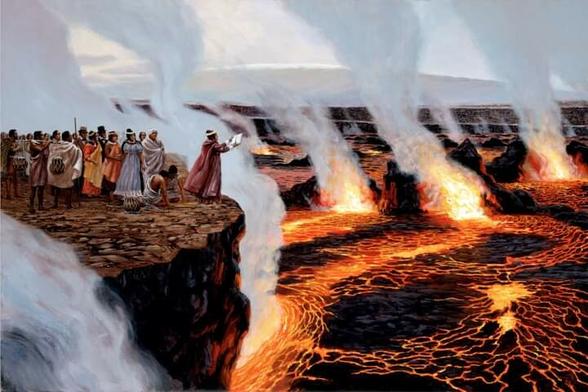
All forms of the natural environment, from the skies and mountain peaks, to the watered valleys and lava plains, and to the shore line and ocean depths are believed to be bodily manifestations of Hawaiian gods and deities.
It was the nature of place that shaped the cultural and spiritual view of the Hawaiian people. "Cultural Attachment" embodies the tangible and intangible values of a culture - how a people identify with, and personify the environment around them.
It is the intimate relationship (developed over generations of experiences) that people of a particular culture feel for the sites, features, phenomena and natural resources etc., that surround them - their sense of place. This attachment is deeply rooted in the beliefs, practices, cultural evolution and identity of a people. (Kent)
The Hawaiian Kumulipo is a genealogical prayer chant linking the royal family to which it belonged not only to primary gods belonging to the whole people and worshiped in common with allied Polynesian groups, not only to deified chiefs born into the living world within the family line, but to the stars in the heavens and the plants and animals useful to life on earth, who must also be named within the chain of birth and their representatives in the spirit world thus be brought into the service of their children who live to carry on the line in the world of mankind. (Beckwith)
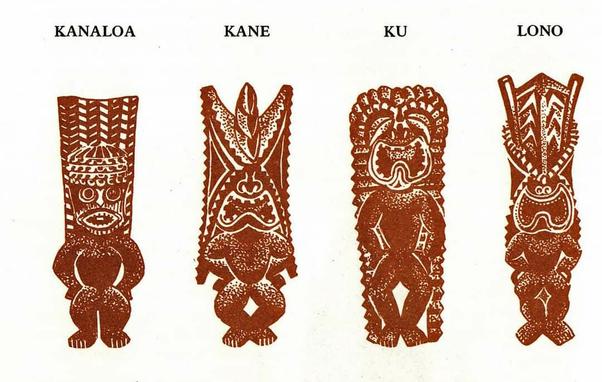
Hawaiians honored a kind of diffused hierarchy of gods, headed by Kanaloa, Kāne, Kū and Lono. Each has his areas of responsibility or “departments.” (Kanahele)
Kāne heads the areas of procreation, fresh water, forests, certain plants and animals. Kū oversees war, politics, certain fish and shrubs, and trees.
Lono is in charge of the peace, agriculture, the weather and healing. Kanaloa’s responsibilities suggest an important role of the oceans, voyaging and fishing.
In addition to these patron gods, many lesser deities were recognized who had their own responsibilities. Certain akua watched over certain professions (healers, dancers, canoe makers, tapa makers, astrologers, etc.)
There were also family gods, and gods for individuals. Each family had its own ʻaumakua (personal god) that watched over and protected them. For some it was the shark, others the pig, and so on. It was thought that spirits could communicate to the living through dreams and often appeared in the form of the family’s ʻaumakua.
Likewise, a vast number of demigods (kupua) that took life forms and represented as part human and part god and often tell of historic and heroic struggles between different kupua.
Kupua stories tend to follow a regular pattern. The kupua is born in some non-human form, but detected and saved by his grandparents (generally the mother’s side,) who discern the divine nature. He is won over by some chief and sent to do battle with his rival. (Beckwith)
Within these various major natural forms, gods, lesser gods, ʻaumakua, kupua and even humans was ‘mana’ – a spiritual energy. It is therefore an external and internal force within and around us.
“The missionaries found that the conflict between the light of Christianity and the darkness of heathenism was no momentary struggle.” (Bingham) The Hawaiians were criticized for believing in a great many spirits, worshipping ‘false gods’ and setting up alters in their honor.
This polytheism (worship or belief in multiple deities) was not and is not unique (although modern Christians may reference it differently.) This is not to suggest the faiths are the same; there are, however, signs of similarity that should not be ignored.
A recent discussion on cultural beliefs helped me see that even in today’s Christian faith, while one God is ever present – Christian worshippers look to and seek guidance and assistance from others within the religion, beyond God.
Take, for example, the Catholic religion and recent beatification of two saints with Hawaiʻi ties, Saint Damien and Saint Marianne. Roman Catholic canonization requires evidence of miracles attributed to that person's intercession. People pray to the religious members for help; multiple miracles may move that member to saintly status.
Catholics pray to God; but within the religion are numerous Saints and Angels who are also looked upon and prayed to; as well as others (as former Father Damien and Mother Marianne, before their elevation to Sainthood.)
During Pope Benedict XVI’s term as Pope (2005-2013) at least 45 new saints were added to the Catholic roles; so, the list of saints continues to grow.
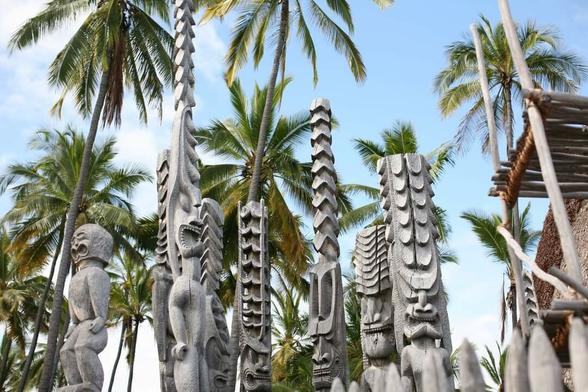
Likewise, look at the monumental edifices erected for worship by other religions, including Christianity. Houses of worship are not simple structures and each has an alter and other religious representations.
Again, I am not saying they are the same; however, it looks like we may all be more similar than we sometimes think."
© 2023 Hoʻokuleana LLC
 SaltPhoenix