All eyes are on the OSIRIS-REx spacecraft, as it gets ready for a special delivery to earth of a capsule filled with pristine material collected from the asteroid Bennu in 2020.

The capsule should land around 10:55 a.m. EDT on Sunday at the Air Force Test and Training Range in Utah.

Here is a map of the location of the spacecraft, currently at a distance about 2x that of the moon.

https://eyes.nasa.gov/apps/solar-system/#/sc_osiris_rex?rate=0&time=2023-09-23T00:12:39.763+00:00
#OSIRISREX #Bennu
1/n

Eyes on the Solar System - NASA/JPL

Explore the 3D world of the Solar System. Learn about past and future missions.

Eyes on the Solar System - NASA/JPL

Here is a nice recap of the OSIRIS-REx mission and a preview of the events that will take place on Sunday morning EDT.

https://youtu.be/O8R2hsoIgTc
#OSIRISREX #Bennu
2/n

To Bennu and Back: Journey’s End

YouTube

The OSIRIS-Rex spacecraft will swing past Earth after releasing the capsule. The mission will be renamed OSIRIS-APEX ('APophis EXplorer'). OSIRIS-APEX will go on to rendezvous with the near-Earth asteroid (and potentially hazardous object) 99942 Apophis in April 2029.

https://en.wikipedia.org/wiki/99942_Apophis
https://solarsystem.nasa.gov/asteroids-comets-and-meteors/asteroids/apophis/in-depth/
#OSIRISREX #Apophis
3/n

99942 Apophis - Wikipedia

Bennu vs Apophis, both from Egyptian mythology.

Bennu was an ancient Egyptian deity linked with the Sun, creation, and rebirth.
Apophis was the ancient Egyptian deity who embodied darkness and disorder.

Both asteroids have near-Earth orbits and are potentially hazardous objects (PHOs).

https://en.wikipedia.org/wiki/Bennu
https://en.wikipedia.org/wiki/Apep
#OSIRISREX #Bennu #Apophis
4/n

Bennu - Wikipedia

The various surface features on Bennu are named (by the International Astronomical Union) after birds and bird-like creatures in mythology.

The asteroid’s surface features include craters, dorsa (peaks or ridges), fossae (grooves or trenches) and saxa (rocks and boulders).

How many of the names shown on the map below can you recognize?

https://www.asteroidmission.org/iau-features-3/
Decoder ring at https://en.wikipedia.org/wiki/101955_Bennu and https://planetarynames.wr.usgs.gov/SearchResults (select Advanced Search and then Bennu).
#OSIRISREX #Bennu
5/n

Here is a zoom-in and closer look at the sample collection site named Nightingale located within the Hokioi crater on asteroid Bennu.

OSIRIS-REx touched down and collected the regolith sample in a dramatic operation on October 20, 2020.

https://iopscience.iop.org/article/10.3847/PSJ/ac5597
#OSIRISREX #Bennu
6/n

The Touchdown.
Oct 20, 2020.
https://youtu.be/xj0O-fLSV7c
#OSIRISREX #Bennu
7/n
OSIRIS-REx Touches Asteroid Bennu

YouTube

At 13:35 EDT (17:35 UTC), OSIRIS-REx is 500,000 km away from Earth. Another 21:20 hours to go before the capsule with regolith samples from asteroid Bennu lands on Earth.

https://eyes.nasa.gov/apps/solar-system/#/sc_osiris_rex/distance?time=2023-09-23T17:35:00.000+00:00&rate=0&to=earth
#OSIRISREX #Bennu
8/n

Eyes on the Solar System - NASA/JPL

Explore the 3D world of the Solar System. Learn about past and future missions.

Eyes on the Solar System - NASA/JPL

Bennu is a carbonaceous asteroid with an orbit that brings it to the proximity of earth's orbit.

It has a 1-in-1750 probability of impacting Earth between 2178 and 2290 with the highest risk on Sept 24, 2182.

Size: 565 m × 535 m
Mass: 73 billion kg
Aphelion: 1.3559 AU
Perihelion: 0.89689 AU

It's orbit shifts by tiny amounts every year due to gravitational effects and due to something known as the Yarkovsky effect.

https://ssd.jpl.nasa.gov/tools/sbdb_lookup.html#/?sstr=bennu&view=VOP
https://en.wikipedia.org/wiki/101955_Bennu#Photometry_and_spectroscopy
#OSIRISREX #Bennu
9/n

Small-Body Database Lookup

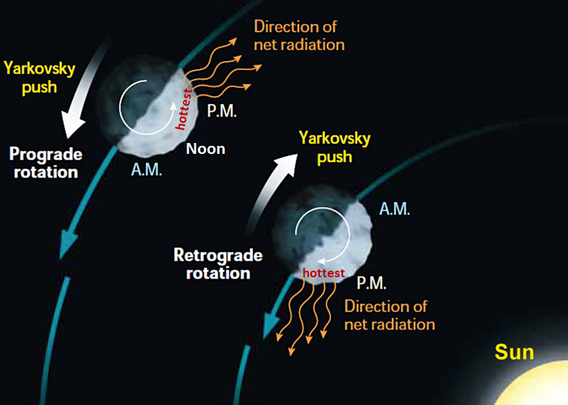
The Yarkovsky effect affects the orbit of small rotating bodies.

An object's day side heats up due to the sun and gradually radiates away the heat as it rotates. The surface is hottest and the radiation highest not at noon but around 2-3 p.m. This creates a net force in the 8-9 a.m. direction as shown below.
With prograde rotation, the force speeds up the body and expands its orbit. For retrograde rotation (like that of Bennu), the orbit shrinks.

https://skyandtelescope.org/astronomy-news/apophis-pays-a-visit-this-week/
10/n
#Bennu #Yarkovsky

Asteroid Apophis Pays Earth a Visit This Week

When a potentially hazardous asteroid glides safely past Earth on March 6th, astronomers will conduct a dress rehearsal for a dramatic close-miss pass in 2029.

Sky & Telescope

The DSN station at Madrid is now communicating with the OSIRIS-REx spacecraft.

Distance at 19:30 EDT (23:30 UTC) = 371,000 km.
Downlink data rate = 40 kbps.

It has traveled 129,000 km in the last 6 hours at an average speed of 21,500 km/h.

On the other side of the Atlantic, DSN Goldstone is receiving data at 160 bps from the venerable Voyager 1 spacecraft now 24,100,000,000 km away!

https://eyes.nasa.gov/dsn/dsn.html
#OSIRISREX #Bennu #DSN
11/n

Deep Space Network Now

The real time status of communications with our deep space explorers

Deep Space Network Now

Here is the timeline of the key events tomorrow morning for the OSIRIS-REx sample return mission -

6:42 a.m. EDT - Release of asteroid sample capsule from OSIRIS-REx spacecraft.
10:42 a.m. EDT - Spin-stabilized capsule enters Earth's atmosphere
10:55 a.m. EDT - Touchdown

NASA webcast begins at 10:00 a.m. EDT.

https://blogs.nasa.gov/osiris-rex/2023/09/08/heres-how-sept-24-asteroid-sample-delivery-will-work/
#OSIRISREX #Bennu
12/n

Here’s How Sept. 24 Asteroid Sample Delivery Will Work – OSIRIS-REx Mission