#ThursdayIsKiteDay
1/7
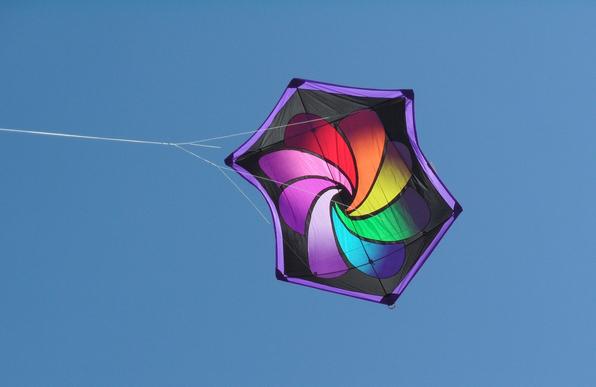
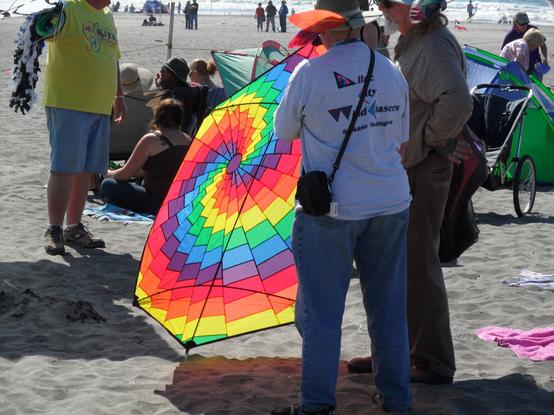
Today we are going to cover Rokkaku kites, a traditional Japanese fighter kite, that when adopted by western kite makers, makes a fine platform for artists. All of today's pictures are from the 2012 Washington State International Kite Festival, apparently a time when we had both a very sunny Saturday and I had a decent camera.

A Rokkaku is a six sided kite. It is traditionally slightly taller that it is wide, although some variation exist. It has a vertical spine and...
2/7
…two cross spars (3 sticks). The cross spars are parallel and neither crosses through the middle of the kite. They are both bowed, although the lower one may be bowed more deeply, depending on wind. That puts it in the general category of "flat and bowed kites". Based on line and flight angle, which is usually around 45 to 65°, it fits well in the category of broadside kites, as opposed to soaring kites, and is best flown at a low altitude (100-250 feet) so the artwork on the face of...

3/7
…the kite can be easily seen. The Baden Powell "Levitator" kite, which was patented (No 17,683) in Great Britain in 1895 (during the aviation boom that lead to the development of the airplane) is identical, and the Levitator was based on sailors' sketches of rokkaku kites.

Kiting, in general, was introduced to the Japanese by Buddhist missionary monks from mainland China. The Japanese took kiting to another level, as they did with ink making, rice planting, and many other imports. At one...

4/7
...point there were kite forms specific to a particular caste and classes, at another, specific provinces. The rokkaku dako (six sided kites) are native to Niigata Prefecture, and are fought across the Nakanokuchi River at an annual tako-kichi matsuri (kite-crazy festival) in the city of Shirone. At this festival they fight a few giant rectangular kites (odako, 23 x 16.5ft and requiring 40-50 people in a team to maneuver) and about a thousand, 10ft x 6.5ft, rokkaku-dako. These later kites...

5/7
...are flown by individuals and smaller teams.

The point of kite fighting in Shirone is not to cut your opponent's kite free, as it is in India, China, Korea, and Brasil, but instead it is to entangle your kite with the line of your opponent's kite. After that it becomes a tug of war, with the river being the dividing line, and whichever side recovers more line on their side is declared the winner of a particular match. The kites, which are made of painted paper and bamboo, are destroyed...

6/7
...in the process. The bones (spars) can be used next year, but the art of samurai and traditional folk tales is destroyed, to be repainted on next year's kites.

Obviously very different from our sturdy western rokkaku kites of ripstop nylon and graphite spars, that are never fought, but our roks continue the tradition of being decorated with faces and brightly colored designs.

For more information on traditional Japanese kite forms please read the fine book, "The Art of the Japanese...

7/7
...Kite" by Tal Streeter, originally published in 1974 but frequently reprinted.

And here is a link to a good 2019 article on the Shirone tako-kichi kite festival:
https://japan-forward.com/niigatas-giant-kite-battle-a-story-of-retaliation-turns-into-a-festival-tradition/

#HappyKiteDay #Kites

Niigata’s ‘Giant Kite Battle’: A Story of Retaliation Turns Into A Festival Tradition

  Three hundred kilometers west of Tokyo, in the heart of Japan’s Niigata Prefecture, lies Shirone. It is a modest city with a yearly festival that is quite unique — even for Japan.   In early June every year, Shirone hosts its annual “Giant Kite Battle” — a festival otherwise known as tako-kichi matsuri — […]

JAPAN Forward