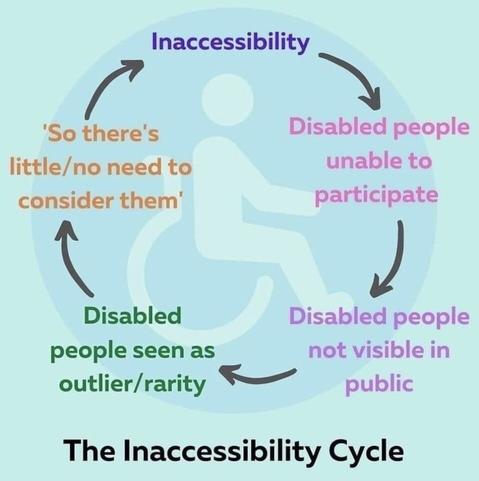

Inaccessibility Cycle
@Jyoti And not every disabilities are visible in the first place.

@Jyoti yeah.

The more ableist a society is the harsher this is...

For example, there's basically no kind of accessibility in Japan regardless if Public Transport or Videogames...

@Jyoti I'm a PhD researcher studying social movements and I'd call this a 'rationalist' account of ableism. It suggests that ableism springs rationally from a gap in public discourse. And if we fill the gap with visibility and awareness, action to reduce inaccessibility will surely follow. Unfortunately ableism is about power not rationality. Abled people are entirely capable of looking at highly visible disabilities and saying 'there's no need to enable their participation in public life.'
@Jyoti Couldn't fit this in my toot but I am also living with an 'invisible disability' (severe mental illness) and as a media-comms practitioner I use my skills to make it visible with very, very mixed effects.

@engagedpractx

Yup, I totally agree with you. And thank you for sharing your personal experience, too!

@engagedpractx

Thank you for this succinct crystallization.

@Jyoti

@engagedpractx How may I learn more about your research?
@Jyoti ALT TEXT: Image shows a cycle labeled with text "The Inaccessibility Cycle" with arrows in a circle superimposed over an icon of a person in a wheelchair. Text in the cycle says "Inaccessibility → Disabled people unable to participate → Disabled people not visible in public → Disabled people seen as outlier/rarity → 'So there's little/no need to consider them' "