Evidence of America’s — and the world’s — climate migrations are mounting.

In this thread, I’ll collect all the papers, news items and anecdotes I find on the subject. Feel free to contribute by using this tag:

#climatemigration

It’s starting with insurers. When homes are destroyed and homeowners lose everything, with no recourse, market forces herd people away from the zones of greatest vulnerability:

https://www.washingtonpost.com/business/2023/09/03/natural-disaster-climate-insurance/

#climate #climatechange #adaptation #climateimpacts

🧵
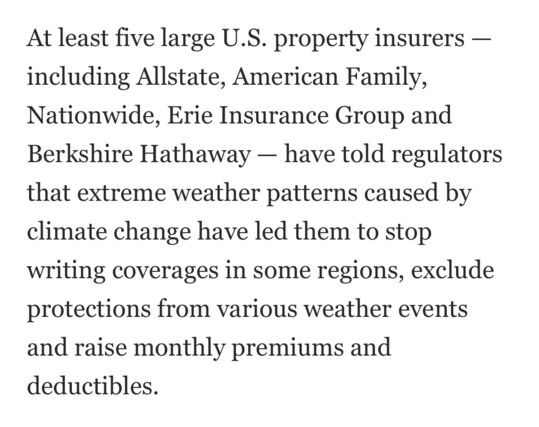
Home insurers cut natural disasters from policies as climate risks grow

Major insurers say they will cut out damage caused by hurricanes, wind and hail from policies underwriting property along coastlines and in wildfire country.

The Washington Post

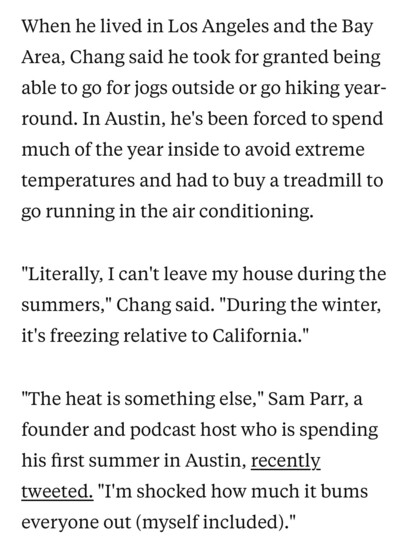
Tech workers who fled to Austin during the pandemic are being repelled — Austin is #3 in the country for outmigration now — by a summer that has smashed all records for heat, with well over a month of days above 100 degrees.

This is a profoundly different weather than Austin had 20 or 30 years ago.

🧵 #climatemigration #climatechange

https://www.businessinsider.com/tech-workers-moved-to-austin-regrets-2023-8

Some tech workers who moved to Austin are having regrets

Drawn by the promise of an emerging tech hub, some tech workers who flocked to Austin found a middling tech scene, subpar culture, and scorching heat.

Insider

@mimsical I've lived in FL, TX (Houston), CA (Silicon Valey), and MA, and visited northern VT when it was darn-cold there (-16F). It's easier to dress for the MA cold than it is to (un)dress for the TX or FL heat. For FL, one factor is the increased ocean (Gulf) heat, which raises the already darn-high humidity.

Also, different people acclimate differently, near-Pacific CA is comfortable to very many people, not everyone can acquire a taste for TX or FL, or for Canadian cold.

@mimsical A tail-risk problem for Florida barrier islands is *if* the north atlantic circulation changes, sea level rise down into the Gulf is likely (there was an incident in 2009-2010 where sea levels rose 5 inches in New England: https://www.nature.com/articles/ncomms7346 -- oddly did not make the news that I usually read). It won't be enough to directly, continuously flood properties, but all the underground infrastructure is at risk; if the water table rises under a road bed, that's bad.
An extreme event of sea-level rise along the Northeast coast of North America in 2009–2010 - Nature Communications

Extreme sea level rises are a threat to coastal communities, but their cause, in terms of seasonal or interannual time scales, has received little attention. Here, the authors combine observational and model data to show that one such rise in 2009–10 was caused by a 30% downturn in the Atlantic overturning circulation.

Nature

@mimsical (I have seen this happen, thanks to an inept land developer in my childhood neighborhood, and one heavy truck turns the road into asphalt crumble. Oversized passenger vehicles won't help.)

Sooner or later municipal finance will become a problem, through a combination of falling property values and risk-averse bond lenders. Strong storms are (historically) not that common in the Sarasota-St Pete-Clearwater area, this might happen before much housing destruction.