
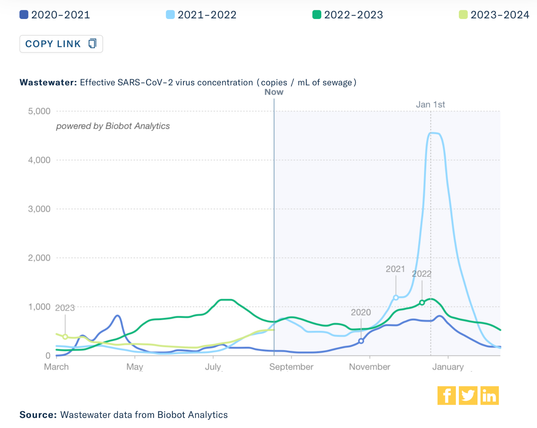
People often say #COVID cases are rising but there are far fewer cases than any other time in the pandemic. Wastewater shows that's false. There are far more cases now than the first summer of the pandemic, and this year's pattern is ominously similar to the lead up to the huge Omicron surge.

@luckytran

I was looking at a similar chart recently & the wastewater patterns are very consistent from year to year - Except for the first few months of 2020, where we were still learning the importance of masking & social distancing, the first year actually kept the levels the lowest - because we were all doing it together. Then in 2021 the Biden Admin removed masks, removed the norm of social distancing, & removed quarantines. 2021 was the worst year of the ongoing pandemic. So far anyway.

@chargrille @luckytran as far as we know. The specific metrics being tracked shifted in 2022 to be more conservative wrt what specifically was counted as a COVID death or hospitalization, nevermind widely acknowledged anecdotes of undercounting. Those were later reflected in the excess deaths, but of course nobody's really tracking PACS which might have been more prevalent in 2022 due to the sheer number of Omicron infections.

@RebelGeek99 I fully agree about the tracking of all kinds.

I was just looking at a chart of wastewater levels, which ostensibly should not change. However, the amount of wastewater monitoring & its geographic extent surely are subject to important fluctuations.

Every wastewater treatment plant in the country should be monitoring #COVID levels & IDing variants.

And if we actually cared to learn about the disease & its spread, we would be funding it.

@chargrille 💯 agree. The wastewater data has been reliable and consistent, though not always easy to interpret for laypeople. I was relying on Biobot.ai for a while since it had my county, though the WA state DOH site has more granular information for stations within my county, but it doesn't go back as far. The copy number bias (i.e., different variants might reproduce better in gut tissues) always makes me wonder how much of a factor that might be, as spotty as surveillance is anyways. There's apparently a formula some people are using to estimate how many people are infected in the community based on signal strength, I'd be curious to know more about that.