
(1/4) I’m very pleased to showcase some research led by early career researchers, now published in The Lancet Public Health.

How much dementia is preventable?

Our team calculated that 38.2% of dementia cases in Australia are attributable to 11 established risk factors. 🧵
https://www.thelancet.com/journals/lanpub/article/PIIS2468-2667(23)00146-9/fulltext
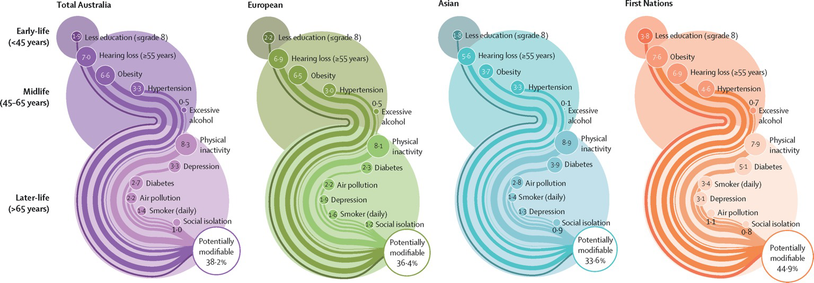
(2/4) We looked at 11 established risk factors: less education; hearing loss; hypertension; obesity; smoking; depression; social isolation; physical inactivity; diabetes; alcohol excess; and air pollution.

Using a population attributable fractions approach, adjusted for communality (to account for shared risk factors), we found that:

1️⃣ physical inactivity (8.3%),

2️⃣ hearing loss (7.0%), and

3️⃣ obesity (6.6%)

accounted for the largest proportion of dementia cases.

(3/4) The 11 established risk factors accounted for a greater proportion of dementia in Aboriginal and Torres Strait Islander people (44.9%) than they did in people with European (36.4%) or Asian (33.6%) ancestry.

This reflects greater disadvantage experienced by Aboriginal and Torres Strait Islander people, leading to greater exposure to the risk factors. However, it also means there’s significant scope to improve brain health & reduce dementia incidence if these risk factors can be improved.

(4/4) For people from all ethnic backgrounds, improving physical activity, preventing and treating obesity, and improving hearing could substantially reduce the incidence of future dementia.

This work was led by Rhiann Sue See and Fintan Thompson from the Healthy Ageing Research Team at James Cook University, with Sarah Russell, Rachel Quigley, Adrian Esterman, Linton Harriss, myself, Sean Taylor, Kylie Radford, Dina LoGiudice, Robyn McDermott, Gill Livingston, and Edward Strivens.

@DrZoeHyde
This sounds interesting. Thank you for posting this. How does hearing loss contribute to dementia?
@vhhancock There are a few theories around this. One idea is that hearing loss might lead to social isolation and depression, which are risk factors for dementia. Alternatively, loss of auditory input might lead to brain atrophy (“use it or lose it”). Or maybe the brain has to work harder to process sound, leaving fewer resources for other tasks. Or hearing loss and dementia could be part of the same disease process. (1/2)

@vhhancock As you can see in the paper that I’ve linked to below, giving people hearing aids seems to reduce their risk of developing dementia.

But there’s also a two-way relationship, because people who have dementia and cognitive impairment may find it harder to use hearing aids. So there’s lots to consider. (2/2)
https://academic.oup.com/ageing/article/51/12/afac266/6931852?login=false

Dementia and hearing-aid use: a two-way street

AbstractObjectives. Hearing-aid use may reduce risk of dementia, but cognitive impairment makes use more challenging. An observed association between reduced he

OUP Academic
@DrZoeHyde I will take a look at the link. Thank you so much for writing back and your detailed response!
@DrZoeHyde Good to see both directions being considered by you. The same probably applies to several of the other risk factors.