
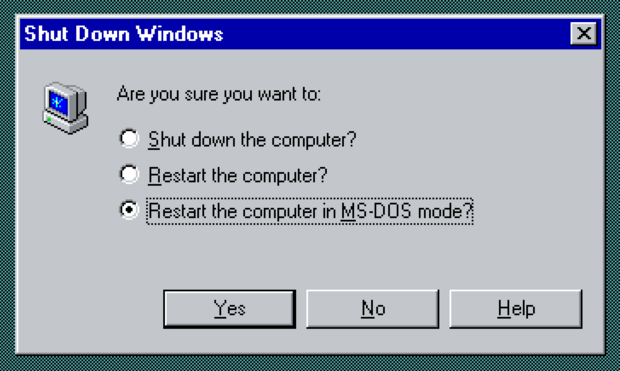
I miss the days when a brand new OS would just let you reboot into a legacy OS. Happy 28th birthday to Windows 95! 🎉🎂🎈🍾🥂
@dosnostalgic let's be fair: Windows wasn't letting you "boot into the legacy OS", it was just letting you quit out of the shell, because at the time, it was literally just a fancy GUI shell for DOS, and remained so (for home users, enterprise users got NT in the early 90s) until Windows XP
@vinesnfluff No. Windows 9x was not "just a fancy GUI shell for DOS". In fact it was sort of the other way around. It was a full on standalone OS that had legacy DOS support fully integrated in its kernel. But if you wanted an actual MS-DOS you had to reboot. There was nothing to quit to, as DOS 7 that was used as a bootloader was completely gone by the time Win9x was running.
@vinesnfluff Here's Raymond Chen, the guy who was essentially responsible for DOS in Windows, on how that actually worked:
https://devblogs.microsoft.com/oldnewthing/20071224-00/?p=24063
What was the role of MS-DOS in Windows 95? - The Old New Thing

It acted as the 16-bit legacy device driver layer.

The Old New Thing
@dosnostalgic @vinesnfluff More like Raymond CHAD for me, this guy is awesome even though I hate Windows and M$

@speaktrap @dosnostalgic Microshaft has done *good work* for Tech.

DirectX as a whole, bringing Multitasking and GUIs to mainstream PCs, the fact that they gave IBM the slip allowing for the entire "PC Compatible" ecosystem, which made computers cheaper over time.

They were never incompetent... They were always evil. "Lawful Evil" to use DnD words :P

@vinesnfluff @dosnostalgic
DirectX wasn't really needed as there was already OpenGL, which was much superior according to John Carmack, and I trust this guy.
OS/2 had multitasking before Windows.
Liberation of PC platform was a bit more compicated and I am pretty convinced it would take off with or without Gates anyway.

@speaktrap @dosnostalgic while I ain't got sources for it, I'd bet a lot of money that the reason Carmack preferred OpenGL was that it allowed him to code closer to the bare metal, which is great if, like Carmack, you're basically a space alien level supergenius.

For everyone else, a library like DX that distanced you from the hardware (especially with how diverse PC hardware had become at that point) and provided a common layer of abstraction between it and software made development of applications infinitely easier.

As for OS/2 I'd have to double check the timeline... But I'm fairly sure it dropped *after* windows 3.0.

... And either way it was codeveloped by the microshaft team and a lot of its code got used on windows too.