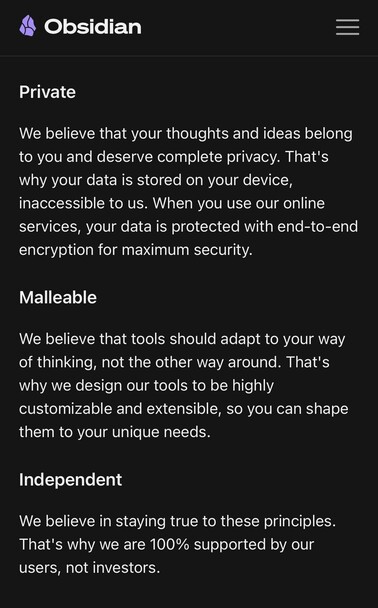
The plan for Obsidian is to never grow beyond 10-12 people, never take VC funding, never collect personal data or analytics.

Continue building with the assumption that software is ephemeral, files matter more than apps. Use formats that are open and durable.

See our manifesto:
https://obsidian.md/about
About - Obsidian

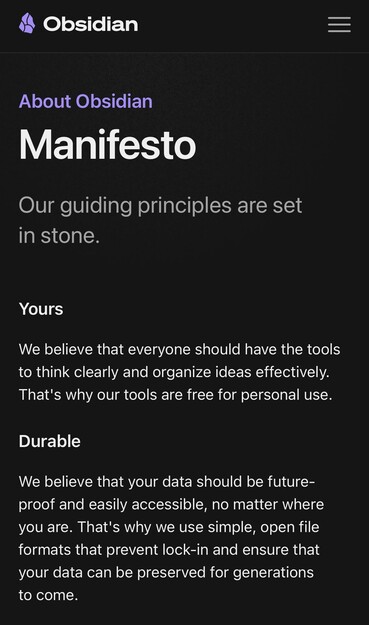
Our guiding principles are set in stone: yours, durable, private, malleable, independent.

Obsidian

From a traditional business perspective the Obsidian approach has many downsides:

we can only focus on 1-2 things at a time, we can't build lots of stuff in parallel like a bigger company can

we have to cover our costs, we can't subsidize pricing — charging a fair price is a disadvantage in the market

we have no lock-in, our users can leave at any time easily

we have less freedom to build fancy features that rely on unencrypted private data (like cloud-based AI) or more sophisticated non-portable data formats

we have limited metrics to inform product decisions, we have to learn directly from what users say

users have the freedom to significantly modify the app via plugins, more things can go wrong or feel less cohesive

... I would not recommend this approach to every business, but these are the tradeoffs we choose knowingly.

@kepano

> we have limited metrics to inform product decisions, we have to learn directly from what users say

I don't fundamentally object to the idea of anonymized telemetry helping to improve a product, but I suspect such data is often used mainly to figure out how to extract more money from me.

@toddz @kepano
Obsidian has *no* telemetry so you can rest quite assured with that.

@nhan @kepano

Thanks, I should have been more clear: I appreciate that Obsidian has no telemetry contributing to metrics, though I'm not completely against any and all telemetry in all cases.