Climate-fueled extremes are endangering people everywhere. So why aren't we seeing an immediate response at scale?

Because they're only dismantling one barrier to action, psychological distance -- and there are two more.

Lack of efficacy is rampant among those already worried about climate change; and paradoxically, the worse the impacts get, the less we think we can do about it. It's a self-reinforcing cycle.

Solution aversion also hardens as the urgency of action becomes ever more evident.

But here's the good news; they can be tackled, too!

Here's how: https://www.youtube.com/watch?v=nkMIjbDtdo0
If I just explain the facts, they'll get it, right?

Global Weirding is produced by KTTZ Texas Tech Public Media and distributed by PBS Digital Studios. New episodes every other Wednesday at 10 am central. Brou...

YouTube
@kathhayhoe This is great! (and has been) -- especially the emphasis that more and more facts doesn't convince people who don't want to be convinced...
@ai6yr @kathhayhoe As far as I can tell, the only solution that can work is regime change (democratically, of course!). Is that what you're talking about? It feels like "making good choices"-type solutions are just another smokescreen, because they can't get enough uptake to matter. (We built a Passivhaus in 2013, but I don't see building codes changing, for example).
FACT SHEET: Biden-Harris Administration Launches Initiative to Modernize Building Codes, Improve Climate Resilience, and Reduce Energy Costs | The White House

New Building Codes Initiative will boost resilience to the impacts of climate change, lower utility bills for homes and businesses, and prioritize underserved communities Today, the Biden-Harris Administration is announcing a National Initiative to Advance Building Codes that will help state, local, Tribal, and territorial governments adopt the latest, current building codes and standards, enabling…

The White House
@GreenFire @ai6yr @kathhayhoe That's kind of the opposite of what I meant, though. "a difficult political obstacle" exists because we aren't electing the right people. We aren't electing the right people because we (collectively) don't want to. Is that something we can change? That's what I'm getting at. "It's politically difficult" is by design—it's not inherently difficult, but is engineered that way by carbon profiteers.

@abhayakara @ai6yr @kathhayhoe
Building codes are local at the level of almost 4,800 jurisdictions in the USA and the difficulty found towards updating them is not entirely caused by those I call #FossilFools as you rightly point out as being bad actors blocking #ClimateAction

No, it's not hopeless though, but imo the consumers are who we've got to manage to reach. Only when there's a market demand for net-zero will businesses start providing it rapidly enough.

Regulations are too slow imo.

@GreenFire @ai6yr @kathhayhoe To be clear, I'm asking Ms. Hayhoe, not you, to answer this question. Your answer appears to be the stock neoliberal answer: if we help people to make good choices, they will make good choices, and that will avert climate catastrophe. This is a strategy for delaying progress, not a way to make progress. I don't know if you are sincere in thinking this could work, but the evidence thus far is that it doesn't work at all. Look at "light trucks" post Obama.

@abhayakara @ai6yr @kathhayhoe
Perhaps Dr. Hayhoe will provide you with an answer more in line with your political ideology as demonstrated by your reply to me with its implied dismissal of my expertise.

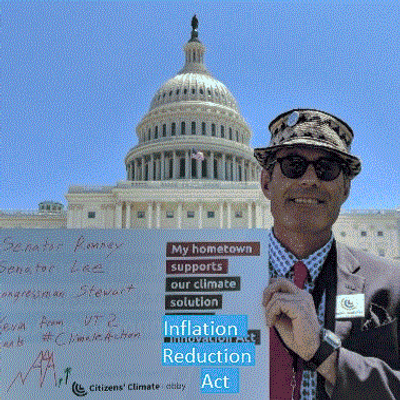
These survey results suggest how "we help people to make good choices" as you ask.

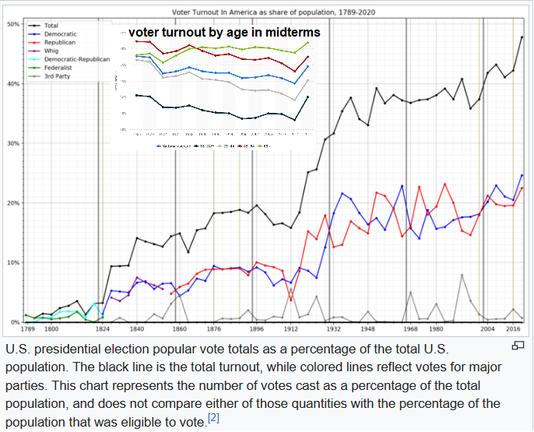
We have to increase voter turnout in order to have representatives that more closely align with the majority opinion on issues like #GlobalWarming especially at our primary elections as seen in North Carolina.

@GreenFire @abhayakara Not to wade into the fray, but I giggled at the "Whig Party" being included in that graph.
@ai6yr @abhayakara
Democratic-Republicans too! Got to love Wikipedia, at least I do.
@GreenFire @ai6yr @kathhayhoe sorry, my previous response was needlessly snarky. But please don’t assert expertise here. I’m asking for engagement, not reassurance. The model you have for this is centralized persuasion, but historically things like this get solved either by tort (smoking) or by grassroots work (above ground test ban). Centralized persuasion has not worked.
@abhayakara @ai6yr @kathhayhoe
I would argue that we don't have an historical analogy to the existential crisis we're facing, but whatever. Hopefully you'll find the answer you're looking for somewhere.

@GreenFire @ai6yr @kathhayhoe Ozone and leaded gas didn't have the same countervailing profit incentive, but tobacco certainly did.

BTW, regarding "market demand," another thing to keep in mind is that the market for green housing is always always going to be smaller than the number of young folks who would like their future not to be a burning disaster. So this also militates for a grass roots approach, not a market demand-based approach.