Here's a botanical gripe that drives me up the wall every so often: using gendered terms for plants. We talk about male and female parts and while reproduction-wise it's understandable how it got to be that way, it's actually massively unhelpful because people can't stop themselves from having all these connotations of gender roles, just like they do for people, but for plants. Which isn't just my conjecture - historically, women were prohibited from being botanists because of these gendered ideas, because of female eggs being impregnated by pollen from male parts, flowers with anthers and styles being described as a bed with so many men and so many women... it was all considered far too hot and steamy for the suggestible female mind.

Which is why for centuries, European women were generally only able to enter the field of botany by becoming illustrators. Most great botanical illustrators from the eighteenth and nineteenth centuries were women.

(1/3)

Just one example: the mindblowing volume that botanist Anne Wollstonecraft wrote in the 1820s in Cuba, only permissable because she did so under the guise of being an illustrator - beside making exquisite illustrations and detailed descriptions, she interviewed the indigenous people of Cuba and wrote about the ways in which they saw and used plants. Something a gentleman explorer would never ever do! The book was never published, only a single (!) hand-written (!!!) volume exists. It makes one weep at what could have been, had women been permitted to participate in this sexy, horny field of botany. How much richer we could all have been, how much more complete our understanding of the world. All because we had to frontload the whole thing with our own prejudices and sexist nonsense.

(2/3)

Returning to my original point, which I lost sight of almost immediately: I wish we would stop referring to plants by the gendered terms we invented to refer to ourselves. Plants don't have genders, and thinking they do has caused a surprising amount of misery.

A happier postscript: to this day, there's a strong tradition of female botanical illustrators in Europe and the UK; I know plenty personally, all the masters are women. As has always been the case, people are resilient in the face of oppression, and so things improve and times change - though the past echoes on forever.

By the way, the mindblowing volume, "Specimens of the plants and fruits of the island of Cuba", which was discovered only a few years ago, can be viewed here: https://babel.hathitrust.org/cgi/pt?id=coo.31924100271489

(3/3)

Specimens of the plants and fruits of the island of Cuba, v.3+.

HathiTrust
@anomalocaris thank you for this!
@LadyTerpsichore @anomalocaris The part about female botanists is spot on. The part about gender in plants, I think, is a bit more complicated. Many plants have individuals that produce sperm and individuals that produce ova. Those plants have what I'd call sexes (male and female). Botanists traditionally use the term gender instead of sex for some reason. But most plants are more complicated than male and female. And even in the simple cases, it's only the gametophytes that produce the gametes.
@LadyTerpsichore @anomalocaris For example, a fern like you'd buy in a pot is a sporophyte (it doesn't make gametes) and is thus neither male nor female nor anything in between. But the spores grow up into gametophytes which do meiosis and make gametes (sperm that swim and ova that are fertilized). A fern gametophyte is a tiny, fragile little thing--but is a plant nonetheless--and they come in male or hermaphrodite.
@rspfau Does that little gametophyte have a gender, though? And 'hermaphrodite' refers to Hermes and Aphrodite - what does that have to do with a plant? That's what I'm driving at. We're using confusing terms that could be replaced by better ones, both more informative and carrying with them less of a cultural and social burden.

@anomalocaris Given that the meaning of the term gender has changed, sex [may?] be the more accurate biological term. Yes, the little gametophyte is either male or a combination of male and female. I don't see what's wrong with using a term derived from a fascinating Greek myth. The only other choice is to use a random letter generator to coin a new term. How about Abbatitate = an individual that produces both sperm and ova?

I guess I'm just not seeing where the confusion and burden is.

@rspfau I entirely agree that there's nothing inherently wrong with these words, the problem for me comes from the connotations they have for many people - sex and gender are very much mixed up in our language. Male and female plants, while referring to genetic states, inevitably conjure up ideas of gender for people. I teach and I talk a lot about plants, and I know people will describe dioecious or grafted plants as transgender, even if only jokingly.

I'm talking about plants because that's what I know - but maybe it would be better to drill down into the language to disambiguate the ideas of sex and gender entirely. Have 'sex' refer to a genetic or physiological state, and 'gender' exclusively to the human condition, so we wouldn't have to change a bunch of terminology, just two definitions. But somehow, that seems no more surmountable a task, and even the physiological descriptor would be full of exceptions and peculiarities when applied to the entire living world.

@anomalocaris Studying the etymology of the word gender reveals its meaning has been in flux for quite some time. This is true of many words and is just the nature of language. Its fascinating that botanists seem to have used gender when other biologists have used sex. The word sex to refer to male and female has been more stable. So I still dont see any issues with continuing with that term.
@anomalocaris When we coin new terms, everyone then must learn meaning of both terms in order to understand the historical literature. So the problem doesnt just go away....it compounds.
@anomalocaris Nature is so diverse that there will always be "exceptions and peculiarities when applied to the entire living world". No terminological scheme can ever be created to encapsulate it all.
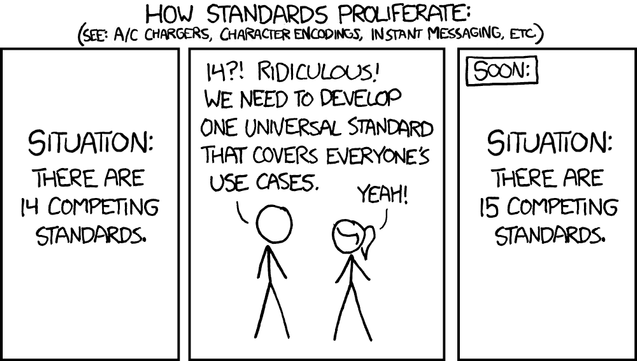
@rspfau Goodness knows we keep trying... as the old adage goes: