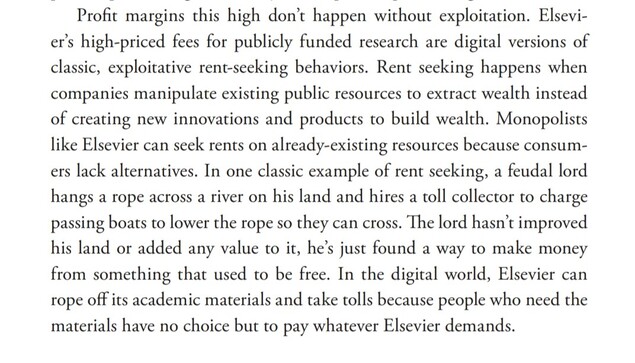
On academic publishing, Elsevier, rent-seeking, and - of course - profit margins (excerpt from "Data Cartels" by Sarah Lamdan)
@jelena3121 I’m not so sure this metaphor of the rope across the river works. If the lord had laborers who (1) linked each boat & boatman to an established identification scheme, (2) organized other boatmen to evaluate each boat seeking passage, (3) worked to improve their usability & aesthetics, (4) made each passing boats discoverable by those looking for something specific, (5) took on responsibility for the continued life of each boat, etc., etc.
@jelena3121 If this lord arranged for all this, we could still argue that he was charging too much for passage + services, that not all the services were necessary or adequately performed, that services were improperly addressed (to government agents or boat users instead of boatmen), that the lord could be paid by someone besides boatmen, etc., etc. We should probably talk about the river, which is actually a constructed channel, requiring its own improvement & maintenance . . .

@jelena3121 In short, we should be wary of metaphors for scholarly communication that figure knowledge as something that just naturally flows, with the malevolent forces blocking the flow. Knowledge doesn’t flow: rather, it’s mediated.

If we want to develop something better than the extractive commercial form of scholarly publishing (I certainly do), flow gives us no purchase on all the work that will need to be done.

#ScholarlyPublishing #BadMetaphors

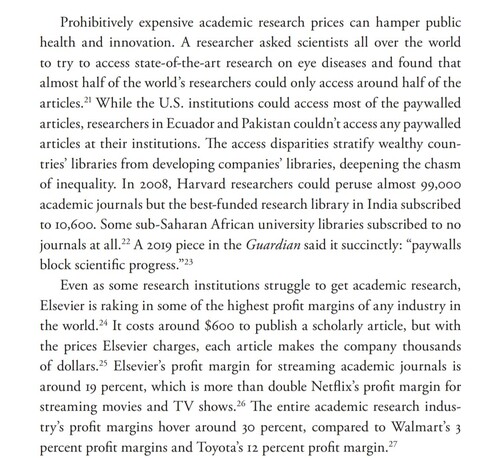
@timelfen You're right, and it gave me pause as well, although I didn't find it so important in the broader context of that chapter (which is on academic publishing). The reason I posted the second image was the first half of the paragraph, especially the first sentence, not the metaphor.
@jelena3121 Got it! Perhaps the focus of my criticism should be on rent-seeking instead of flow, although I can also see how these pointers to what publishers do beyond putting gates in front of what already exists suggest the limits of rent-seeking as a sufficient explanatory framework for understanding commercial publishing. As always, my concern is how such frameworks hinder our ability to imagine or create something better.
@timelfen Right, exactly. Having read most of the book now, I have to say that I'm not very satisfied with Lamdan's treatment of the subject of academic publishing (it's actually only one of several areas she is interested in and writes about, the others being legal, financial, and news). She doesn't go very deeply into it and anyone who has been following the debates involving Elsevier & co. a bit more closely will be familiar with more or less everything said in the book about it.
@timelfen That said, I think for the science studies folks, perhaps the other chapters are bringing something to the table, rather than what she writes about scientific publishing. And as far as I gather some 2/3 of it in, the whole book is about RELX and Thomson Reuters and their sprawling business across sectors.