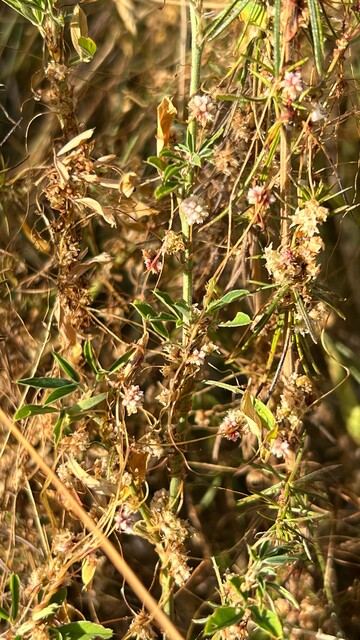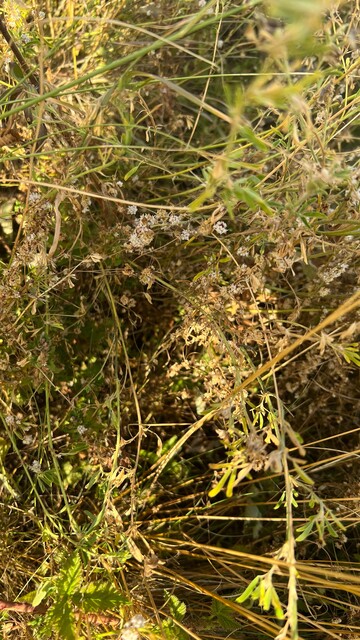
Yes, these are flowers! Dodders are parasitic relatives of Bindweed with rudimentary leaves and no chlorophyll. They look like strings winding and twining around their hosts.This twining rope of tiny white flowers coiling around a stem of Goldenrod is the inflorescence of Rope Dodder (Cuscuta glomerata).

#FloweringFriday #Florespondence #ParasiticPlants

@dandelion I have once noticed different Cuscuta campestris plants on the same meadow have a different floral fragrance.

Not sure if it's phenotypical, or whether it might depend on the host plant, but I found it pretty cool.

Also, dodders find their hosts by "smelling" host-specific volatile organic compounds in the air.

@Mercival That's so cool, I was wondering about that! If you have more interesting info or links, please send them my way. Plants communicate and interact with their environment in much more sophisticated ways than we think.

I didn't know about Dodders until recently - but then I found two different species in our forest. Now I'm fascinated. I'm waiting for the other plants to open their buds to hopefully identify them. There are seven documented Cuscuta species in my area with a few more theoretically possible.

@dandelion I can't really find the original paper, and there has been a lot of research done on it since. But the gist of the experiment was using a dodder that would preferentially seek out tomatos over other hosts.

What they would eventually do was put a hood over the tomato to capture the VOC's, then concentrate the exudate.

@dandelion After that they would present the dodder with a tomato plant covered, so it wouldn't exude VOC's, and the concentrated exudate. The plants would preferentially lean towards the vial of exudate even though there was no host to attach to.

Then there's root parasites like Orobanche. Their seeds are so small, they wouldn't make it without a host, so they've learned to identify strigolactones of the host, which the plants' roots release into the soil to attract mycorrhiza.

@Mercival Thank you, I will have a look for those papers!

@dandelion Speak of the devil! :)

Woah, there's also 6 species in my country, so that might explain the different ways the flowers smell.