 VE7FIM
As part of the #Protonema Electronics Prototyping and Learning System (https://github.com/dslik/protonema), I made an intersection simulator, where people can learn how to write state machines by simulating a traffic light system.
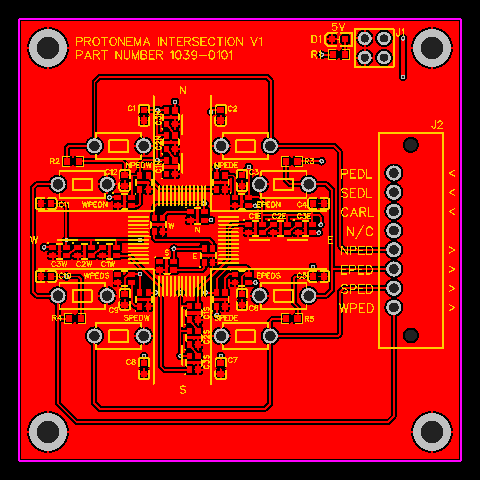
But while this is a textbook exercise (along with simulating an elevator), why cars?
Why not trains?
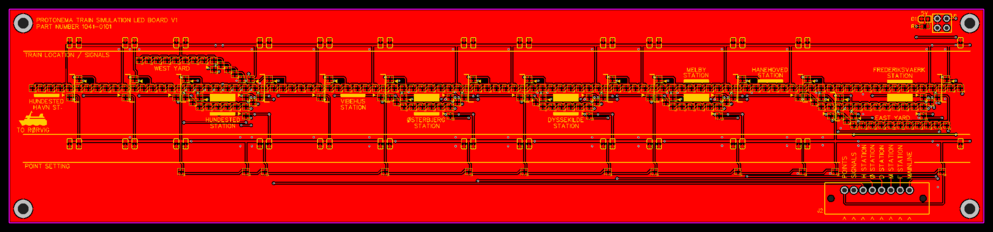
So I made another board where people can learn more programming skills by simulating a small railway.
Much better!
So, one thing led to another, and now I'm working on a hex tile-based train toy, that allows you to create different track arrangements by snapping different hexagonal building-blocks together, then running your trains on them. :)
In-progress repo here: https://github.com/dslik/hex-trains
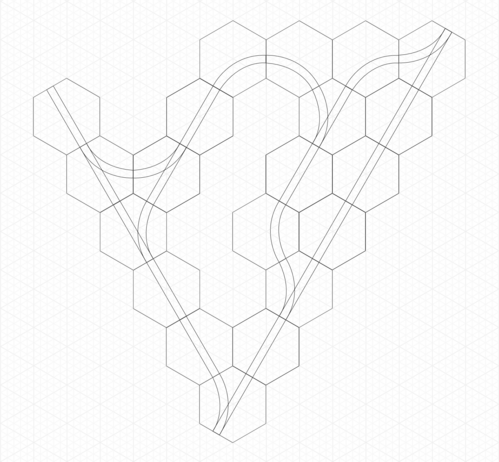
I've been looking at all sorts of ways to allow these hex tiles to easily snap together, and it's been an exercise...
Headers are too finicky to accurately mount.
Pogo pins won't mate very well against each other, and is also a mechanical challenge to attach to the boards.
And all of these would completely blow my BOM targets out of the water.
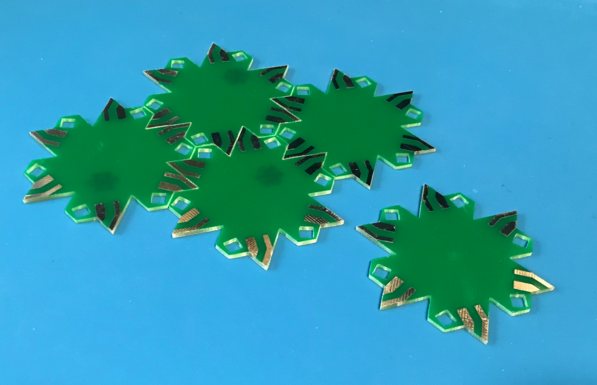
So after around 20 different permutations, I finally settled on this:

The ENIG fingers press against each other, allowing me to have:
a) Four connections between each board
b) Ability to connect a third board to the concave section formed by two boards
c) No shorting and proper power sequencing when connecting boards, regardless of the angle.
Going with a 100% PCB-based approach dramatically reduces the costs.
Next step will be to get some fabricated and see how reliable it is.
Day 275 of #PCBs (Assembly and testing edition)
The mechanical design works! These little guys tesselate so nicely! And you can insert them from the side even when connected together.
@ve7fim should be able to solder across without much effort.
if you find these are tricky or unreliable, add the smallest allowed PTH at each boundary and pay for castellated holes. that'll give you a nice well for the solder to flow into, improving mechanical and electrical reliability.


 Graham Sutherland / Polynomial