Why #pedestrian #infrastructure matters (a thread):

I have to drop my car off at the shop later this week for some maintenance that requires me to leave it for an afternoon. The shop is not really withing my walking radius (especially in July), and my partner’s and my work schedules make it inconvenient for me to ask her for a ride at the time I need it. (1/12)
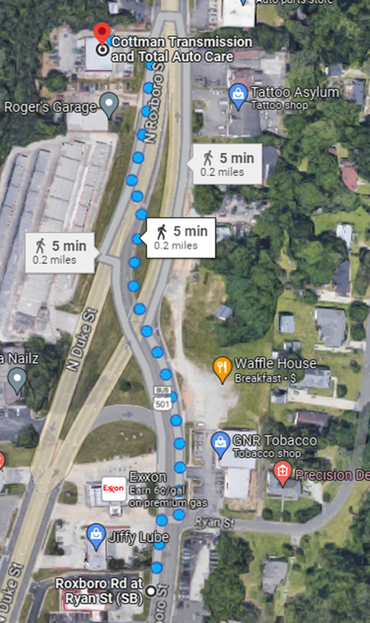
However! There is a bus stop less than a quarter mile from the shop that goes right by my neighborhood. If I time it right, I can get home in 15-20 minutes for free and at no bother to anyone. (It would take me ~10 to drive.) (2/12)
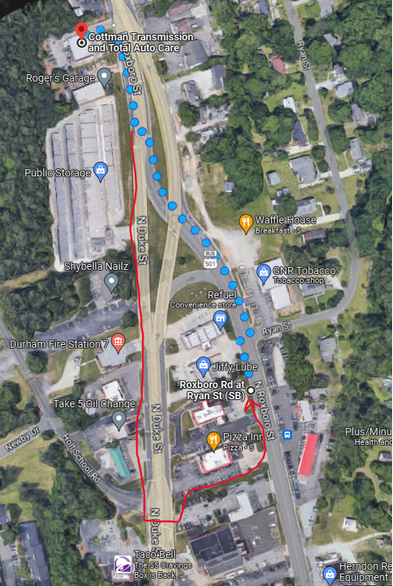
Unfortunately, walking the 1,191 feet from the shop to the stop in the most direct manner is…inadvisable. (3/12)
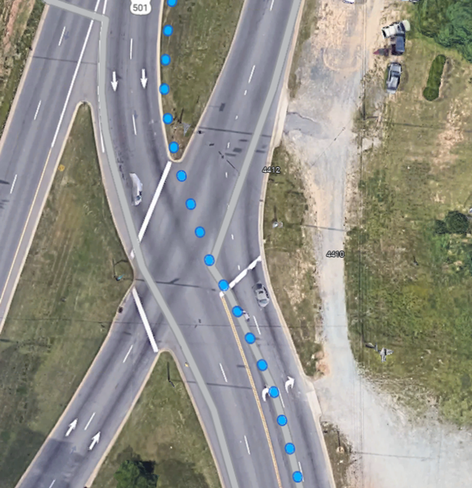
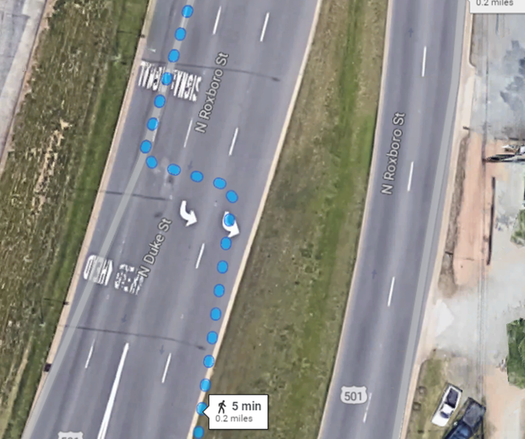
Let’s zoom in on those street crossings that Google Maps has helpfully suggested, shall we? (4/12)
The good news here is that traffic is only coming from one direction. The bad news is that there are four lanes of it, it is FAST, and people are often making last-minute lane changes to get to either Duke or Roxboro at the split. I would not cross here unless it was very early in the morning, and even then I’m not sure. (5/12)

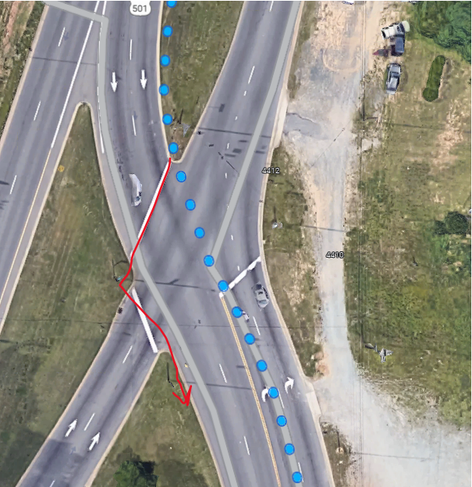
Setting aside the suggestion to walk in the middle of oncoming traffic on Roxboro, even crossing these two lanes the sensible way is a huge problem. Again, traffic is only coming from one direction, but here it is either turning right from Roxboro, or coming straight from Duke. Which is to say, there is *always* car traffic with the right of way here.

For a pedestrian, crossing here is suicidal. (6/12)

It would be theoretically safer to cross as shown here, because you can work with the lights and you ought to have good visibility with the cars stopped at the line. However, because there are no marked crosswalks, no pedestrian signals, and no pedestrian infrastructure whatsoever, literally no driver is expecting you to be here doing this. That is incredibly dangerous. (7/12)
If you take the second option above, you can at least avoid this very inadvisable crossing at Ryan Street, where there is no crosswalk, no signal, and two lanes of fast moving traffic in each direction. The nearest designated crosswalk is nearly a quarter mile south at Horton Road, meaning a half-mile detour (double the distance you just walked from the auto shop). (8/12)
The actual way to do this, of course, is to walk down Duke to the crosswalks at Holt School Road, cross Duke, and cut through the parking lots to Roxboro and up to the bus stop. This adds about 900 feet to the walk, which is not a big deal…in the context of only needing to do it once. However… (9/12)

1) It’s worth pointing out that I have lived here many years and driven through this intersection thousands of times, and I didn’t know the way to do this without scouting it out on Google Maps first.

2) People who rely on public transit have to make these calculations every day of their lives. (10/12)

A 900-ft (approximately 5-min) detour is not a big deal for me. I’m able-bodied, and I only need to do this once. And frankly, I have the means to just call an Uber if I don’t feel like it (which I may!)

This is a position of enormous privilege. (11/12)

For someone who does this every day, these detours add up. If they’re late for work and the next bus doesn’t come for an hour, they are going to take otherwise unnecessary risks.

Effectively, this is a tax on poverty, extracted in time, energy, health, and safety. (fin)

Coda: I realize this framing could be seen as equating "transit users" with "poor people." Not my intention. Everyone should use transit if they can! (And I certainly have, though admittedly not regularly, in Durham.)

My point is that a lot of transit users do not have the luxury of choosing it.

@bullcitybrian Ireland is probably the least transit oriented country in Europe, but we've been happily car free here for 16 months and I don't see any reason for that to change
2
@MrDependable I know we like to aspire to Europe but I'd be happy with (most of) urban Canada. Or even Seattle or Minneapolis.
@MrDependable My point being I think people overestimate how simple it would be to make things *slightly less shitty* for people that don't go everywhere in a car
@bullcitybrian The Durham Walks! group met regularly for 5 or 6 months, I think, probably once or twice a month. We planned a single walking field trip, to exactly the part of town you were talking about - Duke/Roxboro split, then south on Roxboro towards Club. Unfortunately, something spiked gas prices (probably Katrina now that I think of it, which puts it 18 years ago) and we couldn't get a city van. So we walked to the ballpark instead. That was it for first hand research.

@MrDependable We did recently convince CC to fund a Vision Zero coordinator, which is significant progress. Lots more to do, but at least doing it will be someone's job.

https://www.governmentjobs.com/careers/durhamnc/jobs/4118238/vision-zero-coordinator

Vision Zero Coordinator

Work, Serve, Thrive.  With the City of Durham  Advance in your career while making a real difference in the community you serve.The Transportation Department plans, builds, and maintains a safe and vibrant multi-modal transportation network that supports safety, mobility, and environmental sustainability to provide a superior quality of life for our residents, businesses, and visitors.  If you’re interested in helping bring innovative, community-focused transportation solutions to our community while growing in your career, come to Durham!Hiring Range:  $61,357.00 - $73,628.00Workdays/Times:  8:30 a.m. - 5:00 p.m.                               (some after hours or weekend work may be required as part of engagement and outreach efforts)This position supports and promotes the development of the City’s Vision Zero program. This includes developing goals and strategies that can be implemented through partnerships across agencies and sectors in order to meet the goal of zero fatalities and serious injuries on streets in Durham.This position will have primary responsibilities for managing multiple facets of the program including: representing the City in developing the regional Vision Zero Action Plan; developing Vision Zero branding and awareness campaigns; conducting outreach on the Vision Zero Initiative; and participating in any local, regional or national activities in relation to supporting the City’s Vision Zero program; developing applications for grant funding to support Vision Zero activities, and overall communication of the City’s Vision Zero program. 

@bullcitybrian A step in the right direction. One big problem is just how much of transportation policy is created and implemented in Raleigh, and how little leeway Durham has to do anything on its own.

@MrDependable Very true. One of the the other things some of us are working on is building support for requesting control of some NC DOT-owned roads within city limits (and raising the necessary bonds to fund those acquisitions and maintenance.)

It's an idea with some traction though I think some people want to see Chapel Hill do it first.