
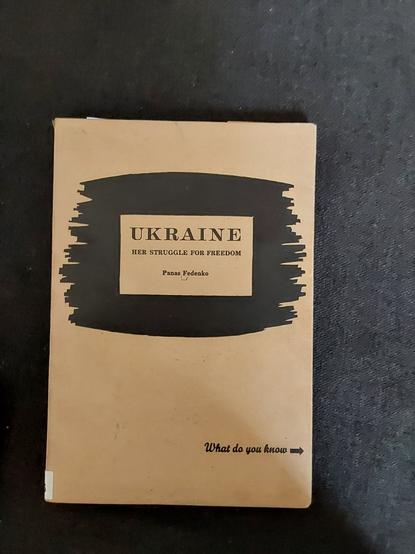
1/7 A few days ago I made a thread about Panas Fedenko's "The National and Social Liberation Struggle of Ukraine". In 1951 Fedenko published "Ukraine. Her struggle for freedom". Looking at the revolutionary period 1917-20, he writes nothing new, perhaps just less detailed.

https://mstdn.social/@mueste300/110744934335412753

I still have to think about of his account of the pogroms against the Jewish population. Fedenko mentions the pogroms, but only in the context that the government was trying to maintain order and ...
Stefan Müller (@[email protected])

Attached: 1 image I am starting to familiarise myself with Ukrainian history and especially the social movements there. Some days ago I read "The National and Social Liberation Struggle of Ukraine" by Panas Fedenko, published in 1923 (Natsional'na i sotsiial'na borot'ba ukraïns'koho narod). Fedenko (1883-1981) was a member of the Central Committee of the Ukrainian Social Democratic Labour Party (encyclopediaofukraine.com/display.asp?li…) 1/n
Mastodon 🐘
2/7 ... "particullary it resolutely fought the excesses of various dark elements against the Jewish population". Fedenko found himself in the situation, as in 1923, of having to draw attention to the independent Ukrainian identity, its history in general, and especially its progressive development 1917 to 1920. He also defends the Ukrainian People's Republic government with the argument that there were representatives of Jewish socialist parties in it.
3/7 At this point, one thing is unclear to me: there was both the government and the so called Directory in the Ukrainian People's Republic in 1919. The government was consistently led by social democrats, while the Directory was led by Symon Petlyura from February onwards. Petlyura had also been a member of the Ukrainian Social Democratic Workers Party but resigned when he became head of the Directory.
4/7 Petlyura's military units, and therefore by extension the government, are now being blamed for some of the pogroms. I wonder how relations between government and the Directory were. I haven't read enough yet to judge that. In any case, I notice that Fedenko is very reserved. After all, the pogroms and Petlyura were already known in the 1920s. In 1926, Petlyura was murdered in his Paris exile by Scholom Schwarzbard in retaliation for the pogroms.
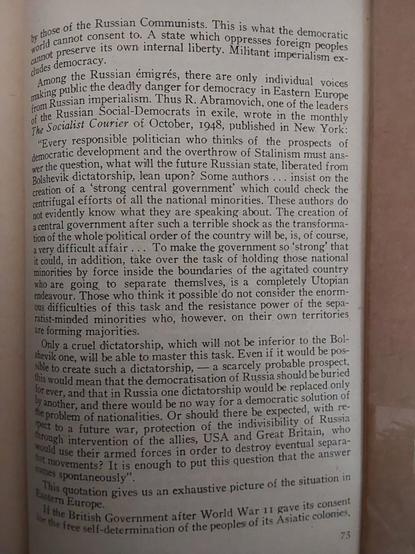
5/7 But that is only a small aspect at the moment. What I find remarkable and prophetic is the outlook Fedenko sketches for Russia's post-Soviet society in 1951 (2 years before Stalin's death). Fedenko approvingly quotes the Russian Menshevik and Bundist Rafail Abramovich, who was exiled to the USA. Abramovich discussed in 1948 what could happen in Russia after the fall of the Bolsheviki.
6/7 He criticised Western positions of the time that warned of a disintegration of Russia and called for a strong central government. In Abramovich's view, a democratic government could not keep centrifugal (national) forces in check. His summary: "Only a cruel dictatorship, which will not be inferior to the Bolshevik one, will be able to master this task." Democracy would then be buried forever.
7/7 The parallels to the present and the past 20 years are unmistakable. Fedenko said at the end that after centuries of tyranny, democratic development in Russia was not to be expected too soon. The peoples colonised by Russia should focus on self-liberation, relying on the help of Western democracies and especially the "nations of the Anglo-Saxon world". The recurrence of these debates is truly remarkable. I will keep you posted.