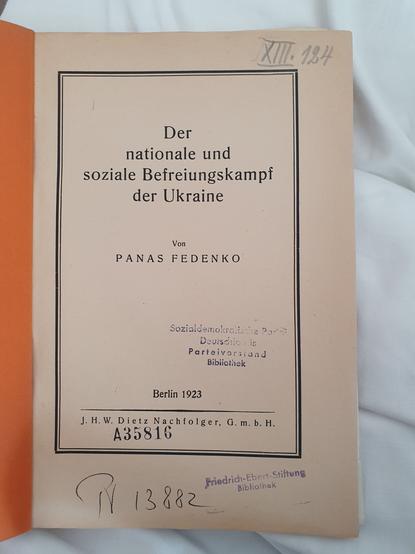
I am starting to familiarise myself with Ukrainian history and especially the social movements there. Some days ago I read "The National and Social Liberation Struggle of Ukraine" by Panas Fedenko, published in 1923 (Natsional'na i sotsiial'na borot'ba ukraïns'koho narod). Fedenko (1883-1981) was a member of the Central Committee of the Ukrainian Social Democratic Labour Party (encyclopediaofukraine.com/display.asp?li…) 1/n
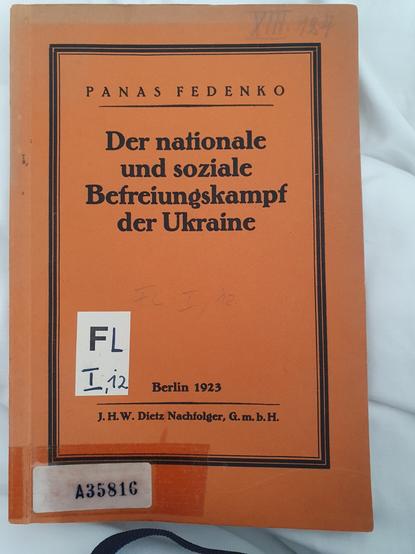
Fedenko (1883-1981) was a member of the Central Committee of the Ukrainian Social Democratic Labour Party (encyclopediaofukraine.com/display.asp?li…) He outlines the history of the short-lived Ukrainian People's Republic (1917-20) as a socialist-democratic state - something I did not know. The Ukrainian People's Republic was headed by an alliance of social democrats and social revolutionaries. 2/n
The republic came immediately under pressure from all sides: the Russian Bolsheviks, the Tsarist troops and also the international interventionists (esp. France). And not forget the German occupiers. Fedenko discusses the social and economic policy of the Republic and he outlines very precisely the colonial approach to Ukraine of both, Bolsheviks and Tsarists. 3/n
It is interesting for me that Russian colonialism was already critizised as colonialism in that times. Even more horrible, Fedenko writes of a policy of hunger by the Bolsheviks toward Ukraine - only few years before #Holodomor. At the end, as I understand, Bolshevik politics strengthened Ukraine nationalism. When many Ukrainians voted for a confederation with Russia in 1917 they stood for national independence after they learned what was Bolshevik internationalism. 4/n
I would say that this part of Ukrainian history is almost unknown in Germany. The German Wikipedia says almost nothing on this story but changes quickly to the Bolshevik counter-government in Kharkiv. This ignorance of the history of Ukraine, especially among progressives and leftists, is part of the problems of the last decades, and is one reason for the focus on Russia. Yet this knowledge was certainly available at one time. This can also be seen in this publication. 5/n
Fedenko's text was published by Dietz |@dietzverlag| in 1923, the SPD publishing house in that time. The edition I read was part of the library of the SPD and came into the library of the Friedrich Ebert Foundation through this channel. 6/n
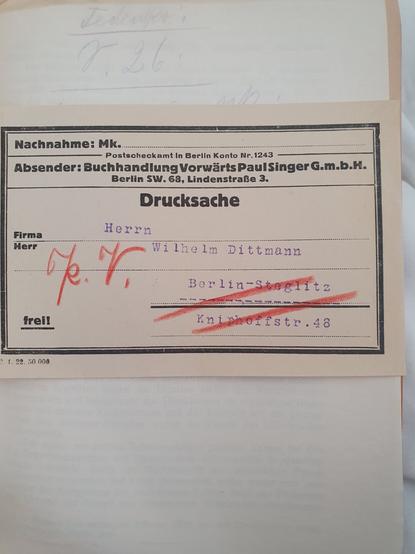
But even more interesting is a small delivery note, which is still in the brochure. Accordingly, this brochure was probably delivered to Wilhelm Dittmann by the Paul Singer bookshop of the SPD in the 1920s. 7/n
Dittmann was a social democrat and, due to his anti-war stance, one of the founding members of the Independent SPD (USPD) in 1917. In 1918 he belonged as one of six members to the "Rat der Volksbeauftragten". At the the end of 1918 Dittmann and his two USPD comrades left the Rat der Volksbeauftragten, but this is another story. However, Dittman did not make it with the communists when KPD and a majority of the USPD merged in 1920, and in 1922 Dittmann went back to the SPD. 8/n
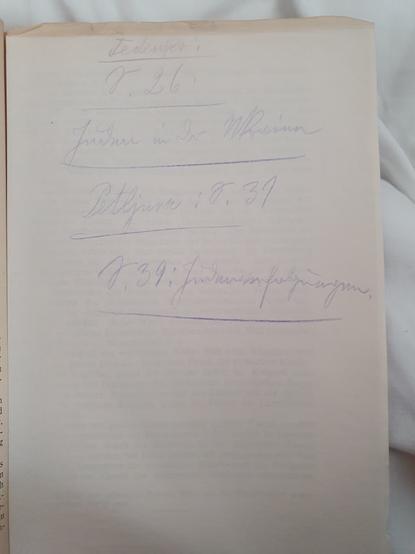
There are many underlinings in the brochure. We don't know if these are made by Dittmann but we can assume they were made by a social democratic reader in the 1920s. Many emphasises are in regard to the Bolshevik terror in Ukraine. Others are in regard to Ukrainian jews. Also in the broshure we still find a small notice, a kind of excerpt. In a mixture of old German and modern Latin letters there is written: "Fedenko! p. 26: Jews in Ukraine. Petljura: p. 31. P. 39: persecutions of the jews. 9/n
In the next month I will try to dig some more of Ukrainian history for the German debate. Support and co-operatione are very welcome. 9/end